
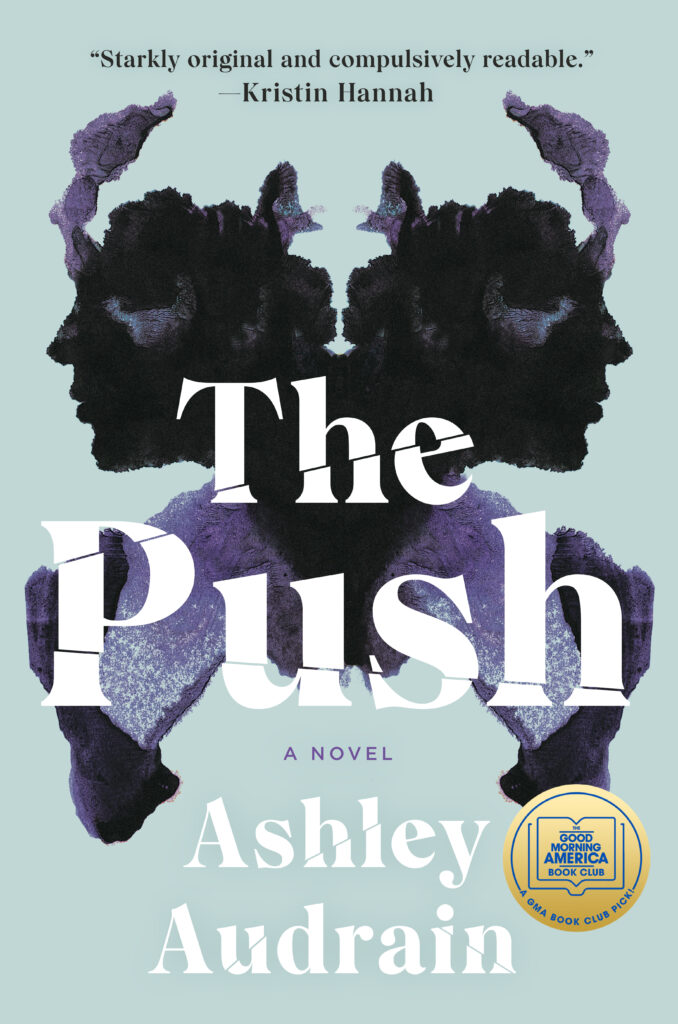
The Push (2021)
Select Sections to Print
×Book Details
The Push (2021)
Jump to Section
⚠️ Trigger Warnings
- Death of a child
- Child abuse and neglect
- Postpartum depression and anxiety
- Intrusive thoughts
- Self-harm
- Suicide
- Pregnancy and childbirth trauma
- Miscarriage
- Abortion
- Infidelity
- Animal death
- Violence between children
- Grief and bereavement
⏱️ 2-Minute Spoiler Summary
Blythe Connor grows up terrified of motherhood because both her grandmother and mother were abusive and unstable. After marrying Fox, she has a daughter, Violet, but struggles to bond with her and gradually becomes convinced Violet is deliberately cruel. When a boy named Elijah falls to his death while playing near Violet, Blythe believes Violet caused it, but Fox refuses to believe her.
Blythe later has a son, Sam, and immediately experiences the maternal love she never felt with Violet. Then Sam’s stroller rolls into traffic and he is killed. Blythe believes she saw Violet push it, but everyone considers the death an accident and blames Blythe’s negligence.
The tragedy destroys Blythe and Fox’s marriage. Fox leaves her for Gemma, and they eventually have a son, Jet. Terrified that Violet could hurt him too, Blythe secretly befriends Gemma under a false identity and warns her about Violet, but Gemma cuts her off after learning the truth.
Years later, Blythe still has no proof that Violet killed anyone. Then Gemma suddenly calls her in hysterics and says that something has happened to Jet, strongly suggesting that Blythe’s fears about Violet were right all along.
📖 Full Spoiler Summary
A Family History of Mothers Who Hurt Their Daughters
The Push is told by Blythe Connor as a long account addressed to her ex-husband, Fox Connor. From the beginning, Blythe is looking back at their marriage, their children, and the question that destroyed their family: Was something truly wrong with their daughter Violet, or was Blythe simply incapable of loving her?
That fear existed long before Violet was born. Blythe comes from a family in which motherhood has repeatedly been associated with cruelty, abandonment, and mental instability.
Her grandmother, Etta, becomes deeply unstable after the death of her first husband, Louis. She later marries Henry, but motherhood brings out a frightening cruelty in her. Her daughter, Cecilia, grows up enduring horrific abuse, including being forced under freezing water and locked in a cellar. Eventually, Etta dies by suicide.
Cecilia grows into a damaged and emotionally distant mother herself. She never gives Blythe the affection or security a child needs, and when Blythe is eleven, Cecilia abandons the family entirely. Blythe is left with her father, Seb West, a passive man who works as a hotel doorman and never protected either his wife or his daughter.
Growing up with this history leaves Blythe terrified that whatever was wrong with Etta and Cecilia might also exist inside her.
Blythe Becomes a Mother
At university, Blythe meets Fox Connor, and his stable, affectionate family seems like everything hers was not. His parents, Helen and Arthur, are warm and devoted, and Blythe is drawn not only to Fox but to the possibility of becoming part of a normal family.
Fox wants children. Blythe is much less certain, but she eventually agrees, hoping she can create the loving family she never had.
Their daughter, Violet, is born after a traumatic labor, and almost immediately Blythe realizes motherhood does not feel the way she expected it to. She is exhausted, anxious, and unable to experience the instinctive bond everyone assumes a mother should have with her baby. Fox, by contrast, adores Violet and seems effortlessly comfortable as a parent.
As Violet gets older, Blythe’s discomfort develops into something more disturbing. She begins to believe her daughter is deliberately cruel.
Violet bites her, behaves aggressively, and seems to understand exactly how to hurt people while appearing innocent afterward. Blythe also notices disturbing behavior toward other children, including a boy named Noah. Fox rarely sees what Blythe sees. To him, Violet is simply a difficult child, while Blythe’s fixation on her behavior becomes increasingly concerning.
The more Blythe insists something is wrong, the more Fox questions Blythe instead.
Elijah’s Death Changes Everything
Blythe’s suspicions become much more serious when Violet is playing near a boy named Elijah on a playground structure.
Elijah suddenly falls and dies.
Everyone treats his death as a horrific accident, but Blythe believes she witnessed something else: Violet intentionally causing Elijah to fall. She is convinced her daughter killed him.
Fox refuses to believe it. There is no proof, and Violet is still a child. From his perspective, Blythe’s accusation confirms his growing fear that her traumatic family history and difficulties with motherhood are distorting the way she sees their daughter.
This leaves Blythe trapped in an impossible situation. If Violet really is dangerous, Blythe is the only person willing to recognize it. But if Blythe is wrong, then she is becoming exactly the kind of mother she always feared she would be—one who sees something monstrous in her own child.
Hoping for a fresh start, the family eventually moves.
Sam Gives Blythe the Motherhood She Wanted
Blythe becomes pregnant again and gives birth to a son, Sam.
Her experience with him is completely different.
She immediately feels the overwhelming love and attachment she had expected to feel with Violet. Caring for Sam comes naturally, and for the first time, Blythe experiences motherhood as something joyful rather than frightening.
This realization is both comforting and devastating. Sam seems to prove that Blythe is capable of being a loving mother after all. Her inability to bond with Violet may not simply have been inherited dysfunction.
Violet notices the difference too.
The family briefly seems happier, but the tension surrounding Violet never truly disappears. Then, during an outing, Blythe’s tea is spilled on her and her attention is diverted. Sam’s stroller suddenly rolls into traffic.
He is struck and killed.
Blythe is shattered, but amid the chaos she is certain she saw something crucial: Violet’s pink mittens on the stroller handle.
She believes Violet pushed her baby brother into the road.
Once again, nobody believes her.
The police view Sam’s death as a terrible accident. Fox believes Blythe failed to secure the stroller and cannot accept responsibility for what happened. Blythe’s insistence that Violet deliberately killed Sam sounds, to everyone around her, like a grieving mother desperately searching for someone else to blame.
For Blythe, however, Sam’s death confirms everything she has feared about Violet.
Sam’s Death Destroys the Family
Blythe cannot recover from losing Sam, and her marriage to Fox disintegrates under the weight of grief and accusation.
Fox eventually begins an affair with his assistant, Gemma, and leaves Blythe. He builds a new life with Gemma, taking Violet with him, and the two eventually have a son named Jet.
Blythe is left largely alone.
But she cannot stop thinking about Violet.
Her obsession is no longer simply about proving she was right. If Violet really killed Elijah and Sam, then Jet may also be in danger. Blythe watches Fox and Gemma’s apparently happy family from a distance, increasingly consumed by the knowledge that they have allowed Violet near another little boy.
Eventually, she begins stalking Gemma.
Blythe discovers that Gemma attends a local mothers’ group and joins it herself using the false name Anne. Gemma has no idea who she really is. Blythe gradually befriends her, listening to Gemma talk about Fox, Violet, Jet, and the family life Blythe once had.
The deception gives Blythe access to the household from which she has effectively been excluded. It also allows her to hear about Violet from someone who does not already think Blythe is unstable.
Fox discovers Blythe’s deception, and whatever possibility remained of a normal relationship between them collapses. Blythe tells Gemma what she believes Violet has done. Gemma is horrified and cuts Blythe out of her life. Blythe is once again unable to protect Jet or prove that her suspicions about Violet are justified.
Blythe and Violet Years Later
As the years pass, Blythe remains isolated. She continues trying to maintain some connection with Violet, but their relationship never becomes warm or easy.
Now a teenager, Violet remains cold toward her mother. Their interactions carry the weight of everything that happened between them: Blythe’s inability to bond with her as a baby, Elijah’s death, Sam’s death, and Blythe’s belief that Violet was responsible for both.
Blythe also begins confronting the painful history of the women who came before her. She continues visiting Mrs. Ellington, the childhood neighbor who provided some of the only maternal warmth Blythe ever experienced. Mrs. Ellington represents the kind of safe, caring presence that was largely missing from Blythe’s childhood.
Still, Blythe never receives the one thing she has spent years wanting: certainty.
There is no confession from Violet. There is no definitive proof that she killed Elijah or Sam. Fox never admits that Blythe might have been right.
Blythe is left with what she remembers seeing and the possibility that everyone else chose the easier explanation—that she was simply a damaged mother projecting her own problems onto her daughter.
Something Happens to Jet
Then Gemma calls.
She is hysterical.
After years of silence and after dismissing Blythe’s warnings about Violet, Gemma reaches out with terrifying news.
Something has happened to Jet.
The novel ends before the details are revealed, but Gemma’s panic and her decision to call Blythe make the implication unmistakable: something has happened involving Violet and her younger half-brother, just as Blythe feared.
For years, Blythe has been treated as unreliable, unstable, and incapable of seeing her daughter clearly. She lost her son, her husband, and much of her relationship with Violet while insisting that Violet was dangerous.
Now another little boy may have become her victim.
And Gemma finally understands why Blythe tried to warn her.
🔚 Ending Explained
How Does The Push End?
The Push ends with the chilling confirmation that Blythe Connor may have been right about her daughter Violet all along. After years of being dismissed, doubted, and made to question her own instincts, Blythe finally receives the validation she desperately wanted—but in the worst possible way.
The Christmas Eve Encounter
Near the end of the novel, Blythe sits outside the home of her ex-husband, Fox, and his new partner, Gemma. From her car, she watches the warm, glowing scene inside: Fox has created the seemingly perfect family life that Blythe was never able to give him.
Violet, now older, is inside with her young half-brother, Jet.
As Blythe watches, Violet notices her sitting outside. Their eyes meet through the window, and Violet refuses to look away. Then Blythe sees her daughter mouth the words:
“I pushed him. I pushed him.”
Blythe understands exactly what Violet means.
Years earlier, Blythe’s young son Sam died after his stroller rolled into the street and he was struck by a car. Blythe had always suspected that Violet deliberately pushed the stroller, but no one believed her. Fox especially treated Blythe’s suspicions as another manifestation of her anxiety, grief, and inability to bond properly with Violet.
Now Violet appears to be confessing.
Whether anyone else will ever know the truth almost doesn’t matter. Violet has given Blythe the one thing she has spent years desperately seeking: confirmation that she wasn’t imagining what she saw in her daughter.
And Violet gives it to her only when there is nothing Blythe can do about it.
What Happens to Jet?
The novel then jumps forward eighteen months.
Blythe is living alone and attempting to rebuild herself. She practices affirmations and tries to believe that she can heal from everything that has happened.
Then Gemma calls.
She is hysterical.
And the final words Blythe hears are:
“Something happened to Jet.”
The novel ends there, without revealing exactly what happened.
But the implication is horrifyingly clear: Violet may have harmed another little boy.
What the Ending Means
The cruelty of The Push is that Blythe finally gets what she has wanted throughout the entire novel: to be believed.
Except nobody actually has to say, You were right.
Violet’s apparent confession about Sam, followed by Gemma’s terrified phone call about Jet, provides the validation instead.
That makes the ending less about a final twist than about the horror of vindication. Blythe has spent years wondering whether Violet was dangerous or whether Blythe herself was simply becoming another damaged mother in a damaged family. The ending strongly tips the balance toward Blythe’s interpretation.
But being right doesn’t save her.
It only makes everything that happened even worse.
The Damaged Mother-and-Child Painting
One of the ending’s most powerful symbols is the Mary Cassatt mother-and-child painting that eventually comes back to Blythe damaged. Its frame is cracked and the canvas itself has been punctured.
The image represents the idealized version of motherhood that has haunted Blythe throughout her life: the assumption that intimacy between mother and child should be instinctive, tender, and natural.
Blythe could never make her relationship with Violet resemble that picture.
The damaged painting therefore becomes a physical representation of the novel’s shattered fantasy of motherhood. The beautiful image remains recognizable, but it has been permanently wounded.
So has Blythe’s understanding of what being a mother was supposed to mean.
Why Violet Confesses to Blythe
Violet’s apparent confession is particularly disturbing because she doesn’t confess out of guilt.
She tells Blythe.
That distinction matters.
Violet knows that Blythe suspected her. She also knows how much those suspicions cost her mother—her marriage, her relationship with Violet, and eventually much of her sense of reality.
By apparently admitting the truth only to Blythe, Violet gives her mother validation without giving her proof.
It can therefore be read as Violet’s final act of control over her.
Blythe was right.
Violet knows she was right.
And now Blythe knows that Violet knows.
Nobody else has to know.
The Meaning of the Title The Push
The title becomes increasingly loaded as the novel progresses.
There is the physical push of childbirth, bringing a child into the world. There is the suspected literal push that sends Sam’s stroller into traffic. But there is also the broader psychological idea of being pushed into motherhood and into society’s expectations of what mothers are supposed to feel.
Blythe fears becoming her mother, Cecilia, just as Cecilia was shaped by her own mother, Etta. Each generation inherits something from the one before it.
The novel therefore keeps asking an uncomfortable question: How much of motherhood—and how much of cruelty—is inherited, and how much is created?
There is never a simple answer.
The Cycle of Mothers and Daughters
The final phone call also transforms the novel’s generational pattern.
For most of the story, the cycle runs through Etta → Cecilia → Blythe → Violet.
Each mother wounds her daughter in a different way.
But Violet represents something different. The violence no longer appears confined to the relationship between mother and daughter. If the implication about Jet is correct, Violet has carried that destructive legacy outward.
That makes Cecilia’s belief that people are “grown from something” especially haunting. Blythe desperately wanted to stop the inheritance of damaged motherhood.
Instead, she may simply have watched it change form.
Why Fox’s Role Matters
The ending is also a devastating judgment on Fox—not because he caused Violet’s behavior, but because he repeatedly refused to take Blythe’s perceptions seriously.
Fox wanted a conventional family and continually interpreted Blythe through the role he expected her to fulfill. When she struggled with motherhood, he saw the problem in her. When she became frightened of Violet, he interpreted that fear through everything he already believed about Blythe.
Eventually, he creates another seemingly perfect family with Gemma.
And then comes the call about Jet.
The implication is brutal: Fox may finally be forced to confront the possibility Blythe tried to make him see years earlier.
The Ending Explained
Ultimately, The Push isn’t simply revealing that Violet is “evil” and Blythe was right.
The ending is more unsettling than that.
The entire novel traps us inside Blythe’s perspective while simultaneously giving us reasons to distrust it. She comes from generations of damaged mothers. She struggles to bond with Violet. She experiences profound grief and psychological distress. Even Blythe doesn’t always trust herself.
That uncertainty forces the reader into the same position as everyone around her:
Do we believe the mother?
The final pages radically change the weight of that question.
Violet’s apparent confession and Gemma’s call don’t erase Blythe’s mistakes or prove every suspicion she ever had. But together, they strongly suggest that the danger Blythe perceived was real.
And that’s what makes the ending so vicious.
For years, Blythe wanted someone to tell her she wasn’t imagining it.
By the end, she may finally have her proof.
But another child may have had to become a victim for anyone else to believe her.
👤 Characters & Fates
🔶 Main Characters

After Sam’s death and her divorce, Blythe lives alone and tries to heal. Violet eventually mouths “I pushed him”, confirming she killed Sam, and Gemma’s frantic final phone call strongly implies Violet has now harmed Jet.

He marries Gemma and has another son, Jet, but his new family is devastated when Violet apparently harms Jet, seemingly proving Blythe was right all along.

As a teenager, Violet silently tells Blythe “I pushed him,” confirming she pushed Sam’s stroller into traffic and killed him. The ending strongly suggests she later does something terrible to her half-brother Jet.

She abandons Blythe when she is eleven to live with Richard and eventually dies alone, with Blythe learning of her death through a stranger’s voicemail.

After years of deteriorating mental health, Etta hangs herself from an oak tree in her front yard.
🔷 Supporting Characters
As a toddler, Sam is killed when his stroller rolls into traffic; Violet later confirms that she deliberately pushed him.
After cutting off contact with Blythe, Gemma calls her hysterically in the final scene after something happens to Jet, strongly implying Violet has harmed him.
The novel ends before revealing exactly what happened, but Gemma’s frantic call strongly implies Violet has harmed Jet.
In old age, she develops dementia and lives in a care home, where Blythe continues visiting her and identifies herself as her “daughter.”
He dies of a heart attack shortly after Blythe moves in with Fox.
They remain close to Fox and his family after his marriage to Blythe collapses, seemingly unaware of the danger Blythe believes Violet poses.
He is gruesomely killed by a silage wagon in a farming accident four months before Cecilia is born.
After Etta hangs herself, Henry is devastated by grief, relinquishes parental responsibility for Cecilia, and becomes a shell of himself.
Violet cuts off a fistful of his hair in the school bathroom and keeps it, forcing his mother to have the rest of his hair buzzed off.
Elijah falls to his death from a twelve-foot play structure; Blythe is certain she sees Violet deliberately trip him, although his death is ruled an accident.
🕳️ Potential Plot Holes
Blythe secretly befriends Gemma for months while disguised as “Anne” with a brown wig. The disguise becomes much harder to believe when she encounters Fox outside the bookstore and he fails to recognize her. Fox was married to Blythe for roughly twenty years, yet apparently does not recognize her voice, mannerisms, body, or general appearance simply because she is wearing a wig, hat, and scarf. His failure to identify his longtime wife at close range feels implausible and is necessary for Blythe’s deception to continue.
The novel establishes that Etta was born in September 1939, on the day World War II began. Her death occurs in a section dated 1972, where she is described as being thirty-two years old. Depending on exactly when in 1972 she died, this can work if her death occurred before her September birthday. Without a conflicting month or date, however, this is only a possible timeline inconsistency rather than a definite one.
📚 Book Club Q&A's
⭐ Final Rating & Thoughts
I went into The Push with dangerously high expectations because everyone seemed convinced it was one of the best thrillers ever written. I wouldn’t go quite that far, but at 4.5 stars, it came surprisingly close.
This isn’t the kind of thriller that races from twist to twist. It’s slower, darker, and much more psychological, digging into motherhood, generational trauma, guilt, and the terrifying possibility that a mother might see something in her child that no one else is willing to acknowledge. At times, I questioned where the story was going, and I did anticipate some of its revelations, which kept it from being a full five-star read.
But then I finished it—and couldn’t stop thinking about it.
That’s ultimately what pushed my rating so high. Ashley Audrain creates such an uncomfortable sense of uncertainty that even when I thought I knew what was happening, I was constantly questioning my own conclusions. The writing is sharp, the atmosphere is unsettling, and the emotional weight lingered long after I closed the book.
✨ Adaptation description
The Push — Screen Adaptation
Ashley Audrain’s 2021 debut novel The Push is still in development as a television adaptation at Heyday Television, the company founded by producer David Heyman. Heyday acquired the film and television rights in October 2020, before the novel was published, after a highly competitive nine-way bidding war. Ashley Audrain is attached as an executive producer. (Madeleine Milburn Literary Agency)
A 2026 industry report about another Heyday acquisition specifically states that Heyday Television is currently developing The Push. (Televisual)
Current status as of August 2026: development. There has still been no publicly announced cast, director, screenwriter, network/streaming platform, production start date, or release date. So despite the rights having been acquired nearly six years ago, it does not appear to have reached production yet.
The original announcement described The Push as particularly suited to television, with Heyday president Tom Winchester and David Heyman involved in acquiring the rights. Audrain said at the time that Heyday’s team had a strong vision for translating the novel to the screen. (Madeleine Milburn Literary Agency)
What the adaptation is expected to cover
The source novel follows Blythe Connor, who enters motherhood determined not to repeat the abusive and neglectful patterns of the women in her family. After the birth of Violet, however, Blythe becomes increasingly convinced that something is fundamentally wrong with her daughter while her husband Fox dismisses her fears. The birth of Blythe’s second child, Sam, and the tragedy that follows push the family toward collapse. (Ashley Audrain)
The novel’s central tension—whether Blythe accurately perceives Violet or whether trauma has distorted her perception—would presumably remain fundamental to the adaptation. The story also explores maternal ambivalence, intergenerational trauma, nature versus nurture, grief, marriage, and the consequences of women not being believed. (Ashley Audrain)
✨ Books Like The Push (2021)
See an error on this page?