

Tender Is the Flesh (2017)
Select Sections to Print
×Book Details
Tender Is the Flesh (2017)
Jump to Section
⚠️ Trigger Warnings
- Cannibalism and industrialized human slaughter
- Graphic violence and gore
- Mutilation and dismemberment
- Sexual violence and rape
- Human trafficking and sexual exploitation
- Animal cruelty and animal death
- Infant death/SIDS
- Child death and harm to children
- Medical torture and human experimentation
- Vivisection
- Dementia and elder neglect
- Suicide
- Dehumanization and objectification of humans
- Forced pregnancy and reproductive abuse
⏱️ 2-Minute Spoiler Summary
After animals supposedly become poisonous to humans, society legalizes human meat (a process called the Transition), and Marcos Tejo works at a processing plant that slaughters people bred specifically for consumption (called heads). Marcos is grieving the death of his infant son Leo, which also destroyed his marriage to Cecilia. His father, Don Armando, has dementia and is horrified by the world created by the Transition.
Through his work, Marcos encounters every part of the human-meat industry: breeding centers, slaughterhouses, tanneries, laboratories, butcher shops, religious sacrifices, and even a hunting reserve where wealthy people hunt humans for sport. Although Marcos is disgusted by much of what he sees, he continues participating in the system.
When breeding-center owner El Gringo gives him a female FGP (First Generation Pure) head, Marcos initially keeps her like livestock but gradually brings her into his home. He names her Jasmine, clothes and feeds her, begins a sexual relationship with her, and gets her pregnant. The pregnancy gives Marcos renewed purpose after Leo’s death.
After Don Armando dies, Marcos secretly scatters his real ashes at an abandoned zoo while giving his selfish sister Marisa an urn filled with dirty sand for her performative memorial service. At work, Marcos also proves that he is capable of the same cruelty he condemns by suggesting that poisoned heads be used to kill troublesome Scavengers.
When Jasmine goes into labor, Marcos calls Cecilia, who helps deliver a healthy baby boy. Cecilia immediately embraces the child as a replacement for Leo. Jasmine desperately reaches for her son, but Marcos no longer needs her. To protect his new family and remove the evidence of what he has done, he stuns Jasmine with a club and prepares to slaughter her.
When Cecilia reacts to Jasmine’s obvious distress, Marcos dismisses it by saying she merely had the “human look of a domesticated animal.” The novel ends with Marcos choosing Cecilia and the baby while reducing Jasmine back to the status of meat.
📖 Full Spoiler Summary
A World Where Humans Have Become Meat
After a supposed virus makes animals poisonous to humans, society undergoes what becomes known as the Transition. Livestock is destroyed, and instead of abandoning meat altogether, governments legalize the breeding, slaughter, and consumption of human beings. The industry carefully strips away the language that might remind anyone what they are doing: the people raised for consumption are called “heads,” their flesh is marketed as “special meat,” and acknowledging that the product is human is socially and legally discouraged.
Marcos Tejo understands this system better than most. He works as the right-hand man to Krieg, the emotionally detached owner of a major processing plant, and his job requires him to move comfortably through every stage of the human-meat industry. Yet Marcos is deeply alienated from the society around him. His infant son, Leo, died of SIDS, and the loss destroyed his marriage. His wife, Cecilia, moved in with her mother, Graciela, leaving Marcos alone.
His father, Don Armando, has also been devastated by the world created by the Transition. A former meat processor himself, Don Armando deteriorated mentally as society normalized the slaughter of humans. He now suffers from dementia and lives at the New Dawn Nursing Home, where a nurse named Nélida cares for him through his increasingly frequent episodes.
Marcos Moves Through the Human-Meat Industry
Much of Marcos’s work involves visiting the businesses that have grown around legalized cannibalism, exposing just how thoroughly the industry has transformed human beings into commodities.
At the tannery run by Señor Urami, human skin is treated as another valuable product, with Urami obsessing over its quality. At the Tod Voldelig breeding center, owner El Gringo proudly explains how his facility produces First Generation Pure (FGP) heads—people born in captivity and specifically bred for consumption. Marcos also meets Egmont Schrei, a German investor interested in the business.
Not long afterward, El Gringo sends Marcos an expensive gift: a high-quality FGP female.
Marcos does not want her. Keeping a head at home creates both practical and legal problems, and initially he houses her in his barn like livestock. Over time, however, he begins treating her differently. He moves her into the house, gives her clothes, feeds her ordinary food, lets her watch television, and eventually names her Jasmine.
His treatment of Jasmine increasingly contradicts the rules of the society around him. By giving her a name and allowing her into his home, Marcos acknowledges an individuality that the meat industry depends upon denying.
His work continues regardless. He visits Spanel, an exclusive butcher who once worked for Don Armando and now prepares human flesh for wealthy customers with clinical precision. Marcos and Spanel also share a complicated sexual history, and they briefly fall back into their old physical relationship during one of his visits.
At the processing plant, Marcos oversees workers such as Sergio, an experienced “stunner” responsible for knocking heads unconscious before they are bled and butchered. Krieg’s secretary, Mari, deals with another grotesque consequence of the Transition: the Church of the Immolation, whose members volunteer to sacrifice themselves.
One elderly believer, Gastón Schafe, allows himself to be killed as part of the church’s ritual. His body is then consumed by the Scavengers, desperate people who survive around the edges of the processing industry and live largely from its waste.
The Cruelty Extends Far Beyond Food
The legalization of human consumption has created an entire economy based on treating certain people as objects, and Marcos repeatedly encounters industries that have pushed this logic even further.
At Valka Laboratory, Doctor Valka performs horrific experiments on human subjects in the name of scientific and medical advancement. The victims are treated as disposable research material because society has already decided that some human bodies have no meaningful rights.
Another stop takes Marcos to Urlet, who operates a private hunting reserve where wealthy clients pay for the privilege of hunting people. Among the hunters are Guerrero Iraola and Lisandrito Núñez Guevara, men whose wealth allows them to turn killing into recreation.
Marcos is forced to attend a dinner involving Ulises Vox, a famous rock star who surrendered himself to the reserve because of enormous debts. After Vox is hunted and killed, parts of his body—including his tongue and genitals—are served to the guests.
The experience disgusts Marcos, but disgust does not make him abandon the system. He continues working for Krieg and facilitating the same industry he privately despises.
Jasmine Becomes Pregnant
At home, the boundary Marcos has drawn between Jasmine and the other “heads” continues to disappear. He begins having sex with her, and Jasmine eventually becomes pregnant.
The pregnancy gives Marcos something he has been missing since Leo’s death: a future to anticipate. He keeps Jasmine hidden and protects the secret while continuing to live outwardly as a normal participant in society.
His relationship with his sister, Marisa, only reinforces his disgust with the world around him. Marisa is socially ambitious, selfish, and completely comfortable with the Transition. Unlike Marcos, she barely disguises the pleasure she takes in the privileges the new system offers.
She even keeps a domestic head at home and has a cold room where she and her guests can perform the “death by a thousand cuts,” slowly removing pieces of flesh while keeping the victim alive as long as possible.
Marisa is equally indifferent toward their father. She refuses to visit Don Armando but remains concerned with appearances and social rituals surrounding the family.
Don Armando Dies
Eventually, Don Armando dies, forcing Marcos to confront both his grief and his resentment toward Marisa.
Marisa wants to arrange an elaborate farewell service, but Marcos knows the ceremony is more about her image than their father. Rather than allow her to turn Don Armando’s death into another performance, he privately has their father cremated.
Marcos takes the real ashes to an abandoned zoo he once visited with Don Armando and scatters them there. The ruined zoo is one of the remnants of the world before the Transition, when animals still existed as something other than forbidden memories.
For Marisa’s ceremony, Marcos gives her a different urn filled with dirty sand. She never realizes that the remains she is publicly mourning are not their father’s.
At the same time, the violence surrounding the processing plant becomes increasingly difficult to contain. A group of Scavengers attacks and overturns a transport truck carrying heads. The driver, Luisito, is killed, and the Scavengers descend upon the human cargo.
When Krieg needs a solution to the continuing problem, Marcos proposes an especially ruthless one: poison several heads and deliberately leave their bodies for the Scavengers to eat. The plan will kill the people who have become inconvenient to the plant.
It is another reminder that whatever private revulsion Marcos feels toward the system, he is perfectly capable of using its logic when it suits him.
Jasmine Gives Birth
Jasmine’s pregnancy eventually reaches its end, and she goes into labor inside Marcos’s house.
Unable to handle the delivery himself, Marcos calls Cecilia. As a nurse, she has the medical knowledge necessary to help, but Marcos has not prepared her for what she is about to find.
Cecilia is horrified when she arrives and discovers a pregnant female head living in her husband’s bed. What Marcos has done is extraordinarily dangerous. Jasmine is legally livestock, and his relationship with her could result in severe consequences, including Jasmine being taken to the Municipal Slaughterhouse.
But when Cecilia realizes the baby is coming, her professional instincts take over. She helps Jasmine through the delivery, and Jasmine gives birth to a healthy baby boy.
For Marcos and Cecilia, the child immediately fills the space left by Leo.
Cecilia takes the newborn into her arms and begins treating him as though he belongs to her. Her horror over Jasmine rapidly becomes secondary to the possibility that she and Marcos can finally have a child again.
Jasmine understands enough to know what is happening.
She reaches desperately for her baby.
Marcos Reveals What Jasmine Always Was to Him
For months, Marcos appeared to be crossing the boundary his society had created between humans and meat. He brought Jasmine into his home, clothed her, fed her, slept beside her, named her, impregnated her, and protected her while she carried their child.
But once the baby has been safely delivered, Jasmine becomes a problem.
Keeping her alive would mean acknowledging what Marcos has done and risking the life he can now rebuild with Cecilia and their new son. The same woman whose humanity he appeared to recognize can no longer be allowed to exist as the child’s mother.
So Marcos returns to the methods he knows from the slaughterhouse.
As Jasmine tries to reach her newborn son, Marcos takes a club and stuns her, preparing her to be slaughtered just like the countless heads that have passed through the processing plant.
Cecilia is disturbed by what he has done. Marcos dismisses Jasmine’s desperate behavior with one final rationalization, telling Cecilia that she only had the “human look of a domesticated animal.”
Jasmine was never Marcos’s escape from the brutal world created by the Transition. Once she has given him what he wants—a child—he disposes of her using the very system he has spent the novel claiming to despise.
🔚 Ending Explained
The ending of Tender Is the Flesh reveals the horrifying truth about Marcos: despite all his disgust with the meat industry and the society created by the Transition, he has ultimately absorbed the same dehumanizing logic he appears to despise.
How Does Tender Is the Flesh End?
Near the end of the novel, Marcos returns home to discover that Jasmine is in labor. Something is clearly wrong—the amniotic fluid is brownish-green, suggesting the baby may be in distress. Unable to handle the delivery himself, Marcos calls his estranged wife, Cecilia, who is a nurse.
When Cecilia arrives, she is horrified to discover Jasmine and realizes that Marcos has been having sex with a “head,” a serious crime in their society. But the emergency quickly takes precedence. Cecilia helps Jasmine through a difficult delivery, made even more disturbing by the fact that Jasmine cannot cry out because her vocal cords were removed at the breeding center.
Jasmine gives birth to a healthy baby boy.
The child immediately changes Cecilia. Still devastated by the death of their infant son, Leo, she embraces the newborn and begins treating him as her own. She refers to the baby as “ours,” effectively reuniting herself and Marcos around the family they lost.
Jasmine, however, reaches desperately for her baby.
Instead of recognizing her as the child’s mother, Marcos suddenly treats her as an obstacle. He takes a slaughterhouse club and strikes Jasmine in the forehead, directly over the FGP brand that identifies her as livestock. He intends to take her body to the barn and dispose of her as meat.
When Cecilia reacts emotionally, Marcos justifies what he has done with the novel’s chilling final observation:
“She had the human look of a domesticated animal.”
Jasmine was never going to become part of Marcos’s family. Her baby was what he wanted.
What Does the Ending Mean?
The final twist completely changes how Marcos’s behavior toward Jasmine can be understood. Throughout the novel, he appears increasingly disturbed by the cruelty of the society around him. He hates the euphemisms surrounding human slaughter, recognizes the hypocrisy of the people working in the industry, and treats Jasmine with an intimacy that seems to distinguish him from everyone else.
But the ending reveals the limit of that empathy.
Marcos may hate the system, but he has learned to think exactly like it does.
He gives Jasmine food, shelter, affection, and even a name, but none of those things ultimately mean that he considers her his equal. Once she has given him something he desperately wants—a child who can replace the family he lost—she becomes disposable.
That makes the ending far darker than simply revealing that Marcos is a hypocrite. The system has succeeded because its values have become instinctive to him. He does not need the slaughterhouse to dehumanize Jasmine anymore. He can do it himself.
The Club and the FGP Brand
Marcos killing Jasmine with a slaughterhouse club is especially significant.
Earlier in the novel, the club is associated with the industrial process that transforms a living human being into meat. Stunning is one of the first physical steps in stripping a “head” of whatever remaining individuality they possess before processing begins.
By wielding the club himself, Marcos crosses the final boundary between observer and executioner.
Even more tellingly, he strikes Jasmine over her FGP brand. The mark has always identified her as property—a First Generation Pure specimen bred for consumption. Whatever private identity Marcos seemed to give her disappears at the moment of her death. The brand wins.
She is Jasmine only for as long as Marcos wants her to be.
Why the Baby Matters
The newborn also exposes what Marcos has actually been searching for.
His deepest wound throughout the novel is the death of Leo and the collapse of his marriage afterward. Jasmine temporarily fills his loneliness, but her pregnancy creates something far more valuable to him: the possibility of rebuilding his old life.
Once the baby is born, Cecilia immediately reconnects with Marcos through the child. Suddenly, the family he lost can seemingly exist again.
Jasmine becomes unnecessary.
There is also a disturbing parallel between the baby and the commodities produced throughout the novel. Marcos takes what he wants from Jasmine and discards the body that produced it. In that sense, his treatment of her follows the same logic as the meat industry: extract the valuable part and dispose of the rest.
Why Marcos Names Jasmine
Naming Jasmine initially seems like one of Marcos’s strongest acts of resistance. Society deliberately avoids giving “heads” names because names imply identity, individuality, and personhood.
Marcos breaks that rule.
But the ending makes the gesture deeply unsettling. Giving Jasmine a name does not actually liberate her. It simply allows Marcos to create a private version of her that satisfies his emotional and sexual needs.
When those needs change, the identity disappears.
His final description of her as a “domesticated animal” effectively takes the name back. Jasmine is once again something that can be categorized, controlled, killed, and consumed.
The Meaning of the Final Line
The final line is deliberately contradictory: Jasmine has a “human look,” yet Marcos immediately qualifies that humanity by comparing her to an animal.
That contradiction captures the moral machinery of the entire novel.
Marcos can see Jasmine’s humanity.
He simply chooses to redefine it.
That is much more disturbing than believing he never recognized her humanity at all. The novel suggests that atrocities do not always require people to be ignorant of their victims’ humanity. Sometimes people recognize it perfectly well and create language that allows them to ignore what they know.
The Transition depends on exactly that kind of psychological maneuver.
Marcos’s Final Transformation
The ending also forces a reevaluation of Marcos’s apparent moral superiority throughout the novel. His disgust with the slaughterhouses, breeding centers, hunting preserves, and consumers of “special meat” can easily make him seem like the story’s remaining moral conscience.
He isn’t.
His revulsion never develops into genuine resistance. When forced to choose between Jasmine’s life and the restoration of his own happiness, Marcos chooses himself without hesitation.
The distinction between Marcos and the society around him therefore collapses. He may dislike its vocabulary and rituals, but when those same rules become useful to him, he embraces them.
What Happens After the Ending?
The novel does not reveal what happens to Marcos, Cecilia, or the baby afterward, but the implications are grim.
Marcos and Cecilia now have the possibility of rebuilding their marriage around the newborn, while Jasmine’s disappearance can presumably be concealed because society never regarded her as a person in the first place.
That means Marcos may receive exactly what he wanted: a wife, a son, and the appearance of a normal family.
And that is precisely why the ending is so bleak.
There is no dramatic punishment and no moral awakening. Marcos does not overthrow the system or escape it. He simply finds a way to benefit from it.
The final horror of Tender Is the Flesh is therefore not that Marcos becomes something monstrous. It is that, in the world created by the Transition, what he does has become completely normal.
The novel begins by showing a society capable of turning human beings into meat. It ends by showing something even more frightening: a man capable of recognizing another person’s humanity, taking everything he wants from her, and then deciding that her humanity no longer matters.
👤 Characters & Fates
🔶 Main Characters
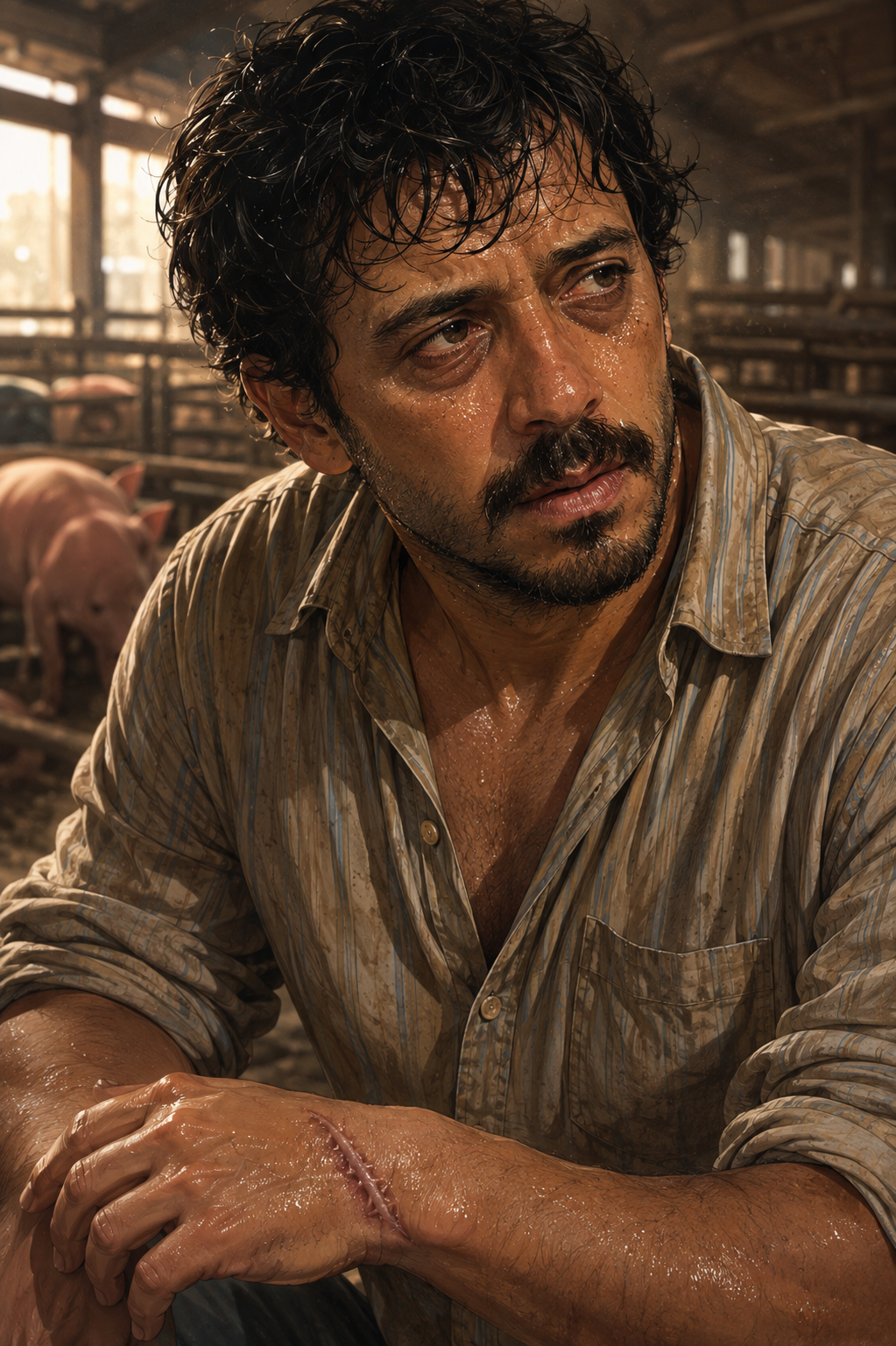
After impregnating Jasmine and seemingly growing attached to her, he takes their newborn son for himself and Cecilia, then stuns Jasmine with a slaughterhouse club so she can be killed as meat—revealing that he ultimately never saw her as fully human.

Marcos impregnates her, but immediately after she gives birth to their son, he clubs her unconscious for slaughter so he and Cecilia can claim the baby as their own.

She delivers Jasmine’s baby, immediately embraces him as her and Marcos’s son, and remains complicit as Marcos prepares Jasmine for slaughter.

He remains in charge of the plant and orders Marcos to devise a way to poison the Scavengers after their violent attack.

She holds a performative memorial for their father without realizing Marcos replaced his ashes with dirty sand, while her own domestic head is slowly mutilated for meat.

He dies at New Dawn Nursing Home, after which Marcos privately cremates him and scatters his real ashes at the abandoned zoo.
🔷 Supporting Characters

He survives and continues running the tannery while terrorizing his employees.
He remains successful in the breeding business and considers expanding into organ harvesting.
After another aggressive sexual encounter with Marcos, she remains at her shop and fatalistically predicts that someday she too will become cattle.
He continues stunning humans for a living while supporting his family.
She informs Marcos of Armando’s death and handles the nursing home’s procedures afterward.
Rather than being punished for her atrocities, she receives a prestigious award for research involving conscious human vivisection.
He remains in business, hosting human hunts for wealthy clients.
After Ulises Vox is hunted and killed, Guerrero eats the rock star’s penis in the belief that it will increase his sexual potency.
He is hunted and killed, after which his tongue and genitals are served and eaten at dinner.
She is left traumatized and crying after the Scavengers kill and eat Luisito.
Sergio stuns him before his body is delivered to the Scavengers for consumption.
After rioting, killing Luisito, and consuming humans from his overturned truck, they become targets of a planned mass poisoning ordered by Krieg and devised by Marcos.
After his truck overturns, the Scavengers kill and eat him.
He attempts to free the captive heads and later dies by suicide.
He remains at the plant and continues working while harboring intense hatred toward Marcos.
After playing a game about what Marcos might taste like, they become frightened when he looks at them as though imagining how they would taste.
He watches Marcos and Spanel’s final sexual encounter through the glass in furious, almost canine jealousy.
A superior forces him to abandon the inspection, but he leaves Marcos with a veiled warning that he remains suspicious.
He uses his authority and history with Marcos to shut down the investigation into Jasmine.
He died of SIDS before the novel begins; Marcos later burns his cot, while Jasmine’s newborn ultimately becomes the replacement child for him and Cecilia.
He samples raw flesh cut directly from an FGP female and appears impressed by the quality.
🕳️ Potential Plot Holes
The human-meat industry is presented as a large-scale replacement for traditional livestock, yet humans are extraordinarily inefficient animals to raise for food. FGPs require years of feeding, housing, medical care, and supervision before they can be slaughtered, compared with livestock that reach slaughter weight far more quickly. It is difficult to see how this system could produce enough affordable meat to function as society’s primary replacement for animal protein.
Society responds to the loss of animal meat by creating an enormous infrastructure for breeding and slaughtering humans, while plant-based protein is largely dismissed through claims that it lacks essential amino acids. Humans can obtain all essential amino acids through combinations of plant foods, making the supposed necessity of human meat questionable. Even allowing for propaganda and government manipulation, replacing livestock with humans would be vastly less efficient than expanding plant-based food production.
The government claims that GGB has infected animals so thoroughly that consuming animal flesh is deadly, yet mosquitoes are apparently considered safe. Because mosquitoes feed on the blood of animals and humans, their continued existence without spreading the supposedly pervasive virus raises questions about how GGB is actually transmitted. This inconsistency supports Marcos’s suspicion that the official explanation for the Transition may not be true.
After a truck carrying heads overturns, Scavengers immediately consume the bodies raw. If GGB really created a worldwide biological crisis severe enough to make animal meat deadly and completely restructure the food supply, the apparent safety of eating raw, uninspected human flesh is difficult to reconcile with the supposed danger. The scene further strengthens the possibility that the official story about the virus is fabricated.
📚 Book Club Q&A's
⭐ Final Rating & Thoughts
Tender Is the Flesh is one of those books that made me deeply uncomfortable while also making it impossible for me to look away. I can’t handle horror movies, but horror novels are another story—especially when the disturbing elements serve a larger purpose. And here, they absolutely do.
What earned this five stars for me is how calculated the novel feels. The horror isn’t there simply for shock value; Bazterrica uses it to explore dehumanization, misogyny, hypocrisy, and just how easily people can normalize cruelty when society gives them the right language to excuse it.
I especially loved the characterization of Marcos. He’s presented with enough apparent humanity that I found myself wanting to see something decent in him, even while the warning signs were there all along. That tension made the novel incredibly effective.
It’s bleak, graphic, upsetting, and definitely not for everyone. But the foreshadowing, social commentary, moral complexity, and razor-sharp execution completely worked for me. Disturbing, intelligent, and unforgettable—an easy five stars.
✨ Adaptation description
Tender Is the Flesh — TV Adaptation
Agustina Bazterrica’s Tender Is the Flesh (Cadáver exquisito) is officially in development as a television series, but the adaptation remains at an early stage. As of August 2026, there is no released film or television adaptation. (Scenic Rights)
The project is represented by Scenic Rights, an international agency specializing in literary adaptation rights. Scenic Rights currently lists Tender Is the Flesh among its projects in development and production and specifically identifies the planned format as a TV series. (Scenic Rights)
✨ Books Like Tender Is the Flesh (2017)
See an error on this page?