
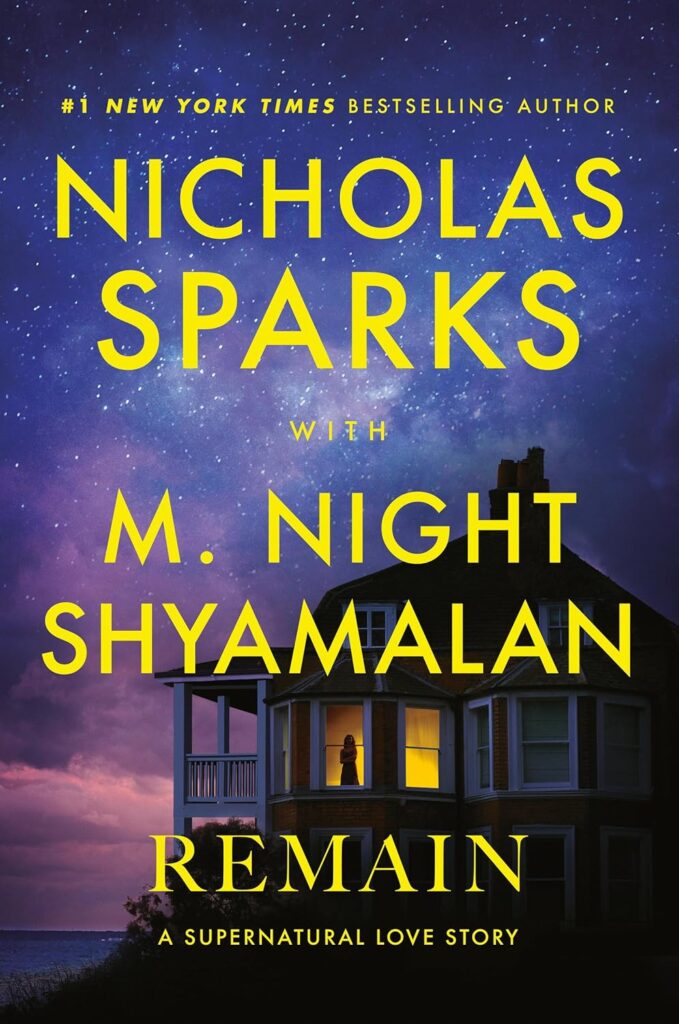
Remain (2025)
Select Sections to Print
×Book Details
Remain (2025)
Jump to Section
⚠️ Trigger Warnings
- Depression
- Suicidal ideation
- Psychiatric hospitalization
- Death of family members
- Terminal illness
- Grief
- Murder
- Graphic violence
- Physical assault
- Domestic abuse
- Stalking
- Harassment
- Arson
- Accidental death
- Substance abuse
- Alcoholism
- Childhood emotional neglect
⏱️ 2-Minute Spoiler Summary
Tate Donovan, a 38-year-old New York architect, arrives on Cape Cod after spending four months in psychiatric treatment for severe depression following the death of his beloved older sister, Sylvia. Before dying, Sylvia told Tate she could see ghosts and passed that ability to him. Now Tate’s wealthy best friend, Oscar, has hired him to design his family’s new summer home and arranged for him to stay in a huge Victorian former bed-and-breakfast.
Soon after moving in, Tate meets a mysterious young woman named Wren Tobin inside the otherwise empty house. She seems perfectly real, but caretaker Louise Gaston insists no one else is staying there. Tate eventually learns the truth from Louise’s husband, Reece: Wren died two years earlier.
Even stranger, Wren appears in two forms. During the day, she is funny, warm, and completely unaware that she is dead. At night, Tate sees a horrifying version of her repeatedly reliving her death in an upstairs bathroom. Eventually, Nighttime Wren tells him directly that she was murdered.
As Tate grows closer to Daytime Wren—and eventually falls in love with her—he investigates the people who had reasons to hurt her. Her former business partner Nash embezzled $50,000 from their toy store. Her estranged husband Griffin was abusive and addicted to drugs and alcohol. Substance abuse counselor Dax became obsessed with Wren and stalked her. Tate finds evidence of all three men’s behavior among Wren’s belongings, making each of them a plausible suspect.
Then someone attacks Tate in the cellar of the house, pushing him down the stairs and beating him. Tate and Oscar begin eliminating suspects based on their whereabouts during the attack, but the real breakthrough comes when Tate witnesses Wren’s murder replayed in full.
A masked attacker smashed Wren’s head against the bathtub faucet, but there were actually two killers, who held her underwater until she drowned. One of them then stole the gold heart-shaped locket Wren had been wearing.
Tate recognizes the locket because Louise is now wearing it.
The killers were Louise and Reece, who is Wren’s cousin and the nephew of her grandmother, Joyce. With Wren dead, Reece stood to inherit the valuable family estate as the remaining blood relative.
Once Tate realizes the truth, Louise knocks him unconscious and Reece sets the Victorian house on fire. Wren’s spirit awakens Tate and helps him escape. Louise then tries to kill Oscar by running him down with Reece’s pickup truck, while Reece approaches the injured Tate with a crowbar.
Before Reece can kill him, the burning house explodes. A massive oak beam shoots from the wreckage and crushes Reece’s head. Louise prepares to attack Tate herself, but Chief Ray Dugan and the police arrive, forcing her to surrender. Wren’s stolen locket becomes evidence against her.
Before Tate leaves Cape Cod, Wren appears to him one last time. Now fully aware of what happened to her, she thanks Tate, tells him she loves him, assures him Sylvia is watching over him, and finally moves on.
Eight months later, Tate has rebuilt his life in New York and begun dating a physician assistant named Rachel. Oscar survived, and construction on his Cape Cod house is moving forward. While walking through snowy Central Park, Tate sees the ghost of a young boy who leaves no footprints behind him. Instead of fearing what Sylvia gave him, Tate now accepts that seeing spirits—and helping them—is part of his life.
📖 Full Spoiler Summary
Tate Arrives on Cape Cod
Tate Donovan arrives in Heatherington on Cape Cod hoping to rebuild his life after the worst year he has ever experienced. The 38-year-old architect recently completed four months of inpatient psychiatric treatment after the death of his older sister, Sylvia, sent him into paralyzing depression.
Tate and Sylvia had always been especially close. Their wealthy parents—a corporate CEO and Romanian model—were distant throughout their childhood and later died in a private jet crash. Sylvia became Tate’s emotional anchor, making her eventual death from a chronic heart condition while waiting for a transplant devastating.
Before she died, however, Sylvia told Tate something extraordinary: she could see ghosts. She claimed the ability could be transferred and blew her breath into Tate’s mouth to pass the gift to him. She also recorded three video messages and instructed her husband, Mike, to send them to Tate at predetermined times after her death.
Now Tate’s best friend, Oscar, gives him a reason to start working again. Oscar, who made nearly a billion dollars selling his retro sports jersey company, hires Tate to design an enormous Cape Cod summer home for himself, his wife Lorena, and their five children. While Tate works on the project, Oscar arranges for him and his cat, Paulie, to stay in a sprawling Victorian former bed-and-breakfast on Fairview Lane.
The property is overseen by caretaker Louise Gaston and her husband, groundskeeper Reece Gaston, who live nearby.
Soon after Tate arrives, Mike sends Sylvia’s first video. Sylvia encourages her brother to talk to a stranger, pushing him to reconnect with the world rather than retreat into himself.
Almost immediately afterward, Tate walks into the parlor and discovers a young woman doing yoga.
Tate Meets a Woman Who Shouldn’t Be There
The woman listens while Tate talks about Sylvia, but she leaves without introducing herself. When Tate mentions the encounter to Louise, the caretaker insists that Tate is the only guest in the house.
That night, things become much stranger. Tate hears crying and splashing coming from an upstairs bathroom, yet when he investigates, no one is there.
The next morning, he finds the same mysterious woman sitting beneath the dining room table working on a 1,000-piece jigsaw puzzle. This time she introduces herself as Wren Tobin.
Tate goes to find Louise and Reece so they can explain what is happening. When he returns, Wren has disappeared—and so have the puzzle and the glass of ice water she had been drinking.
Reece reacts with shock when Tate tells him the woman’s name.
Wren Tobin, he explains, has been dead for two years.
Tate searches online and confirms that the woman he has been talking to really is Wren. He soon realizes that she appears to him in two dramatically different forms. During the day, Wren seems warm, witty, and alive, although her image occasionally shimmers or fades. More importantly, she appears to have no idea that she is dead.
At night, Tate encounters a completely different Wren. This version appears in the upstairs bathroom, terrified and injured, repeatedly begging for help and saying she couldn’t get away. Tate watches in horror as she reenacts having her head violently smashed against the bathtub faucet.
Despite knowing Wren is a ghost, Tate becomes increasingly attached to her daytime self. They play Charades and Boggle, drink wine, and spend hours talking. Wren gradually tells him about the troubled life she was living before she died.
Wren’s Death Doesn’t Look Accidental
Wren was raised by her grandmother, Joyce, after losing her mother in a car accident. Joyce owned and operated the bed-and-breakfast until she died of COVID-19.
Wren also had serious problems with several people in town. Her business partner Nash, with whom she owned Bird’s Toys and Games, embezzled $50,000 and used the business as collateral. Her estranged husband, Griffin, was abusive and struggled with drugs and alcohol. And Dax, a substance abuse counselor at the Mercy Center, became obsessed with Wren after she sought his help and eventually began stalking her.
Officially, Wren’s death was ruled an accident. Police concluded that she fell in the bathtub, hit her head, and drowned.
Nighttime Wren finally tells Tate otherwise.
During another terrifying encounter in the bathroom, she manages to tell him that she died there—and that she was murdered.
Tate becomes determined to discover who killed her, both because he cares about her and because he believes solving the murder may allow her spirit to move on. Oscar joins him in investigating the people who had reasons to want Wren dead.
Inside a neglected storage shed on the estate, Tate discovers a box filled with Wren’s belongings. Among them are financial records documenting Nash’s theft, a list describing Griffin’s domestic abuse, and an obsessive, threatening letter written by Dax.
Tate and Oscar confront Nash about the missing money. They also encounter Griffin, who claims that he and Wren were reconciling before her death and insists that the estate belongs to him. When they confront Dax with his letter, he turns hostile, threatens legal action, and claims Wren was actually the one who seduced him. Dax’s jealous wife, Tessa, later approaches Tate and portrays Wren as manipulative and dangerous.
With Nash, Griffin, and Dax all carrying secrets, Tate has no shortage of suspects.
Tate Falls in Love With Wren
As the investigation continues, Tate’s relationship with Wren becomes increasingly intimate.
They spend an afternoon cooking coq au vin together, and their attraction eventually leads to an unusual “no-touching game” in Tate’s bedroom. They undress in front of each other without making physical contact and finally admit that they love one another.
Their relationship cannot escape the reality that Wren is dead, however, and she eventually disappears again.
Soon afterward, the house loses power. Tate heads into the cellar to inspect the circuit breaker, where an unseen attacker ambushes him. He is shoved down the stairs and repeatedly struck with a blunt object. Tate manages to fight back with an iron and barely escapes.
The attack proves that someone is not only worried about his investigation but willing to kill him to stop it.
Tate and Oscar head to Heatherington’s Mask and Music Festival, trying to determine which suspect could have attacked him. Griffin has an alibi because he was fixing a generator problem at Stage Five, while Nash was also at the festival.
Then Tate begins noticing the supernatural flickers that have accompanied his encounters with spirits. He realizes he needs to return to the Victorian house.
Alone.
Wren Shows Tate Who Murdered Her
Tate enters the dark upstairs bathroom with candles and witnesses Wren’s death replayed more completely than ever before.
This time, he sees exactly what happened.
An attacker wearing a plastic happy-face emoji mask ambushed Wren, grabbed her by the hair, and slammed her head against the bathtub faucet. But Wren’s murder was not committed by one person.
There were two killers.
Together, they held the injured Wren underwater until she drowned. Afterward, one of them reached into the bathtub and removed the gold heart-shaped locket from around her neck.
That detail finally exposes the truth.
Tate has seen the locket before.
Louise is wearing it.
The people who murdered Wren were not Nash, Griffin, or Dax. They were the seemingly helpful caretakers who had been living beside Tate the entire time: Louise and Reece Gaston.
Reece is Wren’s cousin, the son of Joyce’s late brother Tommy. With Wren dead, Reece becomes the surviving blood relative positioned to inherit the valuable family estate. Louise and Reece murdered Wren for the property and then allowed her death to be dismissed as an accident.
Now Tate knows too much.
The House Burns and Wren Finally Leaves
Louise attacks Tate from behind and knocks him unconscious. Reece then pours alcohol and cognac around the Victorian house and sets it on fire, intending to destroy the evidence and kill Tate along with it.
Tate awakens inside the burning parlor because Wren appears to him. Unlike the fragmented versions he has been seeing, she is now whole and aware. She urges him to get out.
Tate manages to escape the inferno, but Louise and Reece are still trying to eliminate anyone who can expose them. When Oscar arrives, Louise drives Reece’s pickup truck at him and runs him down, knocking him aside.
Reece then advances on the injured Tate with a crowbar.
Before he can finish Tate off, the burning house violently explodes. A massive oak beam shoots from the structure and strikes Reece in the head, killing him instantly.
Louise grabs the crowbar and prepares to attack Tate herself, but Chief Ray Dugan and other police officers arrive with their weapons drawn. With nowhere left to run, Louise drops the crowbar and surrenders. She is arrested, and Wren’s stolen heart-shaped locket is recovered as evidence.
Before leaving Cape Cod, Tate returns to the ruins of the estate one final time.
Wren appears wearing her white dress. Now that the truth about her murder has been uncovered, she is finally able to move on. She thanks Tate for helping her, tells him she loves him, and assures him that Sylvia is watching over him.
Then Wren says goodbye and passes into the afterlife.
Eight months later, Tate is back in New York City. He has recovered from his injuries through physical therapy and has even taken up yoga. Oscar survived being struck by the truck, and he and Lorena are preparing to break ground on their Cape Cod summer house, which will include the window boxes Wren suggested.
Tate continues seeing Mike and has also begun dating Rachel, a physician assistant.
While walking through snowy Central Park, Tate notices a young boy.
Something about him is different.
The boy leaves no footprints in the snow.
Tate understands immediately that he is seeing another ghost. This time, he doesn’t question or resist the ability Sylvia gave him. Wren may be gone, but Tate now accepts that the dead can find him—and that he may be able to help them.
🔚 Ending Explained
How the Book Ends
The climax begins when Tate Donovan realizes that Louise and Reece Gaston murdered Wren. The key clue is Wren’s stolen gold heart-shaped locket, which Tate spots around Louise’s neck. Before he can act on the realization, Louise strikes him from behind and knocks him unconscious.
Reece then douses the kitchen cabinets with cognac and sets the Victorian house on fire, intending to kill Tate and destroy the evidence with him. As the house burns around him, Wren’s spirit awakens Tate. She finally tells him that she loves him and urges him to get out—not only to save himself, but also to save Oscar.
Tate manages to escape the burning house, only to find that Louise has driven Reece’s pickup truck into Oscar, knocking him aside. Reece approaches the injured Tate with a crowbar, intending to finish him off. Before he can, the house explodes. A massive oak beam is hurled from the wreckage and crushes Reece’s head, killing him instantly.
When police arrive, Louise, distraught and defeated, drops the crowbar and surrenders. She is arrested and charged with attempted murder.
Tate and Wren’s Final Goodbye
After leaving the hospital, Tate returns to the ruined oceanfront estate one last time. The Victorian house has been reduced almost entirely to ash and rubble, with only part of a wall still standing.
There, Wren appears to him for the final time.
She is dressed in white and is no longer frightened or tormented. She now understands that Reece and Louise murdered her, and with the truth exposed, she is finally free. Tate confesses that he loves her and desperately wants her to stay, but Wren tells him that she has to move on.
Rather than asking Tate to continue mourning her, she asks him to live. She wants him to love deeply, treasure his friendships, appreciate his life, and “honor the gifts you’ve been given.” She assures him that both she and his late sister, Sylvia, will continue watching over him.
After their final farewell, Wren disappears into the afterlife.
At that exact moment, the last charred wall of the house collapses into dust.
The Epilogue: Eight Months Later
Eight months later, Tate has returned to New York City, and his life looks dramatically different.
He has recovered from his knee and head injuries through physical therapy, running, and weekly yoga. Oscar also survived and is preparing to break ground on his family’s Cape Cod summer home. Tate remains close to Sylvia’s husband, Mike, and regularly has dinner with him.
More importantly, Tate has begun actively participating in his own life again. He has weaned himself off his antidepressants, taken up culinary and juggling classes, and started dating a physician assistant named Rachel. He is not pretending that his losses never happened, but he is once again willing to experience joy, friendship, curiosity, and love.
Then comes the final revelation.
Looking from his apartment window toward Central Park on a snowy day, Tate notices a seven- or eight-year-old boy wearing a red Nike T-shirt and running through the snow.
But the boy leaves no footprints.
Tate notices the familiar flickering at the edge of his vision and understands what he is seeing: the child is a ghost.
Instead of recoiling from the sight or questioning his sanity, Tate remembers Wren’s final instruction to honor the gifts he has been given. He puts on his coat, hat, and boots and walks out into the snow to find the boy.
The novel ends with Tate choosing to use his ability rather than fear it.
What the Ending Means
At its heart, the ending of Remain is about moving forward without leaving the dead behind. Tate’s healing does not require him to forget Sylvia or Wren. Instead, both women become part of the reason he chooses to live more fully.
The destruction of the Victorian estate is the clearest symbol of this transformation. Throughout the story, the house represents entrapment: Wren is literally bound to the place where she was murdered, while Tate arrives carrying his own emotional imprisonment through grief and depression. The fire destroys the physical structure holding those memories, and when Wren finally crosses over, the last remaining wall collapses into dust. There is nothing left to keep her there.
Wren’s departure is therefore not another abandonment for Tate. It is the opposite. Loving her means allowing her to leave. Tate wants her to remain, but Wren understands that neither of them can truly move forward if their relationship becomes another form of clinging to the past.
Her final advice also changes the meaning of Tate’s supernatural ability. For much of the story, seeing spirits can be interpreted as something frightening or even as evidence that Tate’s mental health is deteriorating. The epilogue reframes it as a gift with a purpose. Sylvia possessed the same ability, and Wren helps Tate understand what he can do with it.
That is why the ghost boy is so important. Tate does not merely see him. He goes to him.
The difference is crucial. Earlier in the novel, Tate is largely reacting to grief, trauma, and the supernatural. In the final scene, he makes an active choice. Putting on his winter clothes and stepping into the snow represents Tate stepping back into the world. He is no longer simply surviving his losses; he has found a reason to engage with life.
Even the smaller details of the epilogue reinforce that transformation. His yoga and cooking classes show him caring for both body and mind and developing a life beyond grief. His relationship with Rachel demonstrates that loving Wren has not permanently closed him off to another relationship. And the window boxes Wren suggested for Oscar’s new house represent the same idea on a smaller scale: transforming a structure into a home through warmth, beauty, and human connection.
The ending also completes the novel’s treatment of love as something that survives death without requiring the living to stop living. Wren helps Tate heal, and Tate helps Wren finally leave the place where she died. Their relationship cannot continue in an ordinary romantic sense, but it permanently changes both of them.
Reece and Louise provide the darker counterpart to that idea. Their actions are driven by greed and possession, and their attempt to control the estate ultimately destroys them: Reece is killed by the very house he sets ablaze, while Louise is left facing imprisonment. Tate and Wren, by contrast, ultimately choose release rather than possession.
The final scene therefore gives the novel an especially hopeful implication. Tate’s encounter with Wren was not simply an isolated supernatural event. It was the beginning of a new purpose. Sylvia’s gift has passed to him, Wren has taught him how to understand it, and now another lost spirit has appeared.
When Tate walks into the snow to help the child, he is honoring both women.
He cannot bring Sylvia back. He cannot make Wren stay. But he can take what they gave him and use it to help someone else.
That is the real significance of the ending: Tate finally understands that healing does not mean escaping grief. It means allowing grief, love, and loss to become part of a life that is still worth living.
👤 Characters & Fates
🔶 Main Characters

Survives Reece’s beating and the estate fire, exposes Wren’s killers, says a final goodbye as Wren crosses over, returns to New York, weans off antidepressants, begins dating Rachel, and ultimately embraces his supernatural gift by approaching a young ghost in Central Park.

Reece murdered her two years earlier by smashing her head against a bathtub faucet and drowning her with Louise’s help; after Tate exposes them and recovers her stolen heart-shaped locket, Wren shares a final romantic farewell with him and crosses into the afterlife.

Louise hits him with Reece’s pickup during the climax, but he survives with a broken arm and concussion and later proceeds with construction of his summer house, incorporating Wren’s window-box idea.

Dies at 42 while awaiting an AB-negative heart transplant; her presence continues to guide Tate, and he eventually accepts the spiritual gift she gave him.

Knocks Tate unconscious, helps burn the estate, runs Oscar down with a truck, and tries to attack Tate with a crowbar; after Reece is killed, she is arrested, the stolen locket is recovered, and she pleads guilty to attempted murder and goes to prison.
Beat Wren’s head against a bathtub faucet and drowned her with Louise’s assistance; later beats Tate, sets the estate ablaze, and attempts to kill him before an exploding burning oak beam shoots from the house and crushes Reece’s skull, killing him instantly.
🔷 Supporting Characters

Cares for Paulie during Tate’s hospitalization, approves the finished house designs, and returns safely to Newton with her family.
All remain safe and return home to Newton, where they decorate Oscar’s cast after his injury.
Escapes the burning estate unharmed, is found in the woods by Lorena, and returns to New York with Tate.
Continues attending grief support groups and develops a close friendship with Tate through their regular dinners; he later introduces Tate to Rachel.
Dies from COVID-19 three years before the main story, setting the estate inheritance dispute in motion.
Is confronted at the festival but proves not to be Wren’s killer; he is ultimately excluded from inheriting the estate.
Tate and Oscar expose his financial misconduct, but a coworker confirms his murder-night alibi and clears him of Wren’s death.
Tate and Oscar confront him, but his festival movements ultimately clear him of Wren’s murder.
Follows and confronts Tate and Oscar while defending Dax, but is not implicated in Wren’s murder.
Griffin physically assaults her, but she refuses to press charges and continues seeing him intermittently.
After the estate burns, he explains that the property will probably be divided between the town and a conservation trust, with Griffin receiving nothing.
Arrives after the fire, arrests Louise at gunpoint, and oversees the criminal aftermath of the Gastons’ crimes.
Recommends outpatient treatment for Tate when he is discharged.
Continues sitting in her lawn chair and offering advice to locals.
Remains in business while Tate and Oscar warn Nash that Jonah will likely scrutinize the books.
Continues running the center and is promised a financial donation by Oscar.
Spent much of his life in prison and died years earlier during a failed armed robbery.
Henry bled to death after falling on broken glass four years earlier; Bingo remains alive and repeatedly returns to the parking lot where Henry’s spirit lingers.
Eight months later, she and Tate are happily dating and exploring the possibility of a future together.
Die when their private jet crashes into the Atlantic when Tate is 29; Sylvia later briefly sees their ghosts.
Runs through the snow without leaving footprints, and Tate deliberately approaches him to offer help as the novel ends.
Remains in Heatherington, initially unaware of the extent of her husband’s embezzlement.
Continue practicing in Heatherington.
Moved away to Arizona and is now married and living in California.
Successfully weans Tate off the medication, and they amicably end treatment.
Warns Tate about the icy sidewalks as Tate heads toward Central Park, where Tate encounters the ghost boy.
🕳️ Potential Plot Holes
Louise wears Wren’s stolen gold heart-shaped locket after murdering her, yet apparently no one recognizes it for two years. Because it belonged to Grandma Joyce and Wren wore it before her death, it seems unlikely that none of Wren’s friends, the estate’s associates, or the police would notice the caretaker suddenly wearing the victim’s distinctive family heirloom. This is especially conspicuous because Louise was the person who reported finding Wren’s body.
Reece murders Wren believing that, as Joyce’s surviving blood relative, he will eventually inherit the valuable estate. But Wren is still legally married to Griffin, and the estate is already subject to competing claims involving Griffin, the town, and a conservation trust. Wren’s death therefore does not guarantee Reece anything. In fact, exactly what one might expect happens: the estate becomes trapped in litigation for years. Reece may simply be greedy and overconfident rather than legally savvy, so this works better as a foolish murder motive than a true plot hole.
Tate takes considerable precautions against intruders, including locking doors and windows and using thread or tape to reveal unauthorized entry. Nevertheless, Reece manages to enter the Victorian house without Tate detecting how he got inside, including during the climactic attacks. Because Reece is the longtime groundskeeper and caretaker, he could plausibly possess keys or know another entrance, but the novel does not clearly establish this. That makes his repeated undetected access feel like a noticeable logistical gap rather than an impossible event.
📚 Book Club Q&A's
⭐ Final Rating & Thoughts
Remain had such a promising setup that I’m genuinely disappointed by how little it delivered. Pairing Nicholas Sparks with M. Night Shyamalan sounded like the perfect combination: Sparks could bring the emotional romance, while Shyamalan supplied the eerie atmosphere and a killer twist. Unfortunately, only half of that equation really worked for me.
The paranormal romance is easily the strongest part of the book. Tate and Wren have a sweet, melancholy connection, and the story handles grief, loss, and learning to move forward with genuine emotion. The Cape Cod setting also gives the book exactly the kind of haunting atmosphere I wanted.
But as a thriller? This completely fell apart. The middle dragged, the investigation became repetitive, and the red herrings never felt particularly convincing. Worst of all, I figured out the supposed big reveal ridiculously early because the book practically handed me the answer. I kept reading convinced there had to be another twist coming.
There wasn’t.
For a collaboration involving M. Night Shyamalan, that was especially frustrating. A decent supernatural love story, but a painfully predictable mystery—and nowhere near the clever, twisty thriller I expected.
✨ Adaptation description
Remain is an upcoming supernatural romantic thriller written and directed by M. Night Shyamalan, based on the same original story Shyamalan developed with Nicholas Sparks. Rather than functioning as a conventional adaptation in which the novel came first, the project was conceived for film and fiction in parallel: Shyamalan wrote the screenplay while Sparks independently developed the story as his 2025 novel.
The film is produced by Blinding Edge Pictures and will be distributed theatrically by Warner Bros. Pictures. It is scheduled for release on February 5, 2027, after being moved from its original October 23, 2026 date to position the supernatural love story closer to Valentine’s Day.
Jake Gyllenhaal stars as Tate Donovan, with Phoebe Dynevor as Wren. The supporting cast includes Ashley Walters as Oscar, Julie Hagerty as Louise, Jay O. Sanders as Reece, and Tracy Ifeachor as Theresa, along with Hannah James, Caleb Ruminer, Kieran Mulcare, and Maria Dizzia.
The Unusual Book-to-Film Relationship
Remain is unusual because the movie is not simply Shyamalan adapting Sparks’s finished novel. Shyamalan and Sparks developed the underlying story together, then created separate versions suited to their respective mediums. Shyamalan wrote the screenplay and Sparks wrote the novel, allowing each to make different storytelling choices while working from the same central characters and premise.
That distinction is particularly important because Sparks has indicated that readers should not expect the film to follow the novel exactly, even raising the possibility that the two versions may not have identical endings.
Tone Changes
The first teaser suggests that the movie will push the story further toward supernatural suspense and horror than Sparks’s novel. It initially presents Tate and Wren’s relationship with the warmth and intimacy of a conventional romantic drama before abruptly shifting into disturbing supernatural imagery.
That gives the film a pronounced Nicholas Sparks-meets-M. Night Shyamalan structure: romantic connection and emotional healing remain central, but the ghost story and mystery appear to carry considerably more visual menace.
Structural Changes
The novel can spend substantial time inside Tate’s thoughts as he processes his depression, grief, skepticism about ghosts, and growing feelings for Wren. The film necessarily translates those internal experiences into visual encounters, dialogue, suspense sequences, and supernatural imagery.
The teaser also appears designed to establish the central supernatural question much more aggressively. Wren’s strange behavior and apparent disappearance are placed front and center, turning the mystery surrounding her into an immediate cinematic hook.
Because the film has not yet been released, the full extent of the structural changes—and whether major events have been reordered, condensed, added, or removed—cannot yet be confirmed.
Character Changes
The central characters remain recognizable from the novel: Tate is a reclusive architect recovering from depression and the death of his sister, while Wren is the mysterious young woman who draws him back toward life and into the supernatural mystery surrounding Cape Cod.
One confirmed casting detail also establishes that Ashley Walters plays Oscar, Tate’s close friend, while Julie Hagerty and Jay O. Sanders play Louise and Reece, indicating that the Gastons and the murder mystery surrounding Wren remain part of the screen story.
Further character changes cannot yet be reliably identified from the teaser alone.
What the Film Appears to Emphasize
The movie appears to place greater emphasis on the uneasy collision between romance and horror. The teaser deliberately moves from Tate and Wren laughing, dancing, and spending time together to disturbing images suggesting that something is profoundly wrong with Wren and Tate’s perception of her.
Shyamalan’s version also appears likely to make the supernatural mystery more immediately suspenseful, while retaining the novel’s central idea that love can bring someone back from emotional isolation.
What May Be Changed or Expanded
The most intriguing unknown is the ending. Sparks has specifically discussed with Shyamalan whether the novel and movie should conclude in the same way and has declined to confirm that they do.
That leaves open the possibility that Shyamalan’s film could substantially alter the novel’s final revelations, Wren’s fate, or the resolution of Tate’s story. Until the movie is released, however, any specific claims about a new twist or different ending would be speculation.
For now, Remain is best understood not as a straightforward Nicholas Sparks adaptation, but as two versions of the same collaboratively created story: Sparks shaped it as a supernatural romance novel, while Shyamalan is shaping it as a visually darker romantic thriller.
✨ Books Like Remain (2025)
See an error on this page?