
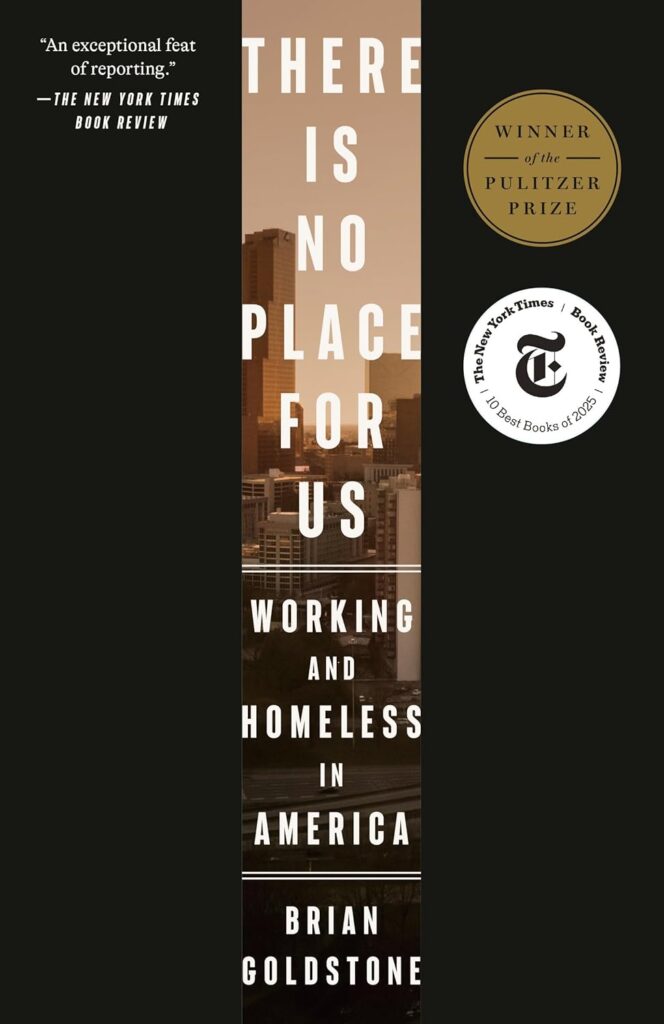
There Is No Place for Us: Working and Homeless in America (2025)
Select Sections to Print
×Book Details
There Is No Place for Us: Working and Homeless in America (2025)
Jump to Section
⚠️ Trigger Warnings
- Housing insecurity, homelessness, eviction, and displacement
- Domestic violence and physical assault
- Gun violence and shootings
- Substance abuse and addiction
- Cancer, serious illness, and medical trauma
- Medical neglect and dismissal
- Car accidents and serious injury
- Childhood sexual abuse
- Attempted sexual assault
- Child endangerment and distress
- Fear of child removal and foster care
- Death, grief, and bereavement
- Drug overdose
- Homicide and murder
- Mental health struggles
- Depression and panic attacks
- Suicidal ideation
- Poverty and extreme financial hardship
- Food insecurity
- Exploitation and predatory financial practices
- Rental scams
- Selling blood plasma and food assistance for money
- Panhandling
- Racism and systemic inequality
⏱️ 2-Minute Spoiler Summary
There Is No Place for Us: Working and Homeless in America follows five working Black families in Metro Atlanta as they struggle to keep a roof over their heads despite holding jobs, raising children, and constantly trying to improve their situations. Their stories unfold from roughly 2018 through the COVID-19 pandemic, showing how one eviction, lost job, bad landlord, credit problem, or bureaucratic delay can push a family into homelessness.
Brittany “Britt” Wilkinson initially seems to have found stability after spending two years waiting for a Section 8 voucher. She moves into QLS Gardens with her children, Desiree and Kyrie, but loses the apartment after temporarily allowing her formerly incarcerated cousin Steve to stay with her. Her landlord refuses to renew her lease, and because she cannot find another landlord willing to accept the voucher before it expires, she loses the assistance entirely. Britt eventually finds a cheap apartment at Gladstone Apartments, where her mother, Cass, also lives. During the pandemic, Britt loses her airport job and starts styling hair on her back porch to survive. Then a developer buys Gladstone to demolish it for expensive BeltLine housing, forcing Britt and Cass out. Britt loses her car, sleeps on friends’ floors with her children, and struggles to rent anywhere because of her credit. After seeing Gladstone reduced to a bulldozed lot, she concludes that there is simply “no place for us here.”
Kara Thompson, a hospital worker and home health aide raising four children, becomes homeless after her landlord fails to replace a dangerously old water heater and their dispute ends in eviction. A desperate attempt to stay with her daughter’s father in Florida ends when his pregnant girlfriend stabs Kara with a fork. Back in Atlanta, Kara cannot afford a motel or find shelter space, so she and her children sleep in her Toyota. She eventually enters a rapid-rehousing program, but a 35-day bureaucratic delay costs her an approved three-bedroom apartment. Rather than wait longer, she takes a smaller apartment and gives up a year of rental assistance. To afford it, she works as much as 90 hours a week. When she loses childcare, 10-year-old Grace is left caring for her siblings overnight while Kara works security.
Maurice and Natalia Taylor have spent years building a stable life in Sandy Springs when their landlord decides to sell their condo. Poor credit forces them into an expensive apartment that turns out to be infested with cockroaches. After Natalia suffers severe panic attacks and goes on disability, one late rent payment leads to an eviction. The family spends eight months at Extended Stay America, paying far more than they had paid in rent. Maurice eventually clears an old debt so they can secure another apartment, and they begin trying to qualify for homeownership while Natalia starts a small bath-and-body business.
Michelle Simmons loses her home after her partner Jacob secretly stops paying the rent and disappears. Her teenagers, DJ and Danielle, come home from school to find the family’s possessions dumped outside. Michelle takes her children to a budget hotel and works nights while the older kids care for toddler Skye, but losing that job sends the family into deeper desperation. Michelle pawns belongings, sells plasma and food stamps, panhandles, and secretly sleeps on a concrete storage-room floor. Although she later receives housing assistance and finds work at a Salvation Army shelter, years of trauma contribute to alcoholism and an abusive relationship with Nick. She loses her apartment again, sleeps in MARTA stations, is badly beaten, and ultimately enters inpatient rehab. From a laundromat, she calls her children and asks their forgiveness.
Celeste Walker’s crisis begins when her rental house burns down. After another temporary home ends in tragedy when a visitor accidentally fires a gun through the floor and kills a pregnant teenager below, Celeste and her children move into Efficiency Lodge. She is then diagnosed with advanced ovarian and breast cancer, yet cannot qualify for certain housing assistance because living in an extended-stay hotel does not technically count as being homeless under HUD rules. After the motel conducts mass gunpoint evictions, Celeste moves from one unsafe temporary home to another. Cancer complications eventually leave her weighing only 85 pounds and dependent on a feeding tube. Concluding that Atlanta is no longer safe or sustainable for her family, she pulls her sons from school, loads them into her Durango, and drives back to Tampa.
Around these families are activists and advocates trying to keep people from falling through the cracks, including LA Pink, who delivers clothing and food to extended-stay motels, and organizers with the Housing Justice League who fight predatory landlords and illegal evictions. Yet the families repeatedly discover that employment alone does not guarantee housing. By the end, some have found temporary stability, others are still struggling, and several have been pushed out of the communities where they were trying to build their lives.
📖 Full Spoiler Summary
Five Families Trying to Stay Housed
There Is No Place for Us: Working and Homeless in America follows five working-class Black families in Metro Atlanta over several years, beginning before COVID-19 and continuing through the pandemic and its aftermath. Although their circumstances differ, they repeatedly face the same problem: they are working, often at multiple jobs, but Atlanta’s housing market is becoming increasingly impossible for them to survive.
The book places their experiences against Atlanta’s longer history of housing displacement, from the destruction of public housing communities to redlining, discriminatory lending, and gentrification around the BeltLine. For the families themselves, however, the crisis is experienced in immediate terms—rent payments, eviction notices, motel bills, bad credit, lost jobs, broken cars, and the constant search for somewhere their children can sleep.
Britt Loses Her Voucher—and Eventually Her Neighborhood
Brittany “Britt” Wilkinson works as a line cook at the Atlanta airport while raising her young children, Desiree and Kyrie. After spending two years on the Atlanta Housing Authority’s waiting list, she finally receives a Section 8 Housing Choice Voucher and moves into a two-bedroom apartment at QLS Gardens.
That stability disappears after Britt temporarily allows her formerly incarcerated cousin Steve to stay with her. Because of his criminal background, the landlord refuses to renew Britt’s lease. The voucher should theoretically allow her to rent somewhere else, but she cannot find a private landlord willing to accept it before it expires. After waiting years for assistance, Britt loses it.
Through Yateshia Evans, an old friend of Britt’s mother Cass, she learns about Gladstone Apartments, where leasing manager Cindy is willing to rent inexpensive units to families who have few other options. Britt gets a one-bedroom apartment for $550 a month, and Cass also lives at Gladstone.
Then COVID-19 arrives. Britt loses her airport food-service job and improvises, turning her back porch into an informal hair salon to make enough money to survive. Just as she is trying to hold things together, Empire Communities purchases Gladstone. The affordable complex is slated for demolition so high-end BeltLine townhomes and condominiums can replace it.
Britt and Cass are evicted. Britt’s situation deteriorates further when she misses car payments after spending money on Christmas gifts for her children, and the car is repossessed. She and the kids begin cycling through other people’s homes. Her friend Janeka lets them sleep on her living-room floor for six months, while Yasmine later lets Britt stay on the floor of her studio.
The instability costs Britt more than housing. After her relationship with Janeka deteriorates, maintenance workers throw away important family documents, including birth certificates. Britt discovers that her credit score makes getting another apartment nearly impossible, so she asks her younger sister Aaliyah to apply for a lease on her behalf.
Eventually, Britt drives past the place where Gladstone once stood. The affordable apartments have been bulldozed. Looking at what has happened to the neighborhood and considering everything she has gone through simply trying to house herself and her children, she reaches the conclusion that gives the book its title: “Me and my kids? There’s no place for us here.”
Kara Works Around the Clock
Kara Thompson is raising four children while working jobs that include janitorial and EKG work at Grady Memorial Hospital, home health care, DoorDash, and eventually security work. Even before becoming homeless, she is stretched beyond exhaustion. At one point, sleep deprivation causes a devastating rollover crash that she survives before giving birth to her youngest child, Joshua.
Kara’s housing crisis begins in earnest at her rental house on Oakwood, where landlord Dejene refuses to properly replace a badly corroded 23-year-old water heater. Their dispute ultimately ends in eviction.
With nowhere to go, Kara drives her children to Florida, hoping they can stay with Darius, the father of her oldest daughter, Grace. Instead, an altercation with Darius’s pregnant girlfriend Tamara ends with Tamara stabbing Kara in the shoulder with a fork. Kara returns to Atlanta with all four children.
A motel costs $380 a week, and shelter beds are unavailable. Kara begins sleeping with her children inside her Toyota, parking at gas stations and Walmarts.
Her best hope comes through Carla Wells, a case manager at Nicholas House who helps Kara enter the Homeless to Homes rapid-rehousing program. Kara is approved for a three-bedroom apartment at Chelsea Gardens, but she cannot move in because the city requires a 35-day environmental review. By the time the bureaucratic process is finished, the apartment has been given to someone else.
A sympathetic leasing agent, Ian, offers her a two-bedroom instead. Kara accepts because her children need somewhere to live immediately, even though doing so means surrendering the 12 months of rental subsidy she could have received.
Now she has housing but must somehow afford it. Kara works as many as 90 hours a week. When her children are expelled from KinderCare after Jermaine scratches another child, her childcare disappears too. She takes an overnight security job in Buckhead and leaves 10-year-old Grace responsible for her siblings. Before leaving, Kara removes potential dangers by locking away kitchen knives and stove knobs. At night, she plays a recording of herself singing gospel songs so her children can hear their mother’s voice while she is away working to keep them housed.
Maurice and Natalia Fall from Stability into Extended-Stay Living
Maurice Taylor and his wife, Natalia, moved from Washington, D.C., to Atlanta hoping to build a life in the “Black Mecca.” For four years they have what they were seeking: a stable rented condo in Sandy Springs where they raise their children, Shantel, Anthony, and eventually baby Matthew.
Their stability begins unraveling in 2019. Shortly after Matthew’s birth and the sudden death of Maurice’s beloved cousin Aaron, their landlord Summer announces that she is selling the condo.
Credit problems make finding another home difficult. The Taylors pay $1,450 to Liberty Rent, a cosigning company, to qualify for an apartment at The Whitney that itself costs $1,450 a month. When they move in, they discover a severe cockroach infestation.
Natalia, meanwhile, is suffering debilitating panic attacks and depression. After a major panic attack at her State Farm job, she goes on short-term disability. A single late rent payment in January 2020 is enough to trigger another disaster: a marshal arrives and evicts the family.
They move into Extended Stay America. Instead of making housing cheaper, homelessness makes it much more expensive. The family spends roughly $2,200 every month on the extended-stay room and remains there for eight months.
Maurice eventually pays off $2,900 they owe Liberty Rent without telling Natalia, allowing the family to qualify for another Sandy Springs apartment by paying a double deposit. They then begin pursuing homeownership through NACA, only to learn they will need to spend another year saving $4,000 and reducing their debts before they can qualify. Natalia starts a bath-and-body pop-up business as the family tries once again to create lasting stability.
Michelle’s Homelessness Becomes a Personal Collapse
Michelle Simmons is raising teenagers DJ and Danielle and toddler Skye when her partner, Jacob, secretly stops paying the rent at Eastwyck Village and disappears.
On September 9, 2019, DJ and Danielle get off their school bus and discover their family’s belongings dumped onto the lawn.
Michelle takes the children to the A2B Budget Hotel and gets a job working nights at the front desk. DJ and Danielle take care of Skye while their mother works, forcing the older children to assume responsibilities far beyond their years.
Then Michelle loses the hotel job.
Her attempts to survive become increasingly desperate. She pawns her laptop, sells blood plasma, sells food stamps for 50 cents on the dollar, and panhandles outside Big Lots. At one point, she secretly sleeps on the concrete floor of an unheated hotel storage room. Phillis, an outreach leader at The Beloved Community church, eventually pays for two weeks at Efficiency Lodge.
Michelle later receives housing in Stone Mountain through PCCI and finds work at a Salvation Army shelter, seemingly giving her another chance at stability. But the accumulated trauma takes a severe toll. She begins drinking heavily and becomes involved with Nick, a younger abusive man.
The relationship and alcoholism send Michelle into another downward spiral. She loses her apartment and begins sleeping in MARTA stations. Nick severely beats her, and she eventually enters an inpatient women’s rehabilitation facility. From a laundromat, Michelle makes an emotional call to her children and asks them to forgive her.
DJ, meanwhile, begins finding some stability of his own through community organizer LA Pink, becoming her “right-hand man” as she assists families living in extended-stay motels.
Celeste Battles Cancer While Searching for Somewhere Safe
For Celeste Walker, homelessness begins with a literal disaster. In May 2018, the rental house where she lives with her children burns down. Instead of releasing her from the lease, private equity landlord The Prager Group demands double rent to break it and obtains a default eviction judgment involving the burned property.
Celeste temporarily sublets another home, but that arrangement ends horrifically when a visitor accidentally fires a gun through the floor and kills a pregnant teenager in the apartment below.
Celeste moves her children into Efficiency Lodge, paying $257 a week. While living there, she is diagnosed with advanced ovarian and breast cancer. Even cancer does not make the housing bureaucracy easier to navigate. Gateway denies her housing assistance because, under HUD rules, staying in an extended-stay hotel does not qualify as “literal homelessness.”
Trying to survive, Celeste operates an informal daycare from her motel room. Then Efficiency Lodge conducts mass evictions at gunpoint, throwing already vulnerable families back into instability.
Celeste moves repeatedly. She stays with her friend Ricky until Ricky’s cousin attempts to sexually assault her. Val, the owner of Talk of the Town soul food restaurant, allows the family to stay in a basement. They also spend time at a Howard Johnson before caseworker Joya places Celeste in a rodent-infested Dixie Hills rooming house the family calls “Hell House.”
By this point, Celeste’s medical condition is becoming catastrophic. Post-cancer starvation complications reduce her weight to 85 pounds, and doctors insert a feeding tube. She raises money through GoFundMe for a portable feeding pump, but her living environment remains dangerously unstable.
Eventually, Celeste decides she cannot keep her children there. She withdraws her sons from school, packs the family into her Durango, and drives back to Tampa, Florida.
The Families Keep Fighting to Survive
Running alongside the five families’ stories are people trying to challenge the system that keeps pushing them into homelessness. LaQuana Alexander, known as LA Pink, runs The Community Boutique with LA Pink, loading her car with food and good-quality clothing and bringing supplies directly to families living in extended-stay motels.
After residents Travis and Eboni are among those evicted from Efficiency Lodge at gunpoint, they join the Housing Justice League and work with organizer Natalie McLaughlin to fight predatory landlords. DeKalb County Commissioner Larry Johnson intervenes during the Efficiency Lodge lockouts, while the book also follows the legal and political forces surrounding the property.
The five families do not arrive at one neat shared ending. Britt is still trying to find a landlord who will accept her despite her damaged credit. Kara has an apartment but must work extraordinary hours to keep it. Maurice and Natalia have returned to rental housing and are trying to position themselves for homeownership. Michelle enters rehab after losing her housing again. Celeste, physically devastated by cancer and unable to find safe housing, leaves Atlanta altogether.
What connects their stories is that none of these families simply stopped trying. They work, take extra jobs, seek assistance, rely on friends and relatives, move into motels, apply for programs, and repeatedly rebuild after setbacks. Yet again and again, the smallest disruption is enough to undo whatever stability they have managed to create, leaving them working constantly while still searching for a secure place to call home.
🔚 Ending Explained
How the Book Ends
There Is No Place for Us closes by returning to the five families whose experiences have illustrated different forms of working homelessness. There is no sweeping happy ending. Some find housing, some leave Atlanta, and some begin rebuilding their lives, but nearly all remain one setback away from another crisis. Pasted text
Britt Wilkinson
After Gladstone Apartments is sold to Empire Communities for $33.25 million, Britt and hundreds of other low-income residents are displaced so the property can be demolished for high-end BeltLine development. Already struggling financially, Britt misses a payment on her subprime auto loan after spending too much on Christmas gifts for her children, and her car is repossessed. She eventually gets it back, but her housing situation becomes even more precarious. Pasted text
With an eviction and damaged credit making it virtually impossible to qualify for another apartment, Britt turns to her younger sister, Aaliyah, who applies for a lease on her behalf. Britt’s final scene is one of the book’s most devastating: she drives past the cleared lot where Gladstone once stood and sees the luxury development rising around it. Her conclusion—“Me and my kids? There’s no place for us here”—gives the book its title and crystallizes its central argument. Pasted text
Kara Thompson
Kara appears to receive the break she desperately needs when she qualifies for the Homeless to Homes rapid-rehousing program. But a mandatory 35-day environmental review delays her move, and the three-bedroom apartment she had been approved for is given to someone else. A sympathetic leasing agent eventually finds her a two-bedroom apartment, but moving into it immediately means sacrificing the 12-month housing subsidy that was supposed to help stabilize her family. Pasted text
The consequences are brutal. Kara works as much as 90 hours a week to keep up with rent and utilities. When a childcare dispute results in all four of her children losing their daycare placement, she has to quit one of her jobs. Facing an unpaid electric bill and possible eviction, she takes an overnight security job and leaves ten-year-old Grace in charge of the younger children. Kara removes the stove knobs, hides the knives, gives Grace a phone, and leaves behind a recording of herself singing gospel songs for the children to hear while she works. Pasted text
Maurice and Natalia Taylor
Maurice and Natalia finally escape the Extended Stay America room that has been costing them $2,200 a month. Without telling Natalia, Maurice pays $2,900 in old debt to Liberty Rent, restoring their ability to use the cosigning service. They are approved for a three-bedroom apartment in Sandy Springs, although their credit forces them to pay a double security deposit. Most of their old furniture has been destroyed by mold in storage, so they essentially begin again from nothing. Pasted text
Their ending is cautiously hopeful rather than triumphant. Natalia begins the process of trying to qualify for homeownership through NACA, only to learn that the family will need at least another year to save $4,000 and reduce their debt. Instead of giving up, Natalia starts a bath-and-body pop-up business and Maurice offers to work additional shifts. Their final moment together beside the river suggests endurance: they have not escaped the system, but they have regained enough stability to imagine a future. Pasted text
Michelle Simmons
Michelle’s trajectory is the darkest. After obtaining housing in Stone Mountain and working overnight at a Salvation Army shelter, exhaustion and unresolved trauma overwhelm her. She quits her job, develops severe alcoholism, enters an abusive relationship with Nick, loses her apartment, and becomes homeless again. Her children eventually live with her aunt Regina while Michelle sleeps in MARTA stations and bus stops. Pasted text
Her turning point comes after Nick brutally beats her. Michelle finally leaves him and enters an inpatient rehabilitation facility. In an emotional call with DJ, Danielle, and Skye, she asks her children to forgive her and promises to get herself straightened out. Her ending offers no guarantee that recovery will succeed, but it restores something she had nearly lost: her determination to survive and reconnect with her children. Meanwhile, DJ finds purpose working alongside community organizer LA Pink to help other unhoused families. Pasted text
Celeste Walker
Celeste never finds lasting stability in Atlanta. After the gunpoint evictions at Efficiency Lodge, she cycles through temporary living arrangements, narrowly escapes sexual assault, stays in a restaurant owner’s basement, lives in a hotel, and eventually lands in a dangerous rooming house known as “Hell House.” At the same time, complications from cancer treatment leave her unable to absorb nutrients and weighing only 85 pounds, requiring a feeding tube. Pasted text
Eventually, Celeste recognizes that remaining in Atlanta is simply too dangerous for her and her sons. She withdraws Micah and Jalen from school, packs her Dodge Durango, visits the storage unit beside Efficiency Lodge one final time, and drives back to Tampa. She leaves her older daughter Nyah in Atlanta with her boyfriend and new baby. Returning to Florida isn’t presented as defeat or victory. It is survival. Pasted text
Ending Explained: What It All Means
The lack of a conventional happy ending is the point. Goldstone doesn’t end by showing five families finally overcoming homelessness through perseverance. Instead, she shows how extraordinary amounts of perseverance are required merely to remain afloat.
Each family’s final decision could look irresponsible when stripped of context: Britt uses her sister’s identity to obtain housing; Kara leaves young children home alone; Maurice secretly spends thousands paying an old debt; Celeste removes her children from school and leaves the state. But the ending reframes these actions as survival strategies created by the absence of reasonable alternatives. Pasted text
That idea is particularly powerful in Kara’s final scenes. Removing the stove knobs and hiding the knives are tiny attempts to control every danger she possibly can before leaving for work. The recording of Kara singing gospel songs takes the symbolism further: because the economic system requires her physical presence somewhere else, she essentially has to record her motherhood and leave it behind. Her voice remains with the children even when she cannot. Pasted text
Britt’s ending provides the book’s clearest image of displacement. Gladstone hasn’t simply deteriorated or closed; it has been physically erased. The forgotten Paw Patrol scooter belonging to her son Kyrie, left behind to disappear beneath the demolition, turns redevelopment into something painfully personal. A working-class community—and the childhoods lived inside it—can literally be bulldozed while something more profitable replaces it. Pasted text
Maurice and Natalia provide the closest thing to optimism. Their son’s Pac-Man bedroom, improvised after the family’s belongings were ruined by mold, symbolizes their ability to manufacture happiness from almost nothing. Yet even their success is deliberately qualified. They have an apartment, but homeownership remains at least a year away and dependent upon more saving, debt repayment, and additional work. Stability is always conditional. Pasted text
The ending therefore dismantles the idea that homelessness is primarily caused by an unwillingness to work. These adults do work, sometimes at multiple jobs and for extraordinary hours. Their problem is that employment no longer reliably produces housing security. At the same time, people living in extended-stay hotels, cars, or temporary arrangements can fall outside HUD’s narrow definition of “literal homelessness,” making some of the people most desperately in need of assistance effectively invisible to the programs designed to help them. Pasted text
There is, however, one important sign that circumstances can change. The Efficiency Lodge residents’ lawsuit ultimately produces a landmark Georgia Court of Appeals ruling establishing that long-term extended-stay residents can be legally recognized as tenants rather than hotel guests, protecting them from being summarily locked out without formal eviction proceedings. Pasted text
That legal victory shifts the book’s final emphasis from individual resilience toward collective action. None of these families can personally work hard enough to solve gentrification, unaffordable rents, predatory lending, restrictive credit systems, or inadequate housing protections. Structural problems require structural solutions.
So Britt’s final realization—“There’s no place for us here”—works on two levels. She means the physical Atlanta neighborhood that has literally displaced her family, but the statement also describes a housing system with increasingly little room for working families who cannot meet its financial thresholds.
The ending is bleak, but not entirely hopeless. Michelle chooses recovery. Maurice and Natalia keep planning. Celeste chooses survival. The Efficiency Lodge residents help establish new legal protections. The book’s final hope does not come from pretending that the families have escaped poverty. It comes from showing that change becomes possible when their experiences stop being treated as isolated personal failures and are recognized as evidence of a larger systemic problem. Pasted text
👤 Characters & Fates
🔶 Main Characters

Loses her Section 8 voucher, then her affordable Gladstone apartment when it is demolished for luxury development. Her car is repossessed, her documents are accidentally discarded, and her credit and eviction history leave her unable to rent in her own name, forcing her to ask Aaliyah to apply for an apartment for her.
After sleeping in her car with four children, she qualifies for rapid rehousing but loses her three-bedroom unit during a bureaucratic delay and gives up her subsidy to take a smaller apartment immediately. When all four children are expelled from daycare, she quits one job and ultimately leaves 10-year-old Grace in charge overnight while she works security. Pasted text
After eviction, he spends eight months with his family at Extended Stay America, secretly pays off their Liberty Rent debt, and eventually secures another Sandy Springs apartment. He and Natalia begin working toward NACA homeownership.
Severe depression and panic attacks force her onto disability before the family’s eviction. After eight months in a hotel, she and Maurice secure another apartment, begin the NACA homeownership process, and she launches a bath-and-body business.
After Jacob secretly stops paying rent, Michelle eventually becomes homeless, panhandles, and secretly sleeps with her children in an unheated hotel storage room. She later obtains housing but spirals into alcoholism and an abusive relationship, loses the apartment, sleeps in MARTA stations, is severely beaten, and ultimately enters inpatient rehab and asks her children for forgiveness. Pasted text
After her house burns down, she is still hit with an eviction judgment, moves into an extended-stay hotel, and develops advanced ovarian and breast cancer. She survives cancer but becomes dangerously underweight, is placed in a rodent-infested rooming house, and finally packs up her sons and moves back to Tampa.
Evicted with Britt when Gladstone is demolished, Cass moves in with her mother Theresa, but an Alzheimer’s-related confrontation with Granny forces her out again. She ultimately crowds into Aaliyah’s one-bedroom apartment.
After caring for Skye and watching Michelle descend into alcoholism, DJ moves in with Aunt Regina. LA Pink mentors him, and he finds stability through school, music, poetry, and helping other unhoused families.
She develops preeclampsia and gives birth to Caleb by C-section. When Celeste returns to Florida, Nyah stays in Atlanta with boyfriend Mike and their baby at Efficiency Lodge.
She gets Kara enrolled in Homeless to Homes but watches bureaucratic delays cost Kara her approved three-bedroom apartment. She remains at Nicholas House fighting the systems that repeatedly fail families.
She organizes aid drives and tenant resistance, rescues Michelle and Skye when they are sleeping outside, and eventually takes DJ under her wing as her assistant.
🔷 Supporting Characters
Moves between relatives’ homes, apartments, hotels, and other temporary housing, and briefly stays with her father’s side while Britt searches for shelter.
Moves from place to place with Britt and Desiree; his beloved Paw Patrol scooter is left behind at Gladstone and buried beneath the demolition.
Lives in a subsidized senior high-rise and is terrified to let Cass or Britt stay because unauthorized guests could cost her the apartment.
Develops worsening Alzheimer’s and becomes paranoid and confused, eventually screaming at Cass during a nighttime episode and forcing her out.
Eventually obtains housing at The Villages of East Lake after East Lake Meadows is demolished, but dies shortly afterward.
Repeatedly houses Britt and other relatives despite risking her own lease; after having a baby, she ultimately agrees to apply for an apartment in her own name for Britt.
Sleeps on Aaliyah’s living-room floor during the family’s housing crises.
Attends college in Florida on a football scholarship while Cass hides the family’s homelessness from him so he will not worry.
Lives with his new wife and children and refuses to take Desiree and Kyrie permanently, even criticizing Kyrie as a “mama’s boy.”
Temporarily stays with Britt at QLS Gardens; when management discovers his criminal history, Britt’s Section 8 lease is not renewed.
Loses her position when Empire Communities buys Gladstone for demolition.
Campaigns against the demolition but cannot stop it; her mother ends up in a rooming house and her disabled daughter in a hotel.
After six months, Janeka abruptly moves out and changes the locks; maintenance then throws away Britt’s Social Security cards and birth certificates.
Lets Britt and her children sleep on the floor of her studio despite facing housing insecurity herself.
Temporarily cares for Desiree and Kyrie while Britt searches for shelter.
Helps Kara throughout their car and motel homelessness and is ultimately left in charge of her three younger brothers overnight while Kara works security.
Moves through cars, motels, and Chelsea Gardens; a minor scalp injury prompts a DFCS investigation of the family.
After pushing a bookshelf and scratching another child at KinderCare, he is suspended and all four Thompson children are expelled from daycare.
Spends infancy moving among hospital rooms, cars, Walmart parking lots, motels, and eventually Chelsea Gardens.
Invites Kara and the children to Florida claiming he can house them, but actually lives in a single room and has a violent girlfriend.
Is jailed on felony drug and domestic-violence charges after beating Kara and disappears from Jermaine’s life.
Attacks Kara with mace and stabs her shoulder with a fork during a parking-lot fight.
Tells Kara that her approved three-bedroom apartment was given to someone else during the environmental-review delay and offers no immediate solution.
Steals Kara’s $70 application fee but fails to get another $1,100 when she notices an Invitation Homes fraud warning.
Calms Kara during a breakdown and helps her obtain a two-bedroom apartment before leaving the property for another career.
Lives through the family’s hotel stay, grieves her godfather Aaron, hides her surroundings during virtual school, and later helps decorate their new apartment.
His parents manage to keep him in his Sandy Springs special-education program, and he eventually celebrates his 10th birthday in the family’s new apartment.
Takes his first steps and celebrates his first birthday at Extended Stay America before the family finally obtains an apartment.
Dies suddenly in Washington, D.C., from HIV-related complications and liver cancer.
Sells the condo and gives the Taylors 60 days to leave despite their history of paying rent.
Faces being locked out of Extended Stay America after her unemployment benefits expire.
Helps care for Skye, moves in with Aunt Regina during Michelle’s alcoholism, and later contributes money to bail Michelle out of jail.
Sleeps on a concrete storage-room floor and accompanies Michelle while panhandling before relatives take her in during Michelle’s addiction and rehab.
Secretly stops paying rent, cheats on Michelle, appears with her on Divorce Court, and eventually abandons Michelle and the children at a Days Inn to live with another woman.
Completely disappears from his children’s lives and does not contact them even on birthdays or holidays.
Takes in DJ and Danielle, locks Michelle out when she arrives drunk demanding Skye, and later helps raise money to bail Michelle out of jail.
Drives Michelle around searching for housing and uses church emergency funds to pay for two weeks at Efficiency Lodge.
Moves into Michelle’s apartment, contributes to their job loss, and brutally beats her; Michelle cuts him with glass during the confrontation, and both are arrested.
Writes music and freestyles while living in hotels and rooming houses, then leaves Atlanta with Celeste for Tampa.
Attends school remotely from unstable housing before moving with Celeste to Tampa.
Lives with his parents in Room 114 at Efficiency Lodge amid health warnings and threats of eviction.
Leaves drug dealing behind, takes an $11-an-hour Duracell warehouse job, attends Caleb’s birth, and remains with Nyah and their baby at Efficiency Lodge.
Repeatedly threatens residents with eviction while overseeing severe code problems, then is fired or disappears after flooding and management scandals.
Coordinates gunpoint lockouts with armed guards and refuses to cooperate even when County Commissioner Larry Johnson intervenes.
Lets Celeste and her children sleep on his floor for four days, but they flee after his cousin attempts to sexually assault Celeste.
Employs Celeste and lets her family stay in her basement until a domestic dispute involving Val’s daughter forces them to leave.
Places Celeste in the rodent-infested “Hell House” and largely ignores her complaints about its dangerous conditions.
Organizes Efficiency Lodge tenants, confronts police during lockouts, and helps build tenant-power campaigns across Atlanta.
After Travis is evicted at gunpoint in front of their three-year-old, the couple joins Housing Justice League and becomes central to the lawsuit that establishes extended-stay residents’ legal tenant protections.
Roy defends Efficiency Lodge against the residents’ lawsuit, but the company loses a landmark Georgia Court of Appeals ruling establishing that extended-stay residents are tenants protected from summary lockouts.
Confronts management during the gunpoint lockouts and secures emergency church funding to place evicted families at Budgetel.
🕳️ Potential Plot Holes
Celeste Walker receives an eviction judgment even though the rental house has already burned and is uninhabitable. While this sounds absurd, the eviction results from the legal process rather than her physically occupying the house. After her landlord sought unpaid rent and served notice at the damaged property, Celeste did not respond within the required period, allowing the landlord to obtain a default judgment that then followed her rental record.
📚 Book Club Q&A's
⭐ Final Rating & Thoughts
I really wanted to appreciate this book more than I did. The reporting is strong, the families’ stories are compelling, and Goldstone makes a convincing case that America’s housing system is deeply broken. The barriers involving credit scores, expiring housing vouchers, extended-stay hotels, and access to assistance are especially frustrating and often infuriating.
But I struggled with how one-sided the book felt. Having been a landlord myself, including renting Section 8-approved housing, I’ve seen situations where financial hardship and systemic problems existed alongside genuinely poor personal decisions. I kept waiting for the book to acknowledge that complexity. Instead, I often felt as though landlords and institutions were presented as the problem while the choices made by the people being profiled received far less scrutiny.
I absolutely have sympathy for people facing homelessness, poverty, and impossible circumstances, but I don’t believe personal responsibility and systemic failure are mutually exclusive. Both can contribute to the same situation. Ultimately, I finished this feeling more manipulated than enlightened. The subject is important and the reporting worthwhile, but I wanted considerably more nuance and self-reflection than I got.
✨ Adaptation description
Adaptation
As of October 2026, no film, television, documentary, or other screen adaptation of There Is No Place for Us: Working and Homeless in America has been officially announced.
Brian Goldstone’s nonfiction book was published by Crown in 2025 and won the 2026 Pulitzer Prize for General Nonfiction. It uses immersive reporting to follow five working families in Atlanta as they struggle with eviction, unstable housing, rising rents, and homelessness despite being employed. The Pulitzer Prizes
✨ Books Like There Is No Place for Us: Working and Homeless in America (2025)
See an error on this page?