
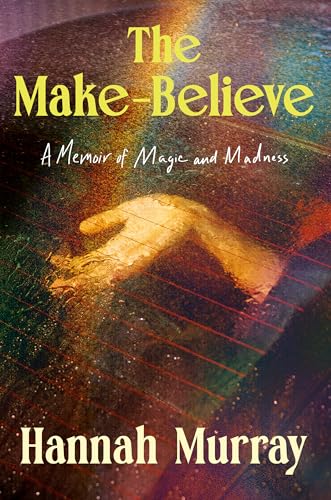
The Make-Believe: A Memoir of Magic and Madness (2026)
Select Sections to Print
×Book Details
The Make-Believe: A Memoir of Magic and Madness (2026)
Jump to Section
⚠️ Trigger Warnings
- Mental illness and severe depression
- Bipolar disorder
- Mania and manic episodes
- Psychosis and psychotic breaks
- Auditory and visual hallucinations
- Delusions and paranoia
- Psychiatric hospitalization
- Involuntary psychiatric commitment/sectioning
- Physical restraint and forced sedation
- Suicidal ideation and suicide themes
- Self-harm/cutting
- Eating disorders and disordered eating
- Severe calorie restriction and compulsive exercise
- Purging/vomiting
- Body-image issues
- Cults and high-control groups
- Cult indoctrination and psychological manipulation
- Spiritual abuse
- Grooming and coercive control
- Sleep deprivation
- Social isolation
- Financial exploitation
- Sexual assault and sexual violence
- Sexual boundary violations and exploitation
- Intoxicated/non-consensual sexual encounters
- Hypersexuality
- Nudity and sexualized filming
- Police brutality and racial violence
- Murder and historical racial violence
- Physical violence and restraint
- Alcohol abuse and binge drinking
- Recreational/illegal drug use
- Cocaine, MDMA/ecstasy, and nitrous oxide use
- Miscarriage and recurrent pregnancy loss
- Genetic disorders and fetal non-viability
- Survivor’s guilt
⏱️ 2-Minute Spoiler Summary
Hannah Murray, the actress known for playing Cassie in Skins and Gilly in Game of Thrones, begins The Make-Believe in a psychiatric ward, naked and deeply psychotic, convinced she is an angelic vessel of Light and that an unseen spiritual master is communicating directly with her. The memoir then goes back to explain how she got there.
In 2016, Hannah is filming Detroit, playing a young woman brutalized during the 1967 Algiers Motel incident. The physically and emotionally punishing shoot leaves her bruised, nauseated, and plagued by nightmares. Already prone to depression and emotional extremes, she visits an energy healer named Grace, who performs a mysterious “Light” treatment. Hannah experiences involuntary movement and overwhelming emotion and comes away convinced that magic might actually be real.
Back in London, she begins taking classes with the spiritual organization Grace recommended. Siobhan, one of its leaders, teaches Hannah rituals involving Magic Circles, chakras, the Akashic Records, supernatural beings, and a supposed Hierarchy of Light. Hannah embraces the teachings even as her mental health deteriorates. She rejects a friend’s suggestion that she consider psychiatric medication and instead relies increasingly on rituals.
At the same time, she is struggling with her complicated relationship with Sam, a longtime friend she loves but who has repeatedly pulled away from her romantically. Siobhan even performs a “Cord Cutting” ritual to sever Hannah’s attachment to him.
In March 2017, Hannah secretly immerses herself in several advanced courses. She learns about astral travel, Atlantis, elves, mermaids, vampires, and the organization’s Ritual Master program. During the five-day Course in Healing, she finally meets its leader, Steve, and immediately develops an overwhelming attraction to him.
After Steve lectures the group about fighting evil, Hannah begins believing she can hear his voice inside her head. Her spiritual beliefs rapidly merge with a manic episode. She becomes convinced Steve is communicating directly with her soul and that she has a divine mission to save the planet.
On March 5, Hannah suffers a complete psychotic break. At Kensington Palace, she believes touching the Golden Gate will activate an earth chakra, reverse the planet’s rotation, and create a utopian Shambhala. Back at the hotel, she barricades herself in a bathroom for hours, believing her crown chakra is giving birth to this new world. When she emerges, organization members perform what resembles an exorcism. Hannah believes she and Steve are ancient mer-creatures destined to rule the universe, runs barefoot through the hotel, tries to strip and enter the pool, and fights police officers. She is restrained and taken to a psychiatric hospital.
Sectioned under the Mental Health Act, Hannah remains severely psychotic. She drinks her own urine as a magical potion and believes she is Jesus, the “Girl with All the Gifts,” and various famous actresses. Steve reinforces some of her delusions by telling her that a dark entity attached itself to her while she was filming Detroit and that he fought it off.
Gradually, with psychiatric treatment and support from friends and family, Hannah accepts that she has bipolar disorder. Yet even after leaving the hospital, she isn’t immediately free of the organization. She returns for more classes and spends more than £1,000 on advanced training.
The spell finally begins to break when Hannah discovers that Lisa, the woman teaching her advanced classes, is Steve’s wife and the mother of his child. Hannah’s fantasy that she and Steve share a unique spiritual connection collapses. She also becomes increasingly disturbed by the organization’s rigid gender roles, victim-blaming, and increasingly ridiculous teachings.
While promoting Detroit and Game of Thrones, Hannah struggles with severe depression but continues moving away from the group. She eventually sends Steve one last message, which he never answers.
The final piece falls into place when Hannah is cast as Leslie Van Houten in Charlie Says. Playing a young woman manipulated by Charles Manson helps Hannah recognize how cult indoctrination works: slowly, through vulnerability, escalating commitments, isolation, and increasingly extreme beliefs.
Hannah ultimately leaves acting, moves away from London, and cuts all ties with the organization. She continues managing bipolar disorder and remains friends with Jodi, another former participant. By the end, the “magic” Hannah values is no longer supernatural. It is ordinary reality—the people who love her, everyday routines, and simply being alive.
📖 Full Spoiler Summary
Hannah Discovers “Magic”
The Make-Believe opens with Hannah Murray already deep inside a psychotic episode. At twenty-seven, the actress known for Skins and Game of Thrones is wandering naked through a psychiatric ward, convinced she is an angelic vessel of Light, a divine mermaid, and the chosen student of an unseen spiritual master. She believes magic is real. The rest of the memoir explains how that belief took over her life.
The story goes back to the summer of 2016, when Hannah is filming Detroit, Kathryn Bigelow’s movie about the 1967 Algiers Motel incident. Hannah plays Julie, an eighteen-year-old who was brutalized during the police raid, and meets the real Julie, now in her sixties and working as a hairdresser on the film.
Hannah feels enormous pressure to do justice to Julie’s experience. She starves herself, relies on double espressos, and endures exhausting night shoots that repeatedly recreate violence. By the end, she is bruised, nauseated, and suffering traumatic nightmares.
Looking for relief from both the shoot and her longstanding depression, Hannah visits an energy healer named Grace in Boston. For $150, Grace performs a “Light” session supposedly designed to activate Hannah’s spiritual DNA and remove trauma. Although Grace never touches her, Hannah begins swaying involuntarily and crying. The experience feels so powerful that she leaves believing something supernatural has happened.
Grace sells her mysterious liquid drops and tells her about a spiritual organization offering formal training. Hannah is intrigued rather than skeptical.
After filming ends, she travels to New York with her friend Sam to see Kanye West’s Saint Pablo Tour. Sam has occupied a complicated place in Hannah’s life for years. They met through their mutual friend Rina, kissed during a birthday trip while wearing unicorn onesies, and eventually slept together. Hannah developed strong feelings for him, but Sam withdrew and later dated a man named Luke, leaving her jealous and heartbroken.
At the concert, Hannah once again feels an invisible force moving her body. After what happened with Grace, she interprets the sensation as another spiritual experience.
Hannah Enters the Organization
Back in London, Hannah contacts Siobhan, an Irish organizer affiliated with the group Grace recommended. Without telling Rina what she is really doing, Hannah attends a two-day initiation course at the King Henry VIII Hotel.
Siobhan introduces Hannah and the only other student, Marek, to an elaborate spiritual system. They create protective Magic Circles, chant in Hebrew and Latin, work with chakras and the Akashic Records, and learn about a Hierarchy of Light. Siobhan teaches them that unicorns, dragons, and fairies actually exist and describes a path through the organization that can eventually make them Ritual Masters.
Hannah is formally initiated in a candlelit ceremony and begins performing the prescribed rituals every day.
Yet her mental health continues to deteriorate. During the autumn, she falls into a severe depression. Her friend Emily notices Hannah’s extreme emotional highs and lows and suggests psychiatric medication, but Hannah rejects the idea. She has begun trusting spiritual practices instead.
Her obsession with Sam remains another source of turmoil. Siobhan performs a “Cord Cutting” ceremony intended to sever Hannah’s energetic attachment to him. But after Hannah confronts Sam at a Halloween party while using cocaine and alcohol, he admits that he once had strong feelings for her and pulled away because he was frightened. Hannah later tells him she will no longer remain trapped in their romantic limbo.
Family tensions also resurface over Christmas. Hannah remembers learning two years earlier that her mother suffered five miscarriages before Hannah was born because of a genetic condition inherited from Hannah’s father. Even more upsettingly, Hannah discovered that she had been tested as a child, carries the same genetic trait, and wasn’t told until she was twenty-five.
By the end of 2016, instead of pulling away from the spiritual organization, Hannah goes deeper. At one of its Psychic Nights, she meets longtime member Maeve and signs up for the Course in Healing.
The Organization Takes Over Hannah’s Life
In March 2017, Hannah secretly rents an Airbnb near the hotel where the organization holds its classes. She lies to both her parents and Rina about what she is doing and completes three prerequisite courses.
The teachings become increasingly bizarre. In Journeys of the Spirit, she meets Jodi, a twenty-four-year-old American who tells Hannah that Grace’s healing cured her severe Crohn’s disease. During Astral Travel, Hannah spends hours staring at a black dot. In Twelve Races of Earth, instructors teach about Atlantis, elves, mermaids, and vampires. Hannah and Jodi are disturbed when they are told that the “Vampire Race” serves society by feeding on supposed human “dregs,” including drug addicts and sex workers.
Despite moments of discomfort, Hannah continues into the five-day Course in Healing with about twenty-five students from around the world. She performs energy healings and receives enthusiastic praise from instructors and fellow students, reinforcing her belief that she has a genuine spiritual gift.
Her commitment intensifies. After dinner with several classmates, Hannah stands naked in front of a mirror repeating affirmations and then immerses herself in an “Against Evil” salt bath, effectively baptizing herself.
Then she meets Steve, also known as Ipsissimus Steven, the leader of the organization.
Steve gives an intense lecture about fighting evil and warns that most students will never survive the path to becoming Ritual Masters. Hannah is immediately overwhelmed by her attraction to him. Part of her even wonders whether she has joined a sex cult.
Soon afterward, she receives her ceremonial wooden wand—and begins hearing Steve’s voice inside her head.
Hannah’s Psychotic Break
By March 5, Hannah’s spiritual indoctrination and rapidly escalating mania have fused together. She believes Steve is communicating directly with her soul and giving her a divine mission.
At Kensington Palace, she approaches the Golden Gate and touches its lion-and-unicorn ironwork. In her mind, she is activating one of Earth’s chakras. She believes her actions will reverse the planet’s rotation, heal Mother Gaia, and bring about Shambhala, a perfect new world.
When she returns to the hotel, her grip on reality collapses completely.
Hannah locks herself inside a basement bathroom cubicle for hours, convinced her crown chakra is literally giving birth to Shambhala. Members of the organization gather outside, and Steve speaks to her through the door. When Hannah finally emerges, Steve holds her while Siobhan and several female leaders surround her and chant from an old book in an apparent attempt to exorcise whatever they believe has taken control of her.
Their intervention only feeds Hannah’s delusions. She now believes she and Steve are ancient mer-creatures destined to rule the universe together.
Barefoot and severely disoriented, Hannah races into the hotel lobby, tries to remove her clothes, and attempts to get into the swimming pool. Police arrive, and Hannah violently fights them. She is restrained, strapped onto a gurney, and taken away by ambulance.
The Psychiatric Ward
Hannah is admitted to Gordon Hospital and then transferred to Amazon Ward, where she is sectioned under Section 2 of the Mental Health Act.
Her psychosis continues. She believes the hospital is actually a palace. She drinks her own urine because she thinks it is a Ritual Master potion. At different moments she believes she is Jesus Christ, the “Girl with All the Gifts,” and various legendary actresses. Her obsession with Steve becomes intensely sexual, with Hannah imagining that they are repeatedly joining together across spiritual dimensions.
When she gets her phone back, she contacts Siobhan and obtains Steve’s number. Instead of challenging Hannah’s supernatural interpretation of what happened, Steve tells her that she became possessed by a dark entity that had attached itself to her during Detroit. He claims he personally fought the entity to save her.
When Hannah asks about the extraordinary sexual and spiritual connection she believes they share, however, Steve avoids giving her a direct answer. He tells her she is special but encourages her to concentrate on getting out of the hospital.
Friends and family repeatedly visit. Rina, Sam, Noah, Max, Emily, and Hannah’s parents all try to reach her. When her mother calls the organization a dangerous cult, Hannah becomes furious and temporarily refuses to allow her to visit.
Her elderly father eventually visits after returning from a train-hobbyist holiday in Portugal, and the two have an emotional conversation about her mother’s miscarriages.
With psychiatric treatment, Hannah slowly begins accepting a radically different explanation for what has happened. An outpatient psychiatrist helps her understand that she has bipolar disorder. Looking back at years of depression, emotional extremes, existential distress, and periods of intense euphoria, Hannah begins recognizing that the organization’s teachings didn’t reveal supernatural truths—they became incorporated into a manic and psychotic episode.
Breaking Free
After three weeks, Hannah leaves the hospital in the care of Rina and Noah. But recognizing that she has bipolar disorder doesn’t instantly undo months of indoctrination.
She actually returns to the organization.
Hannah meets Siobhan, Niamh, Christine, and Jodi to complete her unfinished initiation. Then, in June, she spends more than £1,000 on four days of advanced classes involving Wicca and Cleopatra’s Beauty Secrets.
The instructor is Lisa, a high-ranking Ritual Master and alchemist. Hannah soon discovers something devastating: Lisa is Steve’s wife and the mother of his child.
For months, Hannah has believed her connection with Steve is unique and cosmically significant. Discovering his ordinary family life punctures that fantasy.
The classes themselves further destroy her faith in the organization. Lisa insists that women wear skirts or dresses to properly connect their root chakras, lectures them about supposedly low-vibrational foods, and has them perform activities such as making bath salts and seaweed face masks. Hannah becomes increasingly repulsed by the group’s rigid gender roles and its tendency to blame people’s suffering on their own spiritual “resistance.”
She finally tells Jodi how disgusted she has become.
During the summer, Hannah travels to Los Angeles and Detroit promoting Detroit and the seventh season of Game of Thrones. The manic high is gone, leaving severe depression and body-image struggles behind.
While visiting Lauren in Minneapolis, Hannah meets Lauren’s friend Nora, a high-level Ritual Master. Nora tells her that Steve has been talking about Detroit for years and using it as part of his recruitment pitch for Ritual Master training. The information makes his earlier claims about Hannah’s supposed spiritual connection to the film feel even more calculated.
Standing beside the Detroit River, Hannah sends Steve one final WhatsApp message asking him about the city’s secrets.
He never responds.
Hannah Returns to Reality
The final breakthrough comes through Hannah’s work.
She is cast as Leslie Van Houten in Charlie Says, directed by Mary Harron and written by Guinevere Turner. Playing a nineteen-year-old drawn into Charles Manson’s cult forces Hannah to examine manipulation from the outside.
Through the role, she recognizes what happened to her. Cult indoctrination doesn’t necessarily begin with an obviously outrageous demand. It can happen gradually, especially when someone is vulnerable. Each strange belief prepares the person to accept something stranger, while secrecy and isolation make the group increasingly important.
Hannah eventually leaves acting and moves away from London. She completely severs her relationship with the spiritual organization and continues managing her bipolar disorder.
Not every relationship survives unchanged, but the people who remained connected to the real Hannah—Rina, Sam, her parents, and others—help anchor her back in ordinary life. Jodi remains her friend, one of the few lasting relationships to emerge from their shared experience inside the organization.
By the end of the memoir, Hannah no longer needs supernatural rituals to make the world feel magical. The things that ground her are deliberately ordinary: peeling beetroots, drinking cold coffee, being conscious of the physical world around her, and simply being alive.
After spending so long trying to reach another reality, Hannah ends her story firmly back inside this one.
🔚 Ending Explained
How The Make-Believe Ends
The ending of The Make-Believe is less about one dramatic moment of escape than about Hannah Murray slowly realizing that the extraordinary world she believed she had entered was never what she thought it was. Her recovery happens in stages: the mythology surrounding Steve collapses, her understanding of her psychosis changes, and eventually she stops searching for magic altogether.
One of the biggest blows comes in June 2017, when Hannah pays more than £1,000 for advanced Wiccan and Cleopatra’s Beauty Secrets classes taught by an alchemist named Lisa. There she discovers something devastating: Lisa is Steve’s wife and the mother of his child.
For Hannah, this destroys the fantasy that she and Steve shared some unique spiritual connection. She had interpreted their relationship through the language of destiny, telepathy, initiation, and soulmates. Discovering his ordinary domestic reality forces her to confront how much of that story existed only in her own mind.
The classes themselves further weaken her belief in the spiritual system she had embraced. Lisa teaches rigid rules about women needing to wear skirts to connect with their root chakras, certain foods being “low-vibrational,” and emotional discomfort being evidence of personal “resistance.” Instead of finding these teachings profound, Hannah begins recognizing how superficial and even victim-blaming they are.
Eventually, the relationship with Steve simply dies. While filming Detroit, Hannah sends him one final message asking about the city’s secrets. He never responds. There is no mystical farewell or final revelation. The man who had occupied such an enormous place in her psychological world disappears through silence.
At the same time, Hannah’s medical treatment begins working. Under the care of a psychiatrist, she transitions from olanzapine to aripiprazole along with escitalopram. She comes to accept her diagnosis of Bipolar Disorder, reframing experiences she once understood as supernatural revelation as symptoms of mania and psychosis intensified by cult manipulation.
Medication does not magically solve everything. Hannah describes it more as scaffolding—something that gives her enough stability to rebuild herself.
Unexpectedly, acting provides one of the final pieces of that reconstruction.
Hannah is cast as Leslie Van Houten in Charlie Says, about the young women manipulated by Charles Manson. Researching and portraying Van Houten gives Hannah language for what happened to her. She begins to understand how charismatic leaders exploit vulnerability and how indoctrination occurs incrementally. People do not necessarily wake up one morning and decide to join a cult. They accept one idea, then another, then another, until their entire understanding of reality has shifted.
That realization allows Hannah and her friend Jodi to finally name their own experience plainly:
They were in a cult.
But Charlie Says also becomes Hannah’s final professional acting role. She decides to leave acting behind, recognizing that completely surrendering herself psychologically to characters is no longer something she wants to risk.
She moves out of the London flat she shared with Rina and eventually leaves London itself. She also abandons the esoteric practices that once consumed her life. Rituals and spiritual exercises now make her anxious rather than enlightened.
Even the magical wand that once seemed charged with extraordinary significance receives an almost comically mundane fate: Hannah wraps it in bubble wrap and packs it into a suitcase.
The magic is over.
And surprisingly, that is not presented as a tragedy.
What the Ending Really Means
The memoir begins with Hannah desperately wanting reality to contain something more. She searches for secret knowledge, cosmic purpose, spiritual hierarchies, romantic destiny, transformation, and ultimately a version of herself that might finally feel worthy.
By the ending, she has stopped trying to transcend ordinary life.
That is the real resolution of The Make-Believe.
Steve offered Hannah an explanation in which her suffering was evidence of spiritual significance. Her breakdown could be blamed on demonic forces. Her attraction to him could become destiny. Coincidences could become messages. Starbucks chai lattes could become supernatural breadcrumbs.
Her recovery requires dismantling that entire narrative.
Instead of possession, there is mental illness. Instead of spiritual destiny, there is manipulation. Instead of secret messages from the universe, there are coincidences. And instead of discovering some perfected version of herself, Hannah learns to live with the imperfect person she already is.
That makes the title The Make-Believe especially powerful. Make-believe is not inherently bad—Hannah’s ability to enter imagined worlds is part of what made her an actor. The danger comes when imagination ceases to have boundaries and someone else learns how to exploit it.
Her experience with acting reinforces that ambiguity. Detroit becomes associated with psychological destabilization, while Charlie Says helps her understand what happened to her. Art can both wound and heal. Imagination can both liberate and imprison.
The difference is agency.
The Symbolism of the Final Images
Several seemingly trivial objects become important because Hannah’s recovery involves stripping them of the enormous meanings she once assigned to them.
The wand is perhaps the clearest example. Earlier, it seems erotic, mystical, and almost sentient. By the end, it is wrapped in bubble wrap. It has become what it physically always was: an object made from wood and crystal. Hannah doesn’t have to destroy it dramatically because it no longer possesses power over her.
The same thing happens with Starbucks. Something as ordinary as a chai latte once became evidence in Hannah’s elaborate system of signs connecting her to Steve. By the end, Starbucks is simply Starbucks.
But the memoir does not conclude by arguing that everything is meaningless.
Instead, Hannah relocates meaning.
In the epilogue, she describes peeling beetroots at the kitchen sink, staining her fingers magenta. She notices physical sensations, drinks cold coffee through a straw, feels the world around her, and exists inside her own body.
These tiny details are enormously important.
Earlier, Hannah wanted capital-L Light: enlightenment, transcendence, cosmic purpose.
By the end, she discovers something closer to lower-case light.
The breeze. Food. Color. Friendship. Family. A kitchen. A body. Being alive.
The ordinary world she once desperately wanted to escape becomes miraculous precisely because it is real.
Hannah’s Most Important Choice
Her most significant decision isn’t actually quitting acting, leaving London, abandoning magic, or taking medication.
It’s accepting an explanation of herself that doesn’t make her special.
That is extraordinarily difficult because Steve’s worldview gave suffering a seductive meaning. Hannah wasn’t simply mentally ill; she was spiritually important. Her experiences weren’t symptoms; they were revelations. Her connection with Steve wasn’t an unhealthy fixation; it was destiny.
Recovery requires surrendering that grandiosity.
And the memoir doesn’t replace it with shame. Hannah comes to understand that intelligent, thoughtful people can still be manipulated, particularly when someone finds the exact emotional vulnerability they are trying to heal.
Her relationship with Jodi becomes especially meaningful because they can validate one another without recreating the cult’s mythology. Their simple acknowledgment—we were in a cult—does more for Hannah than all the elaborate spiritual explanations that came before it.
The Tone of the Ending
The ending is remarkably quiet considering how chaotic the memoir becomes.
Earlier sections are frantic, euphoric, terrifying, sexual, grandiose, and disorienting. Reality itself seems unstable because Hannah’s perception of it is unstable.
The epilogue sounds almost like a different consciousness.
It is calm. Reflective. Occasionally amused. Hannah can look backward at what happened without either romanticizing it or completely condemning the person she was when it happened.
Importantly, the memoir doesn’t end with a conventional “and then I was cured” message. Bipolar Disorder remains part of Hannah’s life. Her relationships continue evolving. Rina, Sam, her parents, and others remain connected to her without everything needing a perfect resolution.
Stability becomes something she maintains rather than something she permanently achieves.
The Meaning of The Make-Believe‘s Ending
Ultimately, The Make-Believe ends with a reversal.
For most of the memoir, Hannah believes salvation lies somewhere beyond ordinary reality. If she finds the right teacher, performs the right ritual, reaches the right spiritual level, understands the right sign, or becomes the right version of herself, perhaps everything will finally make sense.
Instead, those attempts to escape herself nearly destroy her.
Her recovery begins when she stops looking upward and starts looking around.
The beetroot staining her fingers is more meaningful than the wand. A genuine friendship is more valuable than a supposed spiritual soulmate. Psychiatric treatment helps her more than ritual purification. And simply inhabiting her own life becomes more profound than believing she has been chosen for some cosmic purpose.
That is why the ending feels hopeful without being sentimental. Hannah doesn’t discover that magic exists. She discovers that she no longer needs it to.
The great revelation at the end of The Make-Believe is almost defiantly ordinary: reality is enough.
👤 Characters & Fates
🔶 Main Characters
After being sectioned in a psychiatric ward, she is diagnosed with Bipolar Disorder and stabilized with medication. Playing Leslie Van Houten in Charlie Says helps her recognize how cult manipulation worked on her; she eventually leaves the cult, quits acting, leaves London, and finds peace in a quieter, grounded life.
After Hannah’s breakdown, he claims she was possessed by a demon connected to filming Detroit. Hannah later discovers that he is married to Lisa and has a child; when she sends him one final message from Detroit, he never replies, permanently ending their relationship.
He supports Hannah during her hospitalization and recovery. Their romantic possibility never materializes; Sam eventually marries, while he and Hannah remain longtime friends who are no longer constantly involved in each other’s lives.
She participates in the attempted exorcism during Hannah’s breakdown and later charges her more than £1,000 for “King Solomon Healings.” She eventually disappears from Hannah’s life as Hannah breaks away from the cult.
She remains beside Hannah through hospitalization and recovery. Eventually the two openly acknowledge, “We were in a cult,” leave the organization behind, and remain lifelong friends.
She visits Hannah in the hospital and welcomes her home afterward. Eventually she asks Hannah to move out because she wants to live alone for the first time, but gives her a loving farewell party and remains an important friend.
She researches Steve’s organization and correctly warns Hannah that it is dangerous, causing manic Hannah to temporarily reject her. They eventually reconcile and develop a much warmer relationship, spending peaceful time together doing crosswords in Bristol.
He visits Hannah after her hospitalization and tearfully admits that he never processed the trauma of his wife’s miscarriages. Father and daughter remain close during Hannah’s quieter post-acting life.
🔷 Supporting Characters
She warmly praises Hannah when her filming concludes, unaware of how profoundly the experience has affected her.
After filming, Julie and Hannah cry together in an emotional moment of catharsis over Hannah’s portrayal.
He was shot and killed during the 1967 incident.
He was killed during the police raid at the Algiers Motel.
He was killed during the 1967 Algiers Motel incident.
After filming wraps, he joins Hannah and Will Poulter for a celebratory steakhouse dinner in Boston.
He celebrates the end of filming with Hannah and Ben O’Toole at a Boston steakhouse.
She later turns out to have received only ordinary Reiki from Grace and had no idea her recommendation would lead Hannah into a high-control esoteric organization.
She sells Hannah mysterious liquid drops and directs her toward Siobhan’s London classes, becoming the accidental gateway into the cult.
He announces Hannah’s wrap after her final court scene and continues working in film production.
She brushes out and comforts Hannah after the repeated dress-ripping sequence and completes her work on the production.
Months later, West himself is hospitalized amid mania and paranoia, creating an eerie parallel Hannah recognizes with her own subsequent crisis.
He and Sam break up after a fight shortly before Halloween.
He completes the initiation with Hannah and describes it enthusiastically as an “out-of-this-world experience.”
She remains a subordinate instructor within the organization, with Lisa casually ordering her around—even making her take out the trash.
She continues working within the group, including operating tables at its Psychic Night.
She visits Hannah in the hospital with Percy Pigs, sheep slippers, and graphic novels and supports her recovery.
He escorts Hannah home when she is discharged from the psychiatric ward, marries Amelia, and remains one of Hannah’s permanent close friends.
She retakes the Course in Healing alongside Hannah because she wants to reconnect with the organization’s “Light.”
She remains within the organization and is praised by fellow students as a powerful spiritual “warrior.”
He is paired with Hannah during exercises immediately before her manic state erupts into full psychosis.
She continues teaching and assisting with Ra Healings while claiming that magical wands communicate with her.
When Hannah’s psychosis explodes, Jasmine participates in the group’s attempted bathroom exorcism rather than obtaining appropriate medical help.
She checks on Hannah inside the toilet cubicle shortly before Hannah’s complete psychotic collapse.
He is amazed when Hannah begins swaying uncontrollably during an energy exercise, further reinforcing her belief in her supernatural sensitivity.
He declares that his destiny is to heal “Mother Gaia” and completes the Course in Healing.
He and Nora host Hannah during her Minneapolis trip while remaining involved with the organization.
She becomes a Ritual Master and hosts Hannah during her Minneapolis visit.
He is paired with Hannah during an exercise as her mania and delusions reach their peak immediately before her collapse.
He completes the Course in Healing.
During Hannah’s breakdown, Fernanda leads the group in chanting an attempted exorcism over her in a basement bathroom.
He visits Hannah in the hospital and remains a close friend throughout her recovery.
He remains so close to the family that he continues spending Christmas with them.
Lisa’s rigid rules—including insisting women wear skirts and dismissing discomfort as spiritual “resistance”—finally help Hannah see through the organization and move toward leaving it.
She remains involved with the organization and continues teaching in Minneapolis with Owen.
She praises Hannah’s deeply authentic performance, which becomes one of the final acting experiences before Hannah ultimately leaves the profession.
She completes Charlie Says, whose production becomes unexpectedly therapeutic for Hannah.
She completes the film with Hannah and remains a valued acting peer.
She wraps the California production alongside Hannah and the rest of the cast.
Van Houten participated in the 1969 LaBianca murders and was sentenced to life imprisonment; her story becomes a crucial catalyst in Hannah’s eventual acceptance that she herself had been in a cult.
He was convicted for his role in the Manson Family murders and died in prison in 2017.
🕳️ Potential Plot Holes
Steve repeatedly treats Hannah’s involvement with Detroit as though she had somehow been exposed to the spiritual secrets or traumatic energy of Detroit itself. But Hannah did not actually film the movie in Detroit; much of her work was done in Massachusetts. This is less a continuity error than another example of Steve constructing a supernatural narrative around Hannah’s acting experience. The historical events depicted in the movie occurred in Detroit, but Hannah’s personal trauma came from portraying those events rather than physically being in the city.
📚 Book Club Q&A's
⭐ Final Rating & Thoughts
The Make-Believe completely caught me off guard. I expected a celebrity memoir with some Skins and Game of Thrones stories, but instead I got something that read almost like a psychological thriller. I genuinely could not put it down.
What impressed me most was how Hannah Murray shows the gradual process of getting pulled deeper and deeper into this strange wellness organization. Nothing happens all at once, and you can understand how someone who is already vulnerable and searching for answers could keep taking that next step. Her descriptions of psychosis and psychiatric hospitalization are frightening, fascinating, and incredibly honest without ever feeling sensationalized.
I also came away with much more sympathy for actors. Murray's experiences preparing for emotionally brutal roles made me realize how psychologically demanding acting can be in ways I'd never really considered before.
This is dark, disturbing, occasionally bizarre, and definitely not an easy memoir. But it is also compulsively readable, surprisingly insightful, and ultimately hopeful. I loved watching Murray slowly reclaim her life and recognize where the real "magic" was all along. An absolutely incredible read.
✨ Adaptation description
Screen Adaptation
As of November 2026, there is no announced film or television adaptation of Hannah Murray’s memoir The Make-Believe: A Memoir of Magic and Madness.
Published by Hutchinson Heinemann in June 2026, the memoir recounts Murray’s experiences as a young actress on Skins and Game of Thrones, her involvement with a manipulative wellness group, the deterioration of her mental health, and the manic and psychotic episode that ultimately led to her involuntary psychiatric hospitalization.
The book attracted considerable publishing interest before release, reportedly selling after a 13-way auction, but that competition concerned publishing rights rather than film or television rights. As of November 2026, no studio, streaming service, network, production company, director, screenwriter, or cast has been publicly attached to an adaptation.
Murray has also stepped away from acting and has spoken about focusing on writing and living a quieter life in East Anglia. There is currently no indication that she is pursuing an onscreen version of her memoir or that she would portray herself if one were eventually produced.
Several unrelated films, documentaries, and plays have been released under the titles Make Believe or Make-Believe. None of these are adaptations of Hannah Murray’s memoir.
✨ Books Like The Make-Believe: A Memoir of Magic and Madness (2026)
See an error on this page?