
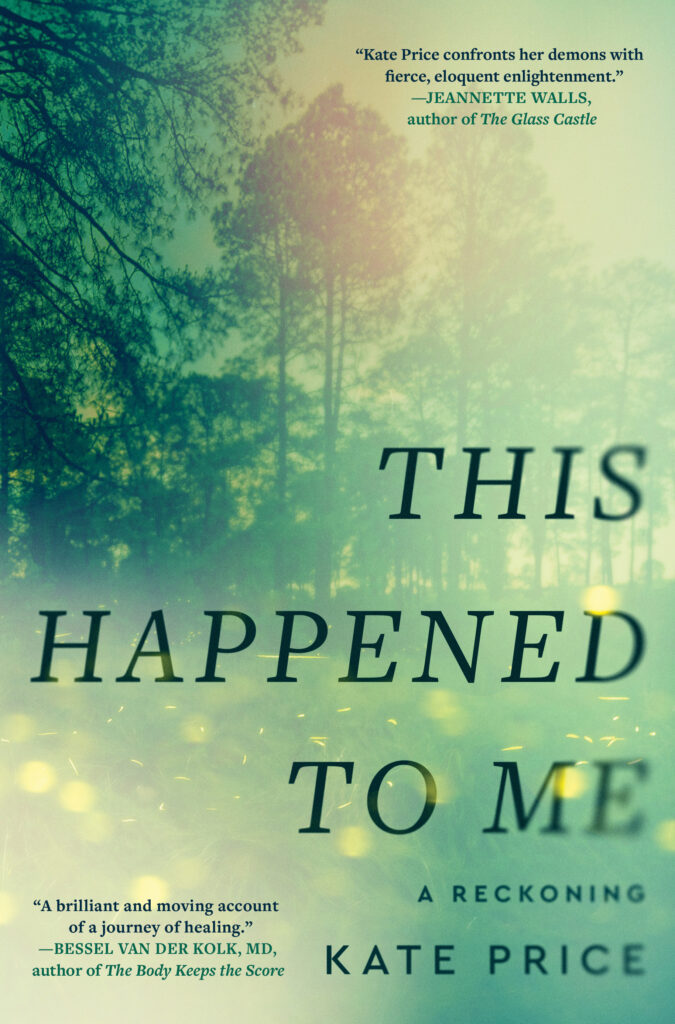
This Happened to Me (2025)
Select Sections to Print
×Book Details
This Happened to Me (2025)
Jump to Section
⚠️ Trigger Warnings
- Child sexual abuse
- Incest
- Rape
- Child sex trafficking / sexual exploitation
- Child sexual abuse material (CSAM) / child pornography
- Grooming and psychological manipulation
- Forced drugging / sedation
- Physical child abuse
- Domestic violence
- Choking / strangulation
- Branding / cutting with a knife
- Parental neglect / failure to protect
- Suicide attempt
- Suicidal ideation
- Family history of suicide
- Alcoholism
- Drug abuse / substance abuse
- Poverty
- Hunger / food insecurity
- Parental abandonment
- Terminal cancer
- Medical trauma
- Death of a parent
- Grief and bereavement
- Infertility and infertility treatments
⏱️ 2-Minute Spoiler Summary
Kate Price grows up with her older sister, Sissy, in an Appalachian mill town where their family survives by keeping secrets. Their alcoholic Father is brutally violent toward his wife and daughters, while their Mother encourages Kate to use education as her escape from poverty. What Kate cannot fully understand as a child is that her father is also trafficking her, taking her to truckers at I-80 rest areas and allowing local men to abuse her in the family garage. He drugs her to make her easier to exploit, and Kate copes by mentally shutting down, “playing possum,” and escaping into books and the safety of the local library.
Her childhood contains a few sources of comfort, including her wild best friend Jess and her neighbor Vida, who takes her to church. But home becomes even more unstable when her father leaves the family for a younger woman. Kate, Sissy, and their mother are plunged into severe poverty, and Kate continues experiencing sexual violence when her first serious boyfriend, Nick, rapes her. At fifteen, overwhelmed by everything she has endured, Kate attempts suicide. Her friend Page keeps her on the phone until help arrives.
Education finally gives Kate the escape her mother always promised. She attends the Philadelphia College of Textiles and Science, studies in India, and travels with the Audubon Expedition Institute. In India, Scott and Aditi recognize that Kate is a survivor and help her understand some of the fear she carries. Still, relationships remain difficult. Her romance with Aiden ends after his infidelity, while Kate’s tendency to physically freeze during intimacy reveals how deeply her childhood trauma still affects her.
When her mother develops terminal stomach cancer, Kate returns to Pennsylvania and helps care for her with Sissy and her mother’s boyfriend, Gerry. After her mother’s death, Kate eventually settles in Cambridge, Massachusetts, working at Harvard and Radcliffe. Her friendship with Maureen gives her something she has rarely experienced: a person with whom she can discuss her past without feeling ashamed.
Therapy finally allows Kate to confront what happened to her. With therapist Natalie and trauma specialist Dr. Bessel van der Kolk, she undergoes EMDR and recovers suppressed memories of being trafficked by her father. She later marries supportive journalist Christopher, they adopt their son N, and Kate earns a PhD in sociology while focusing professionally on child sexual exploitation.
Determined to prove what happened, Kate spends a decade investigating her childhood with journalist Janelle Nanos. She also reconciles with Sissy, who reveals that their father trafficked her too. The investigation eventually produces its most devastating confirmation when family friend Gloria Davis reveals that Kate’s mother actually knew about the trafficking and had overheard their father selling his daughters over a CB radio.
Kate and Janelle ultimately publish the investigation in Boston Globe Magazine. On Easter Sunday 2025, Kate learns that her father has died alone in a nursing home, finally ending the fear that he could return to threaten her. Rather than permanently abandoning the Appalachian community associated with so much pain, Kate decides to reclaim it. She plans to open Mill Girl Books in her hometown, transforming the place she once needed to escape into a place of safety, community, and truth.
📖 Full Spoiler Summary
Growing Up in a Family of Secrets
Kate Price grows up with her older sister, Sissy, in an Appalachian mill town where silence is practically a family inheritance. Their childhood home is a former funeral home, an unsettling setting for a family already filled with violence and secrets. Their alcoholic Father terrorizes the household, brutally beating his daughters and their Mother, while everyone learns to survive by keeping what happens inside the family hidden from outsiders.
Kate’s mother seems powerless against her husband, but she does give Kate one important message: education can be her way out. She encourages her daughter to succeed academically, treating school as a “passport” that might eventually carry her beyond poverty and the life she has inherited.
Books become Kate’s refuge long before she can actually leave. The local library feels sacred because it offers something her home never does: safety. Reading allows her to temporarily escape her family and the sense that something about her has been permanently stained.
There are also people who bring moments of normalcy into her childhood. Her “feral” friend Jess gives her opportunities to be a kid rather than a victim, while her neighbor Vida takes her to church every Sunday. Those relationships provide small pockets of stability, but they cannot protect Kate from what is happening behind closed doors.
Kate’s Father Traffics Her
The darkest secret of Kate’s childhood is one she cannot fully process while it is happening: her father is sexually trafficking her.
He takes her to truckers at rest areas along I-80 and also allows local men to abuse her in the family’s garage. To make her easier to control, he sometimes uses needles to inject her with drugs. At other times, he forces her to drink a strange “shimmering bluish green” liquid that leaves her docile or unconscious.
Kate learns to survive these experiences by mentally disappearing. She “plays possum,” shutting herself down as much as possible while the abuse happens to her. The fragmented nature of these experiences means that she will spend years without fully understanding or remembering the extent of what her father did.
Life at home eventually changes when her father abandons the family for a younger woman who becomes The Stepmother. His departure removes his constant physical presence, but it does not suddenly make life safe or easy. Instead, Kate, Sissy, and their mother are left in extreme poverty. Hunger becomes part of their daily existence, adding another form of instability to a childhood already dominated by violence.
Nor does sexual violence end when Kate’s father leaves. Her first serious boyfriend, Nick, rapes her in his trailer. The assault recreates the same helpless collapse she experienced with her father, reinforcing how little control Kate feels she has over her own body.
By fifteen, the accumulated trauma becomes unbearable. Kate attempts suicide by swallowing pills. Her best friend Page stays on the phone with her until help arrives, preventing the attempt from becoming fatal.
Education Becomes Kate’s Escape
Despite everything happening around her, Kate manages to graduate and follow the path her mother always encouraged. She leaves home to attend the Philadelphia College of Textiles and Science, finally putting physical distance between herself and the Appalachian world in which she grew up.
Leaving, however, does not mean leaving the trauma behind.
Kate’s early adulthood becomes a kind of exile as she searches for a life far removed from her childhood. She studies in India and later travels across the country with the Audubon Expedition Institute. During her time in India, group leaders Scott and Aditi recognize something in Kate that she has struggled to name herself. They understand that she is a survivor and help her begin confronting the fear that still lives in her body.
Her romantic relationships reveal how much work remains. She dates a world traveler named Aiden, but the relationship ends after his infidelity. More troublingly, Kate realizes that intimacy can cause her body to freeze even when she consciously wants to participate. She may have escaped her father’s house, but her body’s reactions continue to reflect what happened there.
Returning Home for Her Mother
Kate is eventually pulled back toward Pennsylvania when her mother is diagnosed with terminal stomach cancer.
She returns to help care for her alongside Sissy and her mother’s dependable boyfriend, Gerry. The return forces Kate back into the family world she worked so hard to escape, but this time she is there as an adult trying to care for her dying mother.
After her mother’s death, Kate builds a new life in Cambridge, Massachusetts, where she works at Harvard and Radcliffe. There she develops an especially important friendship with Maureen, whom Kate considers her “soul sister.” Maureen becomes the first person with whom Kate feels able to discuss her past openly without being consumed by shame.
That ability to speak about what happened becomes crucial as Kate finally begins confronting the missing and fragmented pieces of her childhood.
Recovering the Memories of the Truckers
With the guidance of her therapist Natalie, Kate begins working with trauma specialist Dr. Bessel van der Kolk. Through EMDR, she starts recovering memories that had remained buried or disconnected for years.
Those memories reveal the larger reality of what her father did.
Kate comes to understand that the frightening fragments involving truckers, rest areas, drugs, and men in the garage were part of organized sexual exploitation. Her father was not simply abusing her himself. He was selling access to her.
Recognizing what happened also changes the way Kate understands herself. Instead of carrying responsibility and shame for experiences she could never control, she begins accepting that she was a child being exploited by adults.
Her personal life gradually becomes more stable as well. She meets Christopher, a supportive journalist who encourages rather than silences her desire to investigate her past. They marry and adopt their son, N. Kate also earns her PhD in sociology and directs her professional attention toward child sexual exploitation, turning the subject that shaped her childhood into an area of serious academic work.
Yet understanding her memories is not enough. Kate wants evidence.
The Decade-Long Investigation
Kate eventually joins journalist Janelle Nanos in a painstaking investigation into what happened during her childhood. The process stretches across roughly a decade as they try to determine whether Kate’s recovered memories can be independently confirmed.
At the same time, Kate begins rebuilding her relationship with Sissy. Their father had helped create distance between the sisters when they were young, but as adults they are finally able to compare what each of them experienced.
That reconciliation brings another devastating revelation: Sissy was also trafficked by their father.
For Kate, her sister’s disclosure provides deeply personal confirmation that the exploitation was not something she imagined or misunderstood. Their father had victimized both daughters, and the sisters had spent years carrying different pieces of the same family secret.
The investigation eventually uncovers an even more disturbing piece of information involving their mother.
For much of Kate’s life, her mother had occupied a complicated position in her memories. She had failed to protect her daughters, but she had also encouraged Kate’s education and helped give her the idea that escape was possible. Kate could believe that her mother simply did not understand the full extent of what her husband was doing.
Then longtime family friend Gloria Davis provides the “smoking gun.”
Gloria reveals that Kate’s mother knew about the trafficking. She had overheard Kate’s father on a CB radio selling his daughters to other men.
The revelation fundamentally changes what Kate knows about her childhood. The trafficking was no longer merely something that happened beyond her mother’s awareness. Her mother had information about what her husband was doing and still failed to stop it.
Publishing the Truth and Returning Home
After years of investigation, Kate and Janelle’s work culminates in the publication of a major article in Boston Globe Magazine. The secrets that defined Kate’s childhood are finally brought into public view.
Then, on Easter Sunday 2025, Kate receives news about the man who caused so much of the suffering she has spent her adult life trying to understand.
Her father has died alone in a nursing home.
For Kate, his death means that the threat he represented is finally gone. She no longer has to fear that he might come looking for her or somehow reenter her life. The man whose violence shaped so much of her childhood can no longer reach her.
But Kate’s story does not end with her simply escaping Appalachia forever.
After spending much of her life trying to put distance between herself and her hometown, she begins reclaiming her connection to the place. She plans to open a bookstore there called Mill Girl Books, creating the kind of refuge that books and libraries once provided for her.
The hometown that represented poverty, secrecy, violence, and the desperate need to escape becomes somewhere Kate can return on her own terms. Instead of allowing her father and her family’s secrets to define her relationship with the place where she grew up, she intends to build something new there: a bookstore centered on community, books, and truth.
🔚 Ending Explained
How This Happened to Me: A Reckoning Ends
This Happened to Me: A Reckoning ends not simply with Kate Price surviving her past, but with her finally reclaiming it. After a decade spent investigating the childhood trafficking she endured, Kate reaches the validation she has been searching for: proof that what happened to her was real, that others knew, and that the silence surrounding her childhood was never evidence that she had imagined any of it.
Working with journalist Janelle Nanos, Kate finally uncovers what amounts to a smoking gun. Family friend Gloria Davis reveals that Kate’s mother knew about the trafficking and had even overheard Kate’s father using a CB radio to sell his daughters.
The revelation is devastating because it confirms not only her father’s crimes, but her mother’s awareness of them. Yet it also provides something Kate has desperately needed: corroboration.
The investigation also changes Kate’s relationship with her sister, Sissy. Sissy comes to understand that she, too, was a victim of the same exploitation. Instead of leaving the sisters isolated inside their individual memories, the truth finally gives them a shared understanding of what happened to them and allows them to reconcile.
Kate ultimately publishes her story in The Boston Globe Magazine, bringing into public view the abuse and trafficking that had been hidden within her family for decades. What was once a family secret becomes part of the public record.
Then, on Easter Sunday 2025, Kate’s father dies alone in a nursing home.
His death provides a final kind of release. For much of Kate’s life, even after she had physically escaped him, some part of her remained afraid that he could find her—that she could still be hunted. With his death, that fear finally disappears. The man who dominated her childhood no longer has any power over her future.
By the memoir’s conclusion, Kate has also transformed the very experiences intended to destroy her into the foundation of her professional life. She earns her PhD, becomes an internationally recognized expert on child sexual exploitation, influences national policy, and trains law enforcement and advocates to recognize the kinds of crimes that remained invisible during her own childhood.
But perhaps the most meaningful choice she makes is also the simplest: she goes home.
Rather than remaining in New England, Kate decides to return to Appalachia. Her mother had wanted her to stay away, but Kate rejects permanent exile. Instead, she embraces the womanist idea of “standing in”—remaining in the place where harm occurred and refusing to surrender it to the people who caused that harm.
She plans to open Mill Girl Books, a bookstore named in honor of her mother and grandmothers, all of whom worked in factories. Kate and Sissy also purchase a memorial bench for their mother at the local fairgrounds, choosing to remember her in a place associated with happiness rather than allowing their mother’s legacy to consist entirely of what she failed to do.
The memoir therefore ends with Kate where she once believed she could never safely be: home.
What the Ending Means
The ending is ultimately about reclamation rather than escape.
For years, survival meant getting away—from her father, from her childhood, from Appalachia, and from the silence surrounding what happened to her. By the end of the memoir, Kate no longer needs distance to feel safe. She can return because the place itself does not belong to her father or to the people who remained silent. It belongs to her, too.
That makes Mill Girl Books especially significant. A bookstore represents knowledge, language, education, and stories—the very things that counter secrecy. Naming it after the working-class women in her family also allows Kate to hold complicated truths simultaneously. Her mother failed catastrophically to protect her, but Kate does not reduce her mother to that failure. She incorporates both her formal education and the working-class resilience she inherited from the women who came before her.
The memorial bench performs a similar function. Kate and Sissy do not erase what their mother knew or excuse her failure to intervene. Instead, they choose where and how she will be remembered. Placing the bench at the fairgrounds, somewhere connected to happiness, becomes an act of peace. Forgiveness here does not require pretending the betrayal never occurred.
Her father’s death works very differently. There is no reconciliation with him. His death symbolizes the end of his ability to occupy Kate’s future. The freedom she experiences is not sentimental grief but the realization that she can finally stop waiting for the danger to return.
The ending also completes one of the memoir’s central ideas: the importance of being believed. Kate spent years trying to establish the truth of memories that existed inside a family culture built around secrecy. Finding corroboration does not make the abuse real—it was always real—but it frees Kate from having to carry the truth entirely by herself.
That is why publishing her story becomes so important. The family’s defining rule was silence. Kate breaks that rule publicly. What might be considered a betrayal within a system built on patriarchy and secrecy becomes, for the survivor, an act of salvation.
There is also a powerful reversal in Kate’s decision to “stand in.” As a child, she was trapped in Appalachia and powerless to protect herself. As an adult, she chooses Appalachia. Returning voluntarily transforms the meaning of the place. She is no longer the frightened child trying to get out; she is an adult deliberately coming back with the knowledge and authority to help prevent other children from being abandoned in the same way.
Most importantly, Kate refuses to replicate what was handed down to her. The violence that traveled through generations of her family reaches her—and stops. She raises her son, N, differently and expands that commitment outward through her advocacy for other children.
So despite the horrific experiences that precede it, the memoir does not end in despair. Its final tone is remarkably victorious. Kate has moved from secrecy to testimony, from disbelief to validation, from exile to homecoming, and from being a child whom adults failed to protect to becoming an adult devoted to protecting children.
Her father dies alone. His secrets do not survive him.
Kate does.
And the final victory is that survival is no longer the whole story. By the end, she can define herself not by what was done to her, but by what she chooses to build afterward: a family, a calling, a community, and a home.
She ends the memoir safe, loved, and home.
👤 Characters & Fates
🔶 Main Characters

She earns her PhD, publishes her reckoning in the Boston Globe, learns her mother knew about the trafficking, reconciles with Sissy, and returns home to pursue her dream of opening Mill Girl Books and advocating for exploited children.
She earns an MBA and receives a major professional promotion, while the sisters finally repair their relationship through the devastating discovery that both were victims of their father’s exploitation.
He vehemently denies Kate’s accusations, claiming they are “95 million percent not true,” and ultimately dies alone in a Midwest nursing home on Easter Sunday 2025, finally freeing Kate from the fear that he could come after her.
She dies of stomach cancer at forty-eight after surviving longer than doctors initially predicted, leaving Kate to discover the full extent of her knowledge only years later.
He becomes an editor and writer for the Boston Globe, builds a safe family with Kate and their adopted son N, and is the person who discovers that Kate’s father has finally died.
He grows up in a loving home and becomes so furious about what his grandfather did to Kate that he refuses to read her published article.
Her work on Kate’s story earns major recognition, including becoming a Pulitzer Prize finalist and receiving awards for her sensitive reporting on trauma.
He later publishes the bestselling The Body Keeps the Score, incorporating Kate’s experiences as an important case study while Kate continues building a life beyond her trauma.
🔷 Supporting Characters
Decades after remaining silent, she reconnects with Kate and finally reveals what she knows, confirming one of the memoir’s most devastating truths.
He remains in the community and reconnects with Kate at the town fair during her investigation.
She becomes an executive chef and remains one of Kate’s closest and most trusted confidantes.
She reconnects with Kate in adulthood and supports her unconditionally while Kate investigates and exposes her past.
She remains a close friend, helps Kate face her hometown triggers, and assists with organizing Kate’s PhD celebration.
After Kate’s article is published, she meets Kate and Sissy for lunch and grieves that she never understood what the girls were enduring.
He dies before Kate and Janelle complete their investigation into the trafficking.
He dies after disinheriting Kate, with his first wife Dorothy’s hope chest eventually going to Sissy.
She leaves him for another man, prompting his suicide attempt, and later returns to Appalachia but refuses to provide meaningful answers about his past.
Their relationship ends after his infidelity, and he eventually moves back to Atlanta and disappears from Kate’s life.
After discovering his cheating, Kate finds the strength to throw him out of their Boston apartment and moves forward without him.
She eventually returns to her family farm in Appalachia and remains one of Kate’s close “peeps.”
After Kate’s article appears, Zooey admits she initially thought Kate’s recollections might be “false memories” and had not believed her.
After learning the truth about Kate’s trafficking, she stops sending Kate the Christmas cards she had previously sent for years.
He eventually fades from Kate’s life, although his mother later provides testimony about Kate’s father’s character.
Kate later discovers that “chicken plucker” was trucker slang for a pedophile, giving the childhood name a horrifying new meaning.
She reconnects with Kate as an adult, expresses her support, and tells Kate that she is praying for her.
She becomes an important early figure in the chain of treatment that allows Kate to survive and eventually confront her trauma.
She ultimately offers to sell her bookshop to Kate, opening the possibility for Kate to fulfill her dream of creating Mill Girl Books.
He assists the investigation by supplying historical information that helps Kate piece together what happened decades earlier.
When investigators approach him, he refuses to cooperate and threatens to call the police rather than discuss the past.
She remains an unhappy neighborhood figure for a time before disappearing from Kate’s story without a clearly established fate.
She dies in the living room of Kate’s childhood home when Kate is five years old.
She dies at only forty from a burst ovarian cyst, after which her husband rapidly removes traces of her from the family’s life.
🕳️ Potential Plot Holes
The Price family lived extremely close to neighbors such as Vida and Gloria, yet those neighbors later maintained that they had not witnessed obvious evidence of what was happening inside the home beyond rough language and troubling behavior. Considering the severity and duration of the abuse, readers may wonder how so much could remain hidden at such close range. The memoir presents this not as a literal geographical impossibility but as part of the community’s culture of silence. Abuse could remain effectively invisible when family privacy was fiercely protected and people were conditioned not to interfere in what happened inside another household.
📚 Book Club Q&A's
⭐ Final Rating & Thoughts
What made This Happened to Me so powerful for me wasn’t simply the horror of what Kate Price survived—it was what she did with that survival. This is an incredibly difficult memoir to read, particularly because the abuse is so extreme that it can almost feel impossible to comprehend. Knowing that these events actually happened makes it absolutely devastating.
But this isn’t a book that wallows in trauma. I was fascinated by the investigative element and by Kate’s determination to understand and substantiate her own history rather than simply recount it. That gave the memoir an almost journalistic quality that made it especially compelling.
More than anything, though, I came away in awe of Kate. After everything she endured, she managed to build a life, pursue an education and career, create a family, and ultimately reclaim the story that had been taken from her. There are moments of humor and warmth among the darkness, which kept the book from becoming emotionally unbearable.
It’s heartbreaking, infuriating, fascinating, and ultimately remarkably hopeful. This is easily one of the most powerful memoirs I’ve read.
✨ Adaptation description
Adaptation Status
As of November 2026, no film or television adaptation has been announced for Kate Price’s memoir This Happened to Me: A Reckoning.
The book follows Price’s experiences growing up in northern Appalachia, surviving childhood abuse and sex trafficking by her father, and later confronting fragmented memories of that trauma. Working with trauma specialist Bessel van der Kolk, Price began reconstructing her past and ultimately undertook a decade-long investigation with journalist Janelle Nanos seeking corroboration of what happened to her. The memoir also follows her later work as a researcher and advocate addressing child sexual exploitation and trafficking. Kate Price PhD
✨ Books Like This Happened to Me (2025)
See an error on this page?