
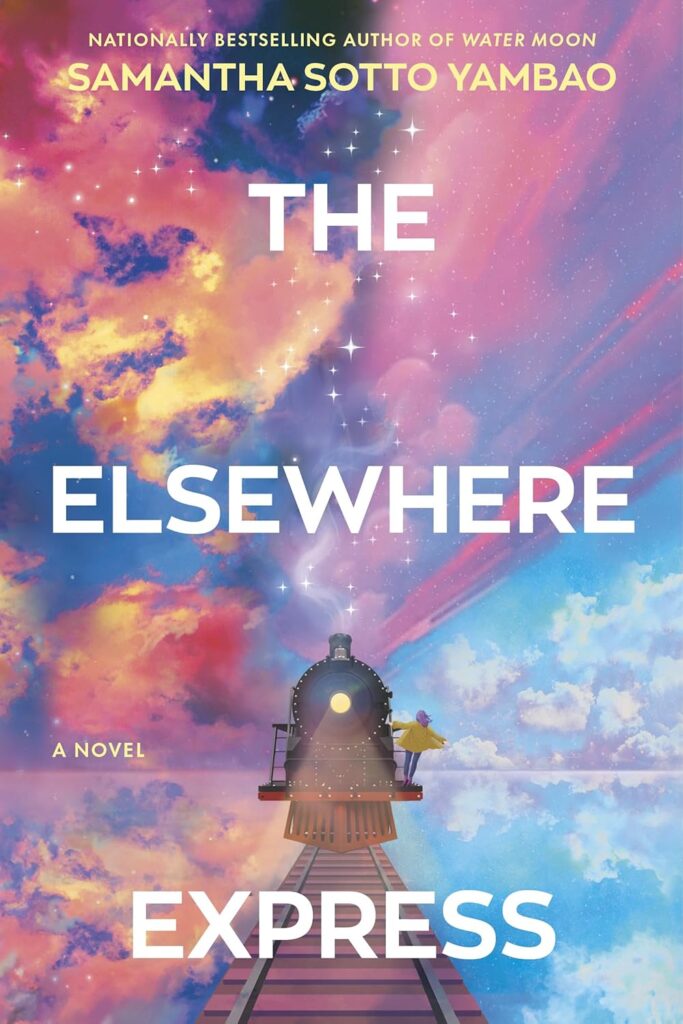
The Elsewhere Express (2026)
Select Sections to Print
×Book Details
The Elsewhere Express (2026)
Jump to Section
⚠️ Trigger Warnings
- Suicide
- Suicidal ideation
- Parental suicide
- Grief and bereavement
- Death of a parent
- Death of a sibling
- Survivor’s guilt
- Replacement child / savior sibling themes
- Fatal motor vehicle accident
- Drunk driving
- Brain death
- Medical trauma
- Hospital and ICU settings
- Life support
- Cadaver dissection
- Human remains
- Progressive disability
- Degenerative illness
- Vision loss and blindness
- Depression
- Parental depression
- Family trauma
- Emotional neglect / emotional numbness
⏱️ 2-Minute Spoiler Summary
Ten years after the death of her older brother Jace, medical student Hiraya “Raya” Sia is still carrying enormous guilt and grief. Jace had been chronically ill, and Raya grew up knowing she had been conceived partly to serve as his bone marrow donor. But his illness wasn’t what ultimately killed him—he was struck by a drunk driver. Raya has never really moved past losing him.
At the same time, young painter Joaquin “Q” Chen Philips is rapidly losing his sight to a degenerative condition. Already traumatized by his father Quentin Sr., who died by suicide when Q was thirteen, Q reaches a subway platform intending to jump in front of a train. He changes his mind at the last moment, but both he and Raya somehow end up aboard the Elsewhere Express, a magical train built from human dreams, thoughts, and unrealized desires.
The train operates outside normal time. Its conductor, Lily, gives Raya and Q glowing eternal-knot tattoos that serve as their tickets and tells them they must find their personal compartments. If they become too weighed down by grief and doubt, their knots can unravel and they can fall from the train as “Echoes.”
Instead of finding their compartments, Raya and Q explore the train’s bizarre collection of worlds. They swim through watercolor paintings, visit impossible landscapes, and meet members of the train’s crew, including former conductor Rasmus, pharmacist Mr. Goh, chef Olly, photographer Dev, artist Astrid, and archivist Han. As Raya and Q grow closer, Q admits that he had planned to die, while Raya reveals how deeply Jace’s death and her childhood role as his potential donor still define her.
But something is wrong with the Elsewhere Express. Rain has begun falling inside the train, signaling that doubt and unresolved grief are literally rotting it. A creature called the Stowaway is moving through the cars and causing them to decay. Lily and Rasmus recruit Raya and Q to help find it.
The Archive binds Raya and Q together with a magical golden tether that allows them to feel each other’s emotions. Their hunt takes them through Raya’s memories, including the night Jace died, before the Stowaway attacks them. Eventually they reach the train’s Engine and trap the creature with Abbie, a mechanical spider archivist.
When the Stowaway reveals its face, Raya sees Jace.
She becomes convinced that her brother is somehow trapped aboard the train, but Q realizes the creature is using Raya’s guilt against her. Raya refuses to let it be destroyed and instead releases it, creating an even greater crisis.
Eventually Raya and Q discover that the train has assigned them the same compartment, even though its rules allow only one passenger per room. Their compartment transforms into Jace’s hospital room, where they finally uncover the truth.
Lily is actually a future version of Raya.
Raya and Q have boarded the Elsewhere Express over and over through multiple time loops. In previous cycles, they repeatedly fell in love, reached the same impossible choice, and Q sacrificed himself so Raya could remain aboard. Raya eventually became Lily, drank one of Mr. Goh’s memory-erasing tonics, and forgot her former life. The Stowaway was created from the grief and guilt she tried to erase instead of confronting.
As the creature threatens to destroy the train, Q realizes what must happen. He touches the Stowaway and sees the memories of their previous cycles. Then, rather than jumping from the train because he wants to die, he deliberately leaps into the darkness to reset the timeline and give Raya another chance to live.
Raya refuses to repeat her future self’s mistakes. Lily finally accepts the truth as well, removes her conductor’s cap to reveal her lavender hair, and jumps from the train into the ocean. Raya briefly becomes conductor but refuses the memory-erasing tonic. She chooses to keep her memories of Jace, Q, and everything that happened.
Then she leaves the Elsewhere Express.
Back in the real world, Raya discovers that the timeline has changed. Q survived. Six weeks earlier, he returned to the subway platform and chose life.
Although Q eventually loses his physical sight, he uses the vision he has left to create HERE, a massive multisensory art installation inspired by the Elsewhere Express. Raya visits the exhibition and finds a recorded message from Q thanking her for guiding him through the darkness and asking her to live fully.
Raya leaves Jace’s purple song notebook behind as a contribution to Q’s art and walks toward “The Station.”
There, Q is waiting for her.
He can no longer see Raya, but he recognizes her through her scent and touch. This time there is no magical train, no shared compartment, and no rule forcing one of them to sacrifice themselves for the other. Raya and Q choose each other freely and walk away from the station together.
📖 Full Spoiler Summary
Raya and Q Board the Elsewhere Express
Ten years after losing her older brother, Hiraya “Raya” Sia is technically moving forward with her life, but emotionally she remains trapped in the past. She is a medical student who carries her anatomy notes alongside the purple notebook where she once wrote songs for her brother Jace. Jace suffered from a chronic illness, and Raya grew up with the uncomfortable knowledge that she had been conceived partly to serve as a bone marrow donor for him. She describes herself as having been born for “spare parts.”
Yet Jace didn’t die from his illness. He was struck by a drunk driver, leaving Raya with years of grief and guilt she has never resolved.
Elsewhere in the subway system, Joaquin “Q” Chen Philips is facing a different kind of loss. Q is a gifted painter, but a degenerative eye condition is rapidly stealing his sight. His depression is compounded by the death of his father, Quentin Philips Sr., who died by suicide by stepping in front of a train when Q was thirteen.
Now Q stands on a subway platform considering doing the same thing.
He ultimately steps back rather than jumping. But reality has already begun to shift.
After Raya falls asleep on a subway train and Q drifts away from the platform, they find themselves aboard the Elsewhere Express, an impossible train that exists outside normal reality. People do not board it at ordinary stations. Instead, the train gathers people through their sighs, dreams, longings, and wandering thoughts.
They are welcomed by the conductor, Lily, who gives each of them a glowing eternal-knot tattoo on the palm. The knot serves as their ticket and their connection to the train. Lily explains that they need to locate their individual compartments, which will anchor them aboard. If they become overwhelmed by the emotional weight they carry, their knots can unravel and they can become “Echoes” floating outside the train.
Raya and Q have no idea that both of them have heard these rules before.
Exploring an Impossible Train
Instead of immediately finding their compartments, Raya and Q begin exploring.
The Elsewhere Express contains entire worlds inside individual train cars. At the Sky Art Studio, they meet Astrid, a cheerful artist who shows them paintings that can literally be entered. Raya and Q jump into watercolor landscapes and eventually slide down a trail of stardust onto a pink-sand beach, where they encounter Dev, a maintenance worker who photographs passengers with his vintage Leica.
Their wandering brings them closer emotionally as well. While climbing a paper staircase hidden inside a dictionary, Q finally admits that his eyesight is disappearing and that, shortly before arriving on the train, he had been contemplating suicide. Raya responds with her own painful confession about Jace and what it was like growing up believing her purpose was tied to keeping her brother alive.
Their journey eventually brings them to the Dragonfly dining car, where they meet chef Olly and Rasmus, a former conductor who now handles some of the train’s stranger maintenance problems.
Something has gone seriously wrong.
Rain is falling inside the Elsewhere Express.
Because the train is constructed from human thoughts, dreams, and belief, unresolved doubt and grief can physically damage it. The rain is evidence of a spreading rot, and a mysterious creature called the Stowaway is moving through the train as cars begin cracking and decaying.
Lily and Rasmus use a memory-restoring tonic created by the train’s pharmacist, Mr. Goh, hoping to remember what they once knew about fighting the creature. When they discover that Raya and Q still haven’t found their compartments, the pair are recruited to help track the Stowaway.
Raya and Q Hunt the Stowaway
At the Archive, Raya and Q are magically bound by a golden tether connecting their hearts. From that point forward, each can sense the other’s heartbeat, warmth, and emotional state.
Their hunt brings them to the Gallery car, overseen by archivist Han. As the rain grows worse, Raya is pulled into an underwater watercolor world that transforms into her own memories. Q follows her, and the two are forced through moments from Raya’s past, including a memory of fifteen-year-old Raya stealing red lipstick and, far more painfully, the night Jace was killed by a drunk driver while she waited at home.
The Stowaway finally attacks them there.
It appears as a monstrous moth-like creature, and its presence causes the Gallery car itself to begin collapsing. Raya and Q escape aboard a miniature crystal train, only for it to crash through a fissure and send them tumbling into the Missed and Misplaced Department, or MMD—the Elsewhere Express’s enormous lost-and-found realm.
There they encounter another version of Olly.
His existence exposes one of the train’s strangest secrets: because the Elsewhere Express travels backward, forward, and in loops through time, multiple versions of the same people can exist aboard simultaneously. There are several versions of Rasmus and Mr. Goh as well.
More importantly, this Olly reveals what the Echoes really are.
They aren’t mysterious outsiders attacking the train. They are discarded pieces of the passengers themselves—memories removed by Mr. Goh’s memory-erasing tonics and abandoned outside the lives of the people who once carried them.
Raya and Q are beginning to understand that forgetting pain does not necessarily destroy it.
The Stowaway Looks Like Jace
After navigating the enormous MMD, Raya and Q eventually discover the train’s Engine. Unlike a normal engine, it contains no conventional machinery. The Elsewhere Express depends on balance, stillness, and the emotional equilibrium of those aboard it.
There they prepare a trap with Abbie, an eight-eyed mechanical spider archivist whose webs can capture the train’s decay and monsters.
The trap works.
Abbie catches the Stowaway.
Then its moth-like exterior opens, revealing a face Raya knows immediately.
Jace.
Raya is overwhelmed. After ten years of grieving her brother, she becomes convinced that some version of him is trapped aboard the Elsewhere Express and needs her help.
Q sees something different. He believes the creature is shapeshifting and deliberately using Jace’s appearance because it knows Raya’s grief is her greatest vulnerability. He begs her not to trust it.
Raya cannot abandon what looks like her brother.
Instead of allowing the Stowaway to be destroyed, she redirects it using the crystal train and sends it onto another track. Her decision infuriates Rasmus, who restrains her with spider silk while Q prepares another possible trap, using dark brushes made from rice stalks to paint a void capable of containing the creature.
But the Stowaway itself is only part of the mystery.
The larger mystery is Raya and Q.
Lily’s Identity and the Repeating Time Loop
Eventually, Raya and Q reach the central lobby, where receptionist Isla checks their glowing palm tickets and discovers something that supposedly should not be possible.
They have been assigned the same compartment.
The Elsewhere Express operates under a strict rule: one passenger, one compartment, one bond. Raya and Q therefore cannot both remain. One of them must take the compartment while the other leaves the train.
When they unlock the door, the room transforms into the last place Raya would want to see again: Jace’s hospital room on the night he died.
There, using records preserved in Rasmus’s embroidered silk, they finally uncover the truth about the train—and themselves.
This is not Raya and Q’s first journey aboard the Elsewhere Express.
They have done this many times.
The train’s looping relationship with time has allowed them to board repeatedly across different cycles. Again and again, Raya and Q meet, grow close, fall in love, and eventually discover that they have been assigned one compartment.
And again and again, Q sacrifices himself so Raya can stay.
The greatest revelation concerns Lily.
Lily is Raya.
She is an older version of Raya from a previous cycle. After Q sacrificed himself, Raya remained aboard the Elsewhere Express, eventually became its conductor, renamed herself Lily, and drank Mr. Goh’s memory-erasing tonic.
That is why Lily does not initially remember being Raya.
It also explains the Stowaway. The creature is connected to the grief and guilt Lily attempted to erase. Instead of disappearing, those emotions accumulated into something destructive that now threatens the entire train.
The Elsewhere Express has allowed Raya to run from her pain repeatedly, but it has never actually made that pain disappear.
Q Breaks the Cycle
As the Stowaway attacks the compartment and the train continues deteriorating, Lily falls back on the solution that has worked in previous cycles: Q must leave.
Once again, Q approaches the open edge of the train.
But this time is different.
Q reaches directly into the Stowaway’s moth-like chest. Through physical contact with the creature, he experiences its memories and finally understands the full history of the repeating cycles. He sees what has happened to him and Raya over and over and realizes that his leap can reset the timeline.
Earlier, Q stood beside train tracks because he wanted his life to end. Now he chooses to jump for an entirely different reason.
He tells Raya to live.
Then he throws himself from the Elsewhere Express.
After Q disappears, Raya confronts Lily—her own future self. Lily finally removes her conductor’s cap, revealing the lavender hair that confirms who she really is. Faced with everything she has spent cycle after cycle trying to forget, Lily stops running.
She steps from the train and falls into the ocean.
Raya temporarily assumes the role of conductor, but when she is offered Mr. Goh’s memory-erasing tonic, she refuses it. She will not become Lily again. She chooses to remember Q, Jace, and the pain she has spent so long trying to escape.
Using a sake bottle as a doorway, Raya leaves the Elsewhere Express.
Back in the Real World
Raya wakes on the subway with her tote bag and memories intact.
Time has reset to the night she originally boarded the train, but Q’s sacrifice has changed what happened before that moment.
Six weeks earlier, Q returned to the subway platform.
And this time, he chose not to board the Elsewhere Express.
He chose to live.
Q cannot stop the degenerative disease destroying his eyesight, but his experience aboard the train changes what he does with the time he has left. He spends his remaining sight creating an enormous multisensory art installation called HERE, inspired by the Elsewhere Express.
Instead of making art that can only be looked at, Q creates something people can physically enter and experience through sound, smell, texture, and space. The installation recreates pieces of the impossible world he remembers.
Raya eventually visits HERE.
Inside, she discovers a room resembling the compartment she shared with Q. A pair of headphones waits inside a nightstand. When she puts them on, she hears Q’s recorded voice.
He explains that although he could not bring his eyesight back from the Elsewhere Express, he did bring something else home: a new understanding of how to create art that does not depend entirely on sight. He thanks Raya for guiding him through the darkness and leaves her with a simple request:
Live. Breathe. Be.
Raya finally leaves Jace’s purple song notebook on the dresser, allowing something she has carried for years to become part of Q’s creation rather than simply another weight from her past.
Then she walks toward the portion of the exhibition called The Station.
And Q is there.
He has lost his sight, but he doesn’t need to see Raya to know her. He recognizes her through her scent and her touch.
For perhaps the first time in all their cycles together, neither Raya nor Q has to disappear so the other can remain. There is no magical tether forcing them together, no conductor deciding their fate, no single compartment they must fight over, and no train carrying them endlessly through the same choices.
This time, they simply choose each other.
Raya and Q walk away from the station together.
🔚 Ending Explained
How The Elsewhere Express Ends
The ending of The Elsewhere Express is ultimately about choosing “here” over “elsewhere”—accepting an imperfect life, with all its grief and limitations, instead of escaping into a beautiful world where nothing ever has to change.
The climax begins when Q confronts the Stowaway and plunges his hand into the moth-like creature’s chest. In doing so, he absorbs its secrets and finally understands what has been happening across the train’s repeating timelines. He realizes that the cycle can be broken if he jumps from the train and allows time to reset.
So Q makes the sacrifice. He smiles at Raya and throws himself into the darkness.
Rather than dying, Q lands back on the real-world subway platform on the night he originally boarded the Elsewhere Express. This time, however, he deliberately chooses not to get on. He understands that boarding again would perpetuate the cycle and eventually awaken the guilt Lily has tried so desperately to bury. Q walks away from the train—and from the magical eyesight it gave him.
Meanwhile, Lily is forced to confront who she really is. Beneath the conductor persona, she is a future version of Raya who has spent years suppressing her memories and guilt. Lily removes her conductor’s cap, revealing her original lavender hair, and leaves the train through one of the sake-bottle doorways, stepping into the ocean.
Raya temporarily assumes the conductor role, but she refuses Mr. Goh’s memory-erasing tonic. She will not heal by forgetting.
Then another passenger arrives: an earlier version of Raya herself. This Raya possesses a ticket that is also an invitation to an exhibition in the waking world:
HERE: An Exhibit By Q Chen Philips Jr.
That is the proof Raya needs. Q survived.
She creates her own sake-bottle doorway and leaves the Elsewhere Express.
Raya Returns to Reality
Raya awakens aboard the real-world subway with her memories intact.
She still carries the electric-blue upcycled tote containing her medical notes and her late brother Jace’s purple song notebook. The important difference is that the bag no longer feels unbearably heavy.
Her grief has not disappeared. Jace is still dead. Her past has not been erased. Instead, Raya has learned that carrying someone with you is different from allowing their absence to consume your life.
She follows Q’s invitation to his art exhibition.
Q’s “HERE” Exhibition
Q is still blind in the waking world. The magical sight he possessed aboard the Elsewhere Express did not follow him home.
But something more important did.
Q has transformed his memories of the train into an immersive, multisensory art installation. Visitors experience versions of its impossible landscapes through sound, touch, movement, texture, and atmosphere: glowing spheres, pink sand, luminescent fish, mist, and the gossamer bridge.
Instead of mourning the art he can no longer see, Q creates art that does not require sight.
Eventually Raya reaches a recreation of the compartment they shared aboard the train. Inside the nightstand she finds headphones containing a recording from Q.
He explains that although he could not bring his eyesight back with him, the Elsewhere Express gave him another way of creating. He thanks Raya for having been his guide through the darkness and leaves her with words drawn from her own lyrics:
“Live, Hiraya. Breathe. Be.”
Raya then leaves Jace’s purple song notebook on the dresser for Q’s estate. It is a quiet but enormous act of release. The songs no longer need to remain locked away with her grief. Her creative voice can become part of the world, just as Q has allowed his own experiences to become art.
The Final Reunion
Raya emerges onto the museum’s platform installation, appropriately called “THE STATION.”
And Q is there.
He drops his walking stick and reaches for her. He recognizes Raya not by seeing her, but through her voice, warmth, scent, and presence.
Q is carrying a Braille invitation to his own exhibition, completing the parallel between them.
The Elsewhere Express once gave them a literal magical tether connecting them across the train. Now there is no supernatural tether at all.
They simply choose each other.
And together, they walk forward into the waking world.
What the Ending Means
The central contrast is contained in two words:
ELSEWHERE → HERE.
The Elsewhere Express initially seems like salvation. It gives Q sight. It gives Raya distance from her grief. It allows passengers to inhabit impossible worlds created from imagination and desire.
But “Elsewhere” eventually becomes another form of imprisonment.
Nothing truly has to end there, which also means nothing can truly begin. Passengers can erase memories, repeat experiences, and retreat into fantasies rather than accepting the losses that made them want to escape in the first place.
Q’s exhibition being called HERE is therefore the perfect answer to the train.
He chooses reality even though reality means blindness.
Raya chooses reality even though reality means Jace remains dead.
Neither receives the conventional magical ending in which everything broken is repaired. Instead, they discover that a meaningful life does not require becoming whole again in exactly the way you were before.
Q’s Blindness
Q’s decision is especially important because the Elsewhere Express can give him something reality cannot: sight.
Walking away means willingly surrendering that miracle.
Yet Q ultimately discovers that sight was never the only way for him to experience or create beauty. His exhibition converts visual memories into something visitors can touch, hear, walk through, and feel.
His blindness therefore stops functioning solely as something the magical world must “fix.” He builds a new artistic identity around the person he actually is.
That idea culminates in his reunion with Raya. He does not need to see her to know her.
Their relationship has moved beyond the train’s magic.
Raya and the Purple Notebook
Raya’s choice works in parallel.
Mr. Goh offers what grief often makes people wish were possible: forgetting.
Raya rejects it.
Her brother’s notebook remains with her when she returns to reality, but its symbolic weight changes. Earlier, Jace’s memory threatens to define Raya’s entire existence. She was conceived to help save him and has spent much of her life thinking of herself as “spare parts”—someone whose purpose belonged to another person.
Leaving the notebook behind at Q’s exhibition does not mean leaving Jace behind.
It means Raya no longer has to guard her grief as though suffering is the only proof that she loved him.
Her music can become something new.
So can she.
Lily’s Ending
Lily represents the alternative future Raya might have chosen.
She has attempted to survive through control, suppression, repetition, and forgetting. Becoming the conductor allows her to impose order on Elsewhere, but it also traps her inside the very refuge that was supposed to save her.
Her buried guilt does not disappear. It manifests destructively.
When Lily removes the conductor’s cap and reveals the lavender hair beneath it, the symbolism is wonderfully simple: the role falls away, and Raya is still underneath.
Stepping through the doorway into the ocean becomes an act of surrender rather than destruction. Lily finally stops trying to control grief and allows herself to leave.
The Golden Tether and Eternal Knot
The magical tether between Raya and Q initially makes their connection literal. They are physically bound together by the strange rules of the train.
But the novel eventually removes the magic and asks a more meaningful question:
Will they still choose one another when nothing forces them to?
The answer is yes.
That is why their final reunion matters so much. The supernatural tether is gone, yet their connection survives. The “eternal knot” has effectively moved inward: what binds them now is memory, empathy, love, and deliberate choice.
Why the Final Scene Matters
The ending deliberately returns Raya and Q to a train platform, the kind of place that once represented escape, despair, and the temptation to disappear.
But this time, they don’t board.
They walk away from it.
That reversal captures the entire novel.
The book does not argue that grief ends, trauma disappears, disability is magically cured, or love restores everything that has been lost. Instead, it suggests that healing means learning to remain present inside an imperfect life.
That is the significance of Q’s final message:
“Live. Breathe. Be.”
Raya spent much of her life believing she existed for someone else. Q spent much of his believing that losing his sight meant losing the life he wanted. Both were drawn toward Elsewhere because reality seemed unbearable.
By the end, neither needs Elsewhere anymore.
The hopeful future implied for them is therefore not one of magical perfection. It is something much more ordinary: Raya and Q get to discover what their lives can become when they stop trying to escape them.
And that is why the book ends not with another journey aboard the Elsewhere Express, but with the two of them finally choosing to be here.
👤 Characters & Fates
🔶 Main Characters

She discovers Lily is her future self and that Q has repeatedly sacrificed himself to reset time. Raya refuses the memory-erasing tonic, escapes into reality through a sake-bottle doorway, attends Q’s “HERE” exhibition, and reunites with him on the subway platform so they can finally live together outside the loop.
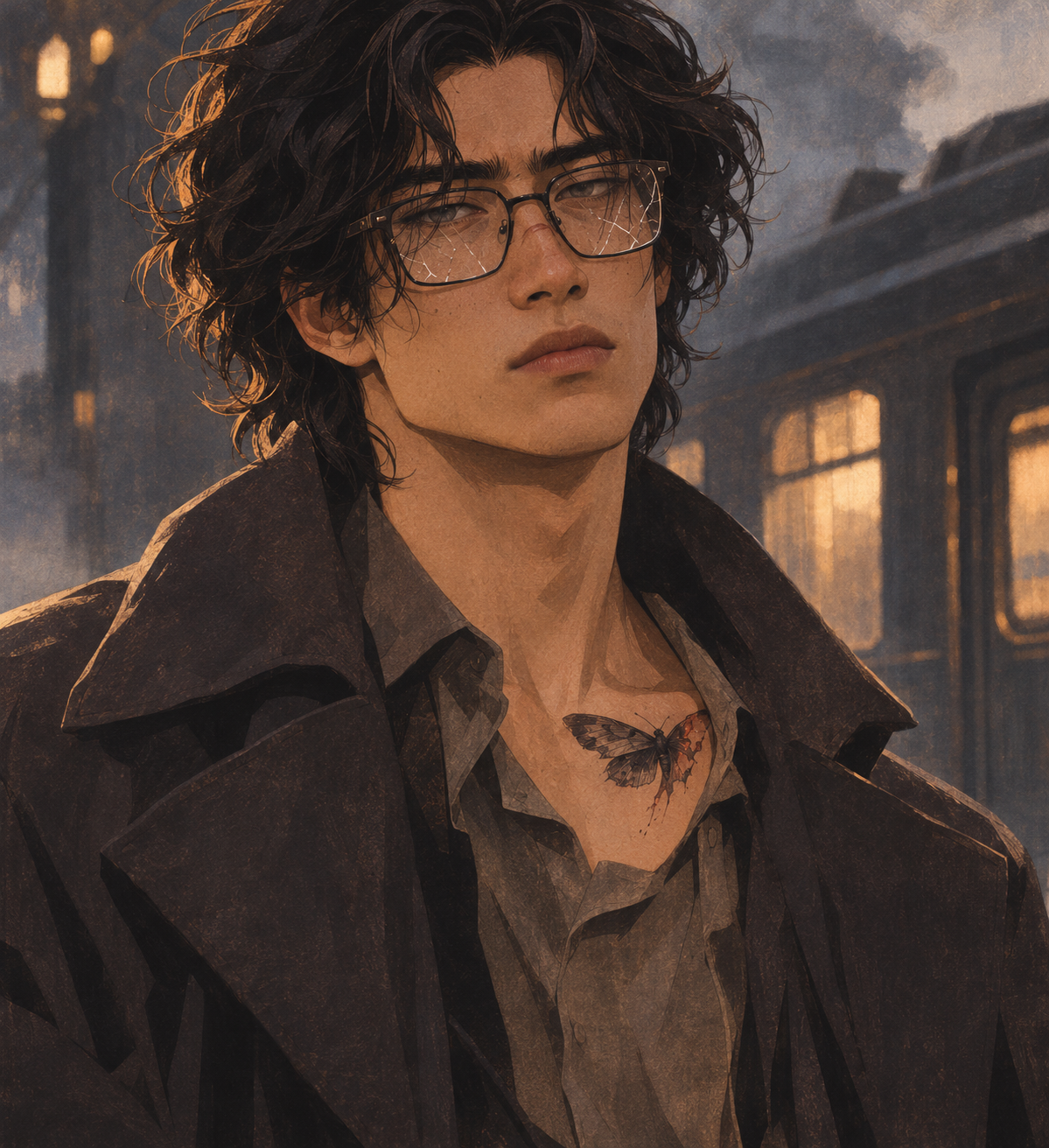
Q realizes jumping into the void can reset the loop and sacrifices himself to save Raya. He awakens six weeks earlier, refuses to board the train, remains blind, creates the multisensory “HERE” exhibition, and eventually reunites with Raya on the station platform.

After Raya forces her to confront the truth, Lily removes her conductor cap, revealing her natural lavender hair, and steps off the train into the ocean rather than continue running from her past; her acceptance helps destroy the Rot.

He survives the Archive collapse with help from magical healing, assists Raya in discovering the history of the loops, and remains aboard the Elsewhere Express performing maintenance and conductor duties after Raya leaves.
🔷 Supporting Characters
He was struck by a drunk driver and died after being placed on life support years before the main story.
He dies by suicide by stepping in front of a train when Q is thirteen.
She died before the story begins, donated her body to medical science, and is dissected by Raya and the other anatomy students.
He continues operating the pharmacy across shifts with duplicate versions of himself so that it never closes.
Chef Olly remains in the Dragonfly kitchen, where cooking keeps him calm, while the other Olly continues existing within the MMD storage realm.
She remains aboard the Elsewhere Express working with the art crew.
He remains aboard the train working in maintenance and mentoring newer crew members.
She remains aboard the train curating the gallery alongside her version of Rasmus.
He continues piloting boats through the Wandering City.
She remains hidden behind her locked door, continuing to create memory-restoring perfumes.
Lily crushes her while she is restraining Raya, but Abbie is later completely restored by a phoenix’s healing fire.
She remains aboard the train working at the central reception desk.
Aki remains aboard the train running the Lotus Lounge.
Both remain in the waking world, with Mustard’s owner unaware that her daydream has physically manifested aboard the Elsewhere Express.
Q traps much of it inside his dark painted void, and it ultimately dissipates when Lily finally confronts and accepts the memories and guilt she has spent so long trying to escape.
🕳️ Potential Plot Holes
As a child, Q dreams repeatedly of a faceless lavender-haired woman and glowing spheres aboard a mysterious train. These visions are eventually revealed to have come from Lily, a future version of Raya who discarded her memories and songs onto the Elsewhere Express. But those dreams help lead Q to the train, where he meets Raya and sets in motion the events that eventually turn her into Lily. This creates a bootstrap paradox: the dreams exist because of events that occur because Q had the dreams in the first place. There is no apparent original source for them. This may be intentional given the train’s nonlinear relationship with time, but the novel never establishes how the loop began.
Leaving the Elsewhere Express does not appear to have one consistent effect. When Q jumps from the train, he returns to the subway platform at the moment before he originally boarded, effectively rewinding his life by six weeks and allowing him to make a different choice. When Raya later leaves through the sake-bottle doorway, she simply returns to the waking world without an equivalent six-week rewind. Different exits may conceivably lead passengers to different points in time because the train exists outside linear time, but the novel never establishes rules explaining why Q’s departure resets his timeline while Raya’s does not.
The Stowaway is ultimately revealed to be connected to Lily’s suppressed guilt over Q’s repeated sacrifices and the destructive cycle she helped perpetuate. The problem is that the story also depicts a Stowaway incident when Lily is relatively new to the train. If the creature originates from guilt produced by later iterations of the Raya/Q loop, its appearance earlier in Lily’s personal history creates another causal paradox. The train’s nonlinear time could theoretically allow the Stowaway to exist before its own cause, but the novel never clearly establishes this as the explanation.
📚 Book Club Q&A's
⭐ Final Rating & Thoughts
There is so much to admire in The Elsewhere Express that I’m almost frustrated I didn’t enjoy it more. Samantha Sotto Yambao’s writing is beautiful, and the train itself is one of the most imaginative settings I’ve encountered in a long time. I loved the premise, the surreal compartments, and the way grief, guilt, memory, and escapism are woven into the world.
Unfortunately, the same creativity that initially enchanted me eventually became the book’s biggest weakness. There was simply too much whimsy, too many magical concepts, and too much dream logic competing for attention. The middle dragged badly for me, and I often felt as though I were wandering through gorgeous scenery while waiting for the actual story to move forward.
I also expected the loss of Q’s eyesight to play a much larger role, so I was disappointed by how quickly that aspect faded into the background. The later twists were clever and ambitious, but by then I felt more intellectually interested than emotionally invested.
A beautiful, wildly imaginative book—just one whose journey exhausted me more than it moved me.
✨ Adaptation description
Screen Adaptation
As of November 2026, no film, television, or animated adaptation has been officially announced for Samantha Sotto Yambao’s 2026 fantasy novel The Elsewhere Express. There is currently no production company, studio, director, screenwriter, cast, or projected release date attached to the book, and no public announcement that the screen rights have been optioned.
The novel was published in January 2026 and follows Hiraya “Raya” Sia and Joaquin “Q” Chen Philips Jr. aboard the mysterious Elsewhere Express, a fantastical train built from human thoughts, dreams, memories, and unrealized possibilities.
Although there is no adaptation in development, the novel has generated considerable reader speculation about its screen potential. Its surreal imagery—including impossible train cars, dreamlike landscapes, floating lights, and environments shaped by memories and imagination—has prompted comparisons to Studio Ghibli, Makoto Shinkai, and Everything Everywhere All at Once. Some readers have specifically suggested that the story could lend itself particularly well to animation or a painterly, watercolor-inspired visual style rather than conventional live action.
For now, however, these comparisons and proposed formats are entirely fan discussion rather than indications of an official adaptation.
✨ Books Like The Elsewhere Express (2026)
See an error on this page?