
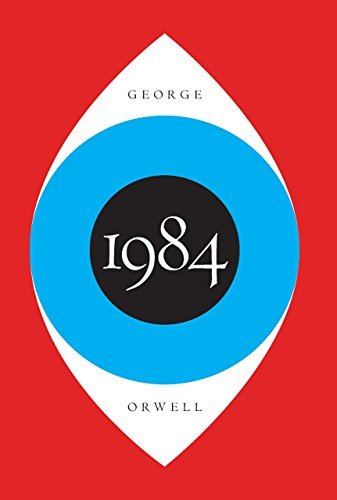
1984 (1949)
Select Sections to Print
×Book Details
1984 (1949)
Jump to Section
⚠️ Trigger Warnings
- Physical torture
- State violence
- Electric shock torture
- Beatings
- Dental torture / teeth extraction
- Rats / severe animal phobia
- Violence against children
- Child death
- War violence
- Bombings
- Public executions / hanging
- Sexual violence
- Rape fantasies / threats
- Murder fantasies
- Psychological abuse
- Psychological manipulation
- Gaslighting
- Brainwashing
- Starvation
- Totalitarianism
- Government surveillance
- Loss of privacy
- Political persecution
- Xenophobia
- Racism
- Family separation
- Parental and sibling loss
- Abandonment
- Suicidal ideation
⏱️ 2-Minute Spoiler Summary
Winston Smith lives under the Party’s totalitarian rule in Oceania, where he secretly rebels by keeping a diary and beginning an illegal relationship with Julia. Believing O’Brien is part of the anti-Party Brotherhood, Winston and Julia agree to join the resistance and receive a book supposedly written by Emmanuel Goldstein explaining how the Party maintains its power.
Their rebellion is actually an elaborate trap. Mr. Charrington, who rented them their supposedly private room, is a Thought Police agent, and O’Brien has been working for the Party all along. Winston is imprisoned in the Ministry of Love, where O’Brien tortures him until he begins accepting the Party’s version of reality.
Winston’s final resistance is his love for Julia, so O’Brien sends him to Room 101 and threatens him with his greatest fear: rats. Terrified, Winston begs O’Brien to torture Julia instead, finally betraying her completely.
After being released, Winston meets Julia again and discovers they both betrayed each other and no longer love one another. Back at the Chestnut Tree Café, Winston hears news of an Oceania military victory and realizes the Party has succeeded in completely remaking him: he loves Big Brother.
📖 Full Spoiler Summary
Winston Smith Begins to Rebel
In the totalitarian superstate of Oceania, Winston Smith lives in Airstrip One, the former Great Britain, where nearly every aspect of life is controlled by the Party. Its supposed leader, Big Brother, stares down from posters everywhere, while telescreens inside homes and workplaces broadcast propaganda and monitor citizens for signs of disloyalty. Even a facial expression can reveal thoughtcrime, because the Party does not merely demand obedience—it wants control over what people believe is true.
Winston works at the Ministry of Truth, despite the ministry’s actual purpose being the falsification of information. His job is to rewrite old newspapers whenever the Party changes its position, ensuring that the historical record always makes the Party appear correct. People who fall from favor are erased so completely that they become “unpersons” who supposedly never existed.
Winston understands exactly what he is doing, and that awareness makes him dangerous. He remembers enough of the past to know that the Party lies, although his own memories have become increasingly difficult to trust. One day he secretly begins writing in a diary he bought from an antique shop. Simply owning and writing in it is a potentially fatal act, but Winston goes even further, eventually writing “DOWN WITH BIG BROTHER.”
His coworkers demonstrate different ways people survive under Party rule. Parsons, Winston’s neighbor, is enthusiastically loyal and proud that his children belong to the Spies, an organization that trains children to watch adults for suspicious behavior. Syme, an intelligent philologist working on the newest edition of the Newspeak dictionary, explains how the Party is systematically eliminating words so that rebellious thoughts will eventually become impossible to express. Winston realizes Syme is far too intelligent and perceptive to survive. Sure enough, Syme eventually disappears and is erased from the records.
Winston also remembers his estranged wife, Katharine, whose devotion to the Party extended into their marriage. She regarded sex as a duty performed only to produce children, and their marriage effectively ended when they failed to conceive.
Winston and Julia Begin Their Affair
At work, Winston repeatedly notices a young woman with dark hair and becomes convinced she is watching him. Her name is Julia, and because she participates enthusiastically in Party organizations like the Junior Anti-Sex League, Winston initially suspects that she might belong to the Thought Police.
Then Julia falls near him in a corridor and secretly slips him a note. Winston opens it expecting a threat or denunciation. Instead, it says that she loves him.
After cautiously arranging a meeting, they escape into the countryside, where Julia leads Winston to a secluded clearing. The landscape resembles the Golden Country Winston has repeatedly seen in his dreams. There, Julia reveals that her outward loyalty to the Party is largely an act. She has had affairs with other Party members and has learned how to appear orthodox while privately breaking the rules.
Their sexual relationship is about more than attraction for Winston. Because the Party attempts to suppress sexual desire and redirect people’s emotional energy toward Big Brother, he sees their affair as an act of rebellion. Julia is less interested in overthrowing the entire political system; she mainly wants to carve out small spaces where she can enjoy herself and ignore its rules.
Eventually, Winston rents a room above the antique shop where he bought his diary. The proprietor, Mr. Charrington, appears to be a harmless elderly widower who shares Winston’s fascination with life before the Party. The room has no visible telescreen, making it seem like an impossible sanctuary.
Winston and Julia begin spending time there together, briefly pretending they have a normal private life. Julia brings forbidden luxuries such as real coffee, sugar, and makeup. Winston buys a glass paperweight containing coral, which comes to symbolize the tiny private world they have created for themselves.
Yet Winston never truly believes they will escape. He repeatedly tells Julia that they are “the dead.” Their only victory, he thinks, is that the Party might control what happens to their bodies without being able to change their feelings for each other.
O’Brien Offers Winston Hope
Winston becomes increasingly fascinated by O’Brien, an intelligent and imposing member of the Inner Party. For years, Winston has felt an unexplained connection to him and has even dreamed of a voice telling him they will meet in “the place where there is no darkness.” He convinces himself that O’Brien secretly opposes the Party and may belong to the mysterious Brotherhood, an underground resistance supposedly led by the Party’s greatest enemy, Emmanuel Goldstein.
When O’Brien finally approaches Winston and gives him his address under the pretense of discussing the Newspeak dictionary, Winston interprets it as the invitation he has been waiting for.
Winston and Julia visit O’Brien’s luxurious apartment, where they are stunned when he switches off his telescreen—an enormous privilege available to members of the Inner Party. In front of his servant Martin, O’Brien confirms everything Winston hoped to hear. He claims to belong to the Brotherhood and asks what Winston and Julia would be willing to do for the resistance.
They agree to commit crimes, sabotage, spread disease, betray their country, and even kill innocent people if necessary. The only thing they refuse is permanently separating from each other.
O’Brien promises Winston a copy of “the book,” supposedly written by Goldstein. Winston later receives it during the chaos surrounding Hate Week, when Oceania’s enemy suddenly changes from Eurasia to Eastasia. The Party instantly announces that Oceania has always been at war with Eastasia, forcing Winston and his coworkers to frantically rewrite years of records proving the opposite.
In the room above Mr. Charrington’s shop, Winston begins reading Goldstein’s book. It explains how the world is divided into three enormous superstates locked in continuous warfare and how permanent war allows the ruling class to consume resources while keeping ordinary people poor and dependent. It also describes the Party’s manipulation of reality through doublethink: the ability to accept contradictory ideas whenever the Party requires it.
For Winston, the book confirms much of what he already suspected. What he still cannot understand is the ultimate reason the Party wants power so completely.
The Thought Police Were Watching All Along
While Winston and Julia are together in their rented room, Winston casually repeats that they are the dead.
A hidden voice answers, “You are the dead.“
A telescreen has been concealed behind a picture on the wall the entire time.
The Thought Police storm the room. The glass paperweight is smashed, destroying the little world Winston and Julia believed they had created. Even worse, Mr. Charrington enters without his elderly disguise. He is not a harmless shopkeeper at all but an agent of the Thought Police who has been watching them.
Winston is taken to the Ministry of Love, where the Party imprisons and tortures its enemies. There he encounters several familiar faces. Ampleforth, a poet who worked altering old literature, has been arrested because he left the word “God” in a poem when he could not find another suitable rhyme.
Then Parsons arrives.
Despite his fanatical loyalty, Parsons has been denounced by his own seven-year-old daughter after she heard him saying “Down with Big Brother” in his sleep. Rather than blaming her, Parsons is proud of her for doing her duty.
Winston also witnesses the guards’ casual brutality. A prisoner named Bumstead tries to give a piece of bread to a starving, skull-faced man and is savagely beaten for it. The prisoners are terrified whenever Room 101 is mentioned, although Winston does not yet understand what happens there.
Then O’Brien enters.
For one brief moment, Winston thinks O’Brien has also been arrested.
He quickly realizes the truth.
O’Brien was never part of the Brotherhood. The entire rebellion was a trap.
O’Brien Breaks Winston’s Mind
O’Brien becomes Winston’s interrogator and torturer, but he does not see himself as simply punishing Winston. He tells him that the Party intends to cure him.
Winston is beaten, interrogated, starved, humiliated, and subjected to increasingly sophisticated psychological torture. O’Brien uses a machine with a dial that can produce excruciating pain while questioning Winston about reality.
When O’Brien holds up four fingers, Winston insists that he sees four.
O’Brien demands that he see five if the Party says there are five.
Eventually, Winston becomes incapable of separating physical reality from whatever O’Brien tells him. The famous idea that “two and two make five” becomes the ultimate test of submission. The Party’s power is not complete if Winston merely says something false to stop the pain. He must actually believe it.
O’Brien finally explains the question Goldstein’s book could not answer: why does the Party want power?
Because power itself is the goal.
The Party is not building a better society or sacrificing the present for some future utopia. It wants permanent control over human beings. If it can control memory, language, history, and perception, then it can effectively control reality itself.
Even after months of torture, however, one piece of Winston remains intact.
He still loves Julia.
He realizes that although he has confessed to countless crimes and said anything O’Brien demanded, he has not emotionally betrayed her. As long as he can still love Julia, some private part of himself remains beyond the Party’s control.
That is why O’Brien sends him to Room 101.
Room 101 and the Final Betrayal
Room 101 contains whatever each prisoner fears most.
For Winston, that is rats.
O’Brien knows about Winston’s overwhelming terror of them and brings out a cage containing starving rats. The cage is designed to be fastened directly to Winston’s face so that, when a mechanism is released, the rats can attack him.
Winston panics completely.
There is only one thing he can imagine that might save him: someone else must take his place.
He screams for O’Brien to do it to Julia instead.
That is the betrayal the Party has been waiting for.
Winston has not merely said Julia’s name under torture or confessed something about her. Faced with his greatest fear, he genuinely wants her to suffer instead of him. The last private loyalty he possessed has been destroyed.
The Party has finally won.
Winston Loves Big Brother
After his release, Winston is physically and psychologically transformed. He spends much of his time alone at the Chestnut Tree Café, drinking Victory Gin and following military news. He has been given an easy, meaningless job and enough money to survive, but there is little left of the man who once secretly wrote against Big Brother.
Eventually, he encounters Julia in a park.
She has changed too. There is a scar on her face, and her body feels different when Winston embraces her. Neither has any real desire for the other anymore.
Julia tells Winston that she betrayed him.
Winston admits that he betrayed her too.
They understand that torture did something more profound than forcing them to speak. When each of them begged for the other person to suffer instead, their feelings actually changed. The love they once believed the Party could never touch is gone.
They separate without any meaningful attempt to see each other again.
Back at the Chestnut Tree Café, Winston listens to reports from the war. When news arrives of a tremendous military victory for Oceania, Winston is swept up in genuine emotion. He imagines himself finally overcoming his long struggle and returning completely to the protection of the Party.
Looking at the enormous face of Big Brother, Winston realizes that the battle inside him is over.
He no longer hates the Party.
He no longer wants to rebel.
He loves Big Brother.
🔚 Ending Explained
How 1984 Ends
George Orwell’s 1984 ends not with Winston Smith’s death, but with something far more devastating: the complete destruction of the person he once was.
After his imprisonment and torture in the Ministry of Love, Winston is released back into society. He spends his days at the Chestnut Tree Café, drinking Victory Gin, following war reports, and idly working through chess problems in the Times. The rebellious Winston who once wrote “DOWN WITH BIG BROTHER” in his diary is gone. He has become passive, physically deteriorated, and almost entirely disconnected from his former self.
At one point, Winston encounters Julia in a park. Their reunion makes clear just how completely the Party has destroyed their relationship. Neither feels genuine affection for the other anymore. Both admit that, under torture, they betrayed the other in the most absolute sense: when confronted with their worst fears in Room 101, each genuinely wanted the punishment transferred to the person they supposedly loved.
Their betrayal matters because Winston and Julia’s relationship had represented one of the last territories the Party could not completely control. Winston once believed that even if the Party forced him to confess, it could never make him stop loving Julia.
He was wrong.
Back at the Chestnut Tree Café, Winston listens to reports from the war in Africa. When news arrives of an enormous Oceania victory, he is overwhelmed with emotion. Looking at the enormous portrait of Big Brother, Winston finally feels genuine love and gratitude toward him.
He realizes that his struggle is finished. He has achieved what the Party wanted all along: victory over his own independent mind.
The novel ends with its devastating final realization:
“He loved Big Brother.”
That sentence is the Party’s true victory.
What the Ending Means
The Chestnut Tree Café
The Chestnut Tree Café is essentially a graveyard for people who have already been psychologically destroyed.
Earlier in the novel, Winston remembers seeing disgraced Party members there before they disappeared. By placing Winston in the same café, Orwell signals that Winston has joined them. Whether he is eventually executed almost becomes irrelevant. The meaningful part of Winston has already died.
The song associated with the café reinforces this:
“Under the spreading chestnut tree
I sold you and you sold me.”
That is exactly what happens to Winston and Julia. Their relationship ends not simply because they confess information about one another, but because the Party forces each of them to choose themselves over the other.
The betrayal destroys the private loyalty that once existed outside Party control.
The Chessboard
Winston repeatedly occupies himself with chess, eventually reflecting that “White always mates.”
The symbolism is brutally simple. In Winston’s new worldview, there can be only one predetermined outcome. The Party always wins.
Even the concept of competition has become meaningless because the result is already decided. Winston’s rebellion was never a contest between two equal forces. He was playing a game in which his opponent controlled the board, the pieces, the rules—and reality itself.
Victory Gin
Victory Gin once disgusted Winston. By the ending, it has become an essential part of his existence.
That change mirrors everything else that has happened to him. The Party has taken something repulsive and taught Winston to depend upon it, just as it has transformed Big Brother from the object of his hatred into the object of his love.
His deteriorating physical appearance also creates a grim irony. The Party claims to have “cured” him, yet he looks ruined.
His body exposes what the Party’s version of salvation actually means.
Why Winston and Julia Betray Each Other
Room 101 is the crucial moment of the novel because O’Brien does not merely want Winston to say that he betrays Julia.
He wants Winston to mean it.
Faced with the rats, Winston screams for the punishment to be inflicted on Julia instead. At that instant, his desire to save himself becomes stronger than his love for her.
Julia undergoes the same process with her own greatest fear.
When they meet afterward, they understand what happened. Something between them has been permanently severed. They may remember loving each other, but that emotional bond no longer exists.
This fulfills one of the Party’s most frightening ambitions: there can be no loyalty stronger than loyalty to Big Brother.
Family, friendship, sexuality, romantic love, memory, and personal identity all represent competing attachments. The Party therefore cannot tolerate them unless they ultimately serve the state.
Winston’s Final Surrender
The most disturbing part of the ending is that Winston does not merely pretend to believe.
Earlier, Winston clings desperately to the idea that objective reality exists. If he knows that two plus two equals four, then there remains some part of reality beyond the Party’s control.
By the end, even that refuge has disappeared.
When a loving childhood memory involving his mother and sister returns to him, Winston dismisses it as a false memory. He has learned to distrust his own mind whenever it contradicts the Party.
That represents the completion of his transformation.
The Party no longer needs a guard standing beside Winston correcting his thoughts.
Winston now does it himself.
That is the ultimate purpose of crimestop and doublethink: power becomes strongest when people automatically prevent themselves from thinking anything that might challenge it.
Why the Party Doesn’t Simply Kill Winston
This is one of the most important ideas in the ending.
The Party could have executed Winston immediately after his arrest. Instead, O’Brien spends enormous amounts of time torturing, educating, and psychologically dismantling him.
That is because killing a rebel leaves something unresolved.
A person can die still believing he was right.
The Party wants something much greater than obedience. It wants control over the internal reality of the individual.
Winston therefore has to be converted before he can be discarded. The Party must make him sincerely accept its reality and genuinely love Big Brother.
His eventual physical death is almost beside the point.
The rebellion has already been erased.
The Final Victory of Big Brother
The ending completes the novel’s argument about totalitarian power.
At the beginning, Winston believes that memory, truth, love, sexuality, and individual consciousness provide small territories the Party cannot completely invade.
One by one, those defenses collapse.
His memories can be rewritten.
His senses can be doubted.
His love for Julia can be destroyed.
His fear can overpower his principles.
Even his hatred of Big Brother can be transformed into love.
That is why “He loved Big Brother” is considerably darker than an ending in which Winston simply dies.
A dead Winston could remain a rebel.
The Winston sitting in the Chestnut Tree Café is something worse: a rebel who has been remade into a believer.
What the Ending Suggests About Oceania’s Future
On the surface, the novel offers almost no hope. O’Brien imagines the future as “a boot stamping on a human face—forever,” and Winston’s fate demonstrates how such a society might perpetuate itself.
The Newspeak appendix makes the implications even more disturbing. Newspeak is designed to steadily reduce the range of expressible thought. Eventually, rebellion would not merely be dangerous—it would become increasingly difficult to conceptualize.
There is, however, a fascinating ambiguity surrounding the appendix. It describes Newspeak largely in the past tense and from a perspective outside the Party’s immediate propaganda. That has led some readers and scholars to interpret it as a subtle suggestion that Oceania and its ideology may eventually have disappeared.
Orwell never confirms that interpretation.
And within Winston’s story, there is no last-minute revolution, hidden victory, or reassuring suggestion that his resistance mattered politically.
The ending belongs entirely to the Party.
The Meaning of the Ending
Ultimately, 1984 ends by asking what remains of a human being when a government gains control not only over what people do, but over what they are capable of believing.
Winston begins the novel believing that his private consciousness belongs to him. He may be watched, frightened, and eventually killed, but somewhere inside himself he can still say that the Party is lying.
The tragedy is that O’Brien proves otherwise.
The Party does not defeat Winston by proving that Big Brother deserves his love. It systematically destroys every emotional and intellectual foundation from which Winston could refuse that love.
That is the horror of the final sentence.
Winston has not simply lost his rebellion.
He has lost the part of himself that could ever rebel again.
👤 Characters & Fates
🔶 Main Characters
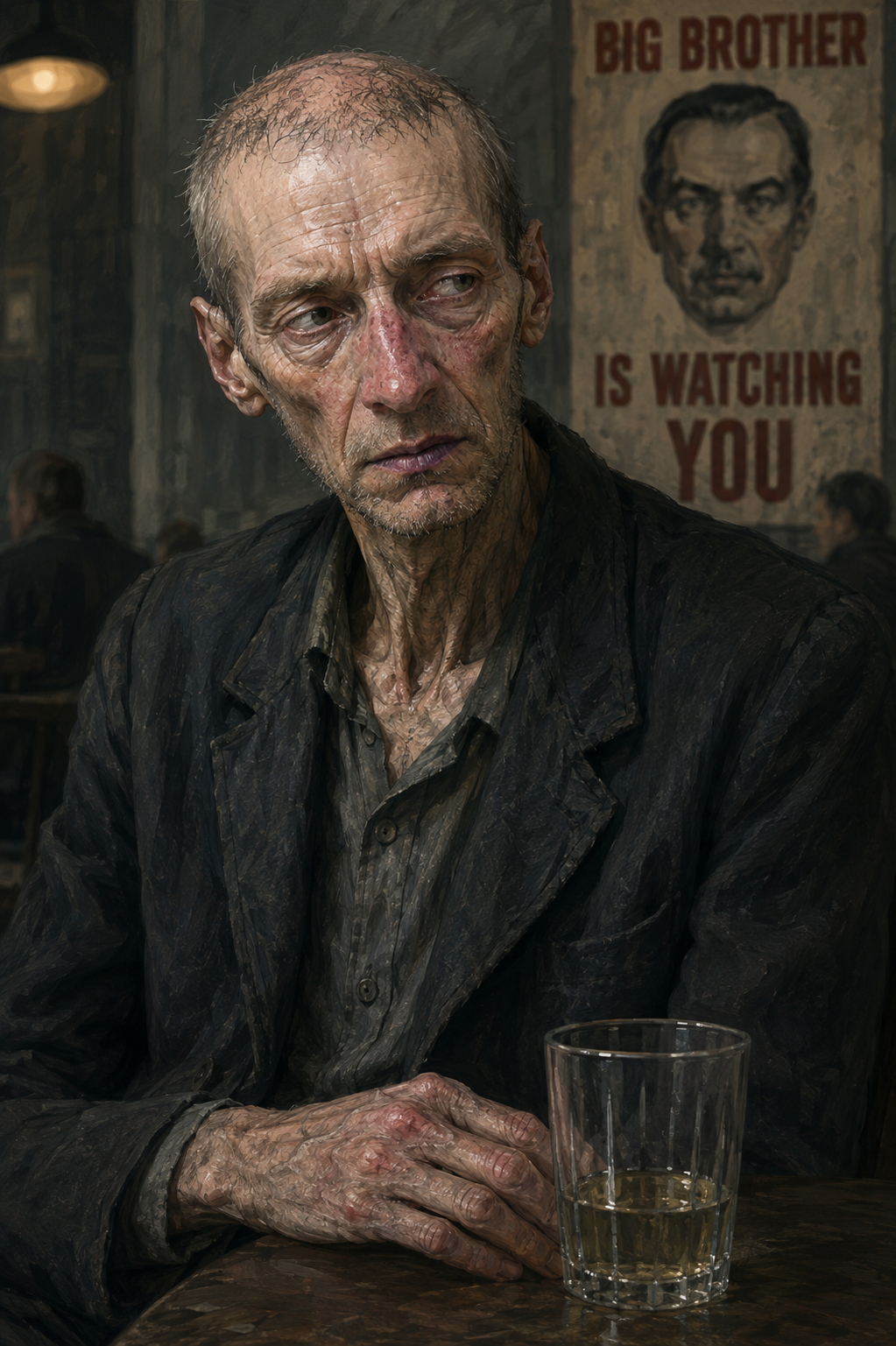
Tortured by O’Brien and finally broken in Room 101, where his terror of rats makes him betray Julia; after his release, he becomes an empty, obedient alcoholic who ultimately realizes that he loves Big Brother.

The Thought Police arrest and torture her until she betrays Winston; when they later meet, both admit their feelings for each other have been destroyed.

He tortures and psychologically dismantles Winston until Winston accepts the Party’s version of reality, betrays Julia, and finally loves Big Brother.
🔷 Supporting Characters

He remains the seemingly eternal face of the Party, and Winston’s final defeat occurs when he genuinely loves Big Brother.
Whether Goldstein or the Brotherhood truly exists is never confirmed; O’Brien claims Goldstein is alive but also reveals that the Party itself helped write his book.
His disguise is exposed when the Thought Police arrest Winston and Julia; the supposedly harmless 63-year-old is revealed as a much younger agent who helped engineer their capture.
Despite his loyalty, he is vaporized and erased from existence because his intelligence and perceptiveness make him dangerous.
His seven-year-old daughter reports him for saying “Down with Big Brother” in his sleep, and he is arrested for thoughtcrime while remaining grateful to the Party for catching him.
Her ultimate fate is unknown, although Winston believes her children will eventually betray her just as their daughter later betrays Parsons.
Their daughter eventually denounces her own father to the Thought Police after hearing him commit thoughtcrime in his sleep.
He is imprisoned in the Ministry of Love because he left the word “God” in a Kipling poem when he could not find another rhyme for “rod”; his eventual fate is unknown.
She and Winston separate after failing to have children, and her ultimate whereabouts and fate are never revealed.
His ultimate fate is never revealed.
His true allegiance is never explicitly explained, but O’Brien’s deception strongly implies that Martin was part of the trap rather than a genuine rebel.
A guard brutally smashes him in the face for offering the bread, knocking out his false teeth; what ultimately happens to him afterward is unknown.
He begs the guards to torture or kill anyone else—even offering to let them cut his wife and three children’s throats in front of him—but is dragged away to Room 101 anyway, and his final fate is unknown.
🕳️ Potential Plot Holes
During Hate Week, Oceania’s enemy suddenly changes from Eurasia to Eastasia, and the Ministry of Truth immediately begins rewriting the historical record so that Oceania has supposedly always been at war with Eastasia. Within about a week, books, newspapers, pamphlets, posters, photographs, and other records are supposedly corrected or replaced. Given the enormous amount of physical material that would exist throughout Oceania, it is difficult to see how the Party could locate and destroy every contradictory record so quickly. The Party can certainly control official information, but completely erasing such a massive amount of physical evidence within days stretches the logistics of the world considerably.
The Party subjects its own members to relentless surveillance while leaving the proles—roughly 85 percent of the population—comparatively unmonitored because it considers them politically harmless. This creates a strange weakness in a regime determined to eliminate organized opposition. With such an enormous portion of the population able to interact with far less scrutiny, the prole districts would seemingly provide ideal places for dissidents to communicate, organize, or hide. The Party’s confidence that the proles will never become politically conscious explains its behavior, but leaving the overwhelming majority of the population relatively unsupervised still seems unusually risky for a government otherwise obsessed with controlling every potential source of rebellion.
📚 Book Club Q&A's
⭐ Final Rating & Thoughts
1984 is easily one of the best books I’ve ever read. ⭐⭐⭐⭐⭐
What makes it so terrifying isn’t the world Orwell created—it’s how recognizable so much of it still feels. The constant surveillance is unsettling, but what disturbed me most was the Party’s ability to manipulate truth. Facts can be rewritten, memories questioned, and obvious contradictions accepted simply because those in power insist they’re true. The concept of an entire population being gaslit into doubting its own reality is genuinely horrifying.
This book also hit me on a more personal level. Some of the propaganda, shortages, rationing, and government messaging reminded me of things I experienced growing up, which made Orwell’s fictional world feel much less fictional than I would have liked.
Despite being published in 1949, 1984 doesn’t feel dated. Its ideas about propaganda, censorship, language, surveillance, and the control of information remain painfully relevant.
It’s bleak, disturbing, and not remotely comforting—but that’s exactly why it works. This is a book I think everyone should read at least once.
✨ Adaptation description
Nineteen Eighty-Four (1984) — Film Adaptation
Michael Radford’s Nineteen Eighty-Four is the best-known feature-film adaptation of George Orwell’s 1949 novel. Released in 1984—the year in which Orwell set the story—the British film was written and directed by Michael Radford and produced by Virgin Films and Umbrella-Rosenblum Films.
The film stars John Hurt as Winston Smith, Suzanna Hamilton as Julia, and Richard Burton as O’Brien. It was Burton’s final feature-film performance before his death in 1984. The production famously filmed several scenes during the exact dates specified in Orwell’s novel, giving the adaptation an unusual connection to its source material.
Key Differences
The film is very faithful to the novel’s central story, but it substantially compresses Orwell’s political exposition, Winston’s memories, and his internal thoughts. Much of the book’s intellectual explanation of how the Party maintains power becomes something the audience experiences visually rather than reads through Winston’s reflections.
Several secondary characters and subplots are also reduced or eliminated so that the story can concentrate on Winston, Julia, O’Brien, and Winston’s destruction by the Party.
Tone Changes
Radford preserves the novel’s bleak, oppressive, hopeless atmosphere closely. Airstrip One is portrayed as dirty, cold, deteriorating, and almost colorless, with Winston surrounded by decaying buildings, rationed food, propaganda, and constant surveillance.
The difference is largely in how that oppression is communicated. Orwell frequently explains Winston’s fear and intellectual resistance through narration, while the film relies heavily on John Hurt’s physical performance, production design, sound, and imagery.
The film also gives Winston and Julia’s relationship a somewhat more immediately tender and tragic quality. Seeing their physical affection makes their eventual separation and betrayal operate more directly as a doomed love story alongside the political narrative.
Structural Changes
One of the largest reductions involves Emmanuel Goldstein’s book, The Theory and Practice of Oligarchical Collectivism.
In the novel, Winston reads enormous sections of the manifesto, allowing Orwell to explain the three superstates, perpetual warfare, class structure, economic scarcity, and the political logic behind the Party.
The film reduces this material dramatically. Goldstein and the Brotherhood remain important to Winston’s supposed rebellion, but the lengthy political treatise is replaced by brief excerpts and dialogue.
Similarly, the novel’s long passages concerning Newspeak, doublethink, historical revision, and the proles are compressed. The movie assumes that its images of altered newspapers, telescreens, propaganda, and Party slogans can demonstrate many concepts that Orwell explicitly explains.
Character Changes
Winston Smith retains essentially the same story, but the film necessarily loses much of his interior life. His diary and occasional voice-over preserve some of his thoughts, while John Hurt’s increasingly emaciated appearance communicates his deterioration physically.
Julia remains Winston’s practical, sexually rebellious lover, although the novel provides considerably more discussion of her attitude toward Party politics. Her distinction from Winston—she wants to break Party rules rather than understand the entire political system—is less extensively explored.
O’Brien remains remarkably close to Orwell’s character. Richard Burton plays him with a calm, almost paternal quality, making his torture of Winston feel less like uncontrolled brutality and more like a deliberate process of instruction and psychological reconstruction.
Syme, however, is effectively removed as a substantial independent character. As a result, the novel’s fascinating conversations about the deliberate destruction of language through Newspeak receive far less attention.
Characters such as Parsons, Mr. Charrington, Winston’s mother, and Winston’s sister remain present or relevant to varying degrees, but their histories and thematic functions are considerably condensed.
What the Adaptation Emphasizes
The film places enormous emphasis on the physical reality of totalitarianism.
Orwell can tell readers that Winston’s world is impoverished and deteriorating; Radford shows it through rubble, grime, rotten food, malfunctioning infrastructure, shabby clothing, and exhausted human bodies. The physical degradation of society mirrors the Party’s destruction of individual identity.
It also emphasizes Winston’s body as a battleground. His transformation from a frail but functioning man into the skeletal prisoner seen during the Ministry of Love sequences makes the Party’s assault on the individual extraordinarily visible.
The relationship between Winston and O’Brien consequently becomes one of the movie’s strongest dramatic elements. Their interrogation scenes condense many of the novel’s philosophical arguments into direct confrontations over reality, memory, truth, and power.
What It Softens, Removes, or Expands
The adaptation substantially softens the novel’s density rather than its brutality. Orwell’s lengthy discussions of political philosophy, economics, language, history, and class are the material most heavily removed.
Winston’s childhood is also greatly reduced. The novel spends considerably more time on his memories of his mother and younger sister, including his guilt over stealing chocolate from his starving family shortly before they disappeared. The film turns much of this material into fragmented memories and dreamlike imagery.
The proles are less important philosophically. Winston’s conviction that hope lies in the proles is central to his thinking in the book, whereas the film uses them more as part of the social environment surrounding him.
The Newspeak project is similarly diminished because Syme’s role and many of the linguistic discussions are missing.
Conversely, the film expands the importance of visual propaganda and physical surveillance. Big Brother’s face, telescreens, military imagery, the Two Minutes Hate, enormous government buildings, and public announcements constantly intrude upon the frame, allowing the Party’s presence to be experienced visually rather than explained.
The ending retains Orwell’s essential outcome: Winston has been psychologically conquered. His relationship with Julia has been destroyed, his resistance has disappeared, and the Party has succeeded in changing not merely his behavior but his inner loyalties. The film presents that conclusion with a somewhat more intimate, mournful quality, while preserving the novel’s fundamental endpoint—Winston’s eventual acceptance of Big Brother.
✨ Books Like 1984 (1949)
See an error on this page?