
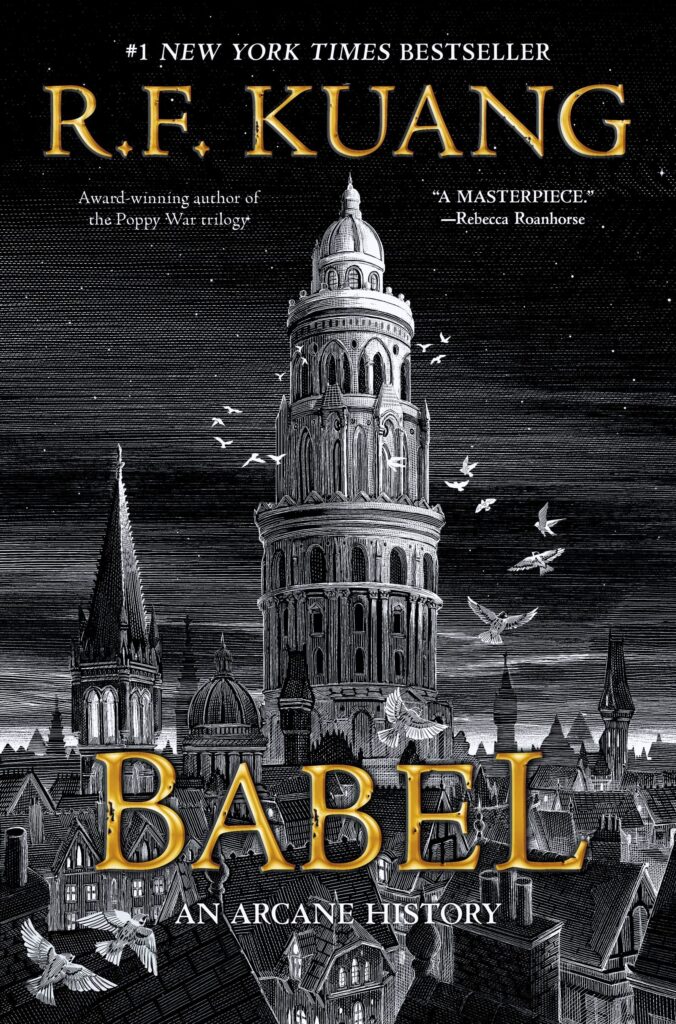
Babel (2022)
Select Sections to Print
×Book Details
Babel (2022)
Jump to Section
⚠️ Trigger Warnings
- Racism
- White supremacy
- Racial slurs
- Xenophobia
- Racial harassment
- Colonialism
- Imperialism
- Chattel slavery
- Human trafficking
- Graphic violence
- Murder
- Gun violence
- Torture
- Physical abuse
- Corporal punishment
- Opium addiction
- Drug use
- Forced drug trade
- Epidemics
- Graphic illness
- Death
- Death of family members
- Grief
- Suicide
- Suicidal ideation
- Self-harm
- Self-sacrifice
- Misogyny
- Sexual harassment
⏱️ 2-Minute Spoiler Summary
In 1828, eleven-year-old Robin Swift is the sole survivor of a cholera outbreak that kills his family in Canton. British scholar Professor Richard Lovell saves Robin using a magical silver bar, takes him to England, and raises him as his ward. Professor Lovell is secretly Robin’s biological father, but he refuses to acknowledge him publicly. Instead, he trains Robin relentlessly in languages so he can eventually attend Oxford’s prestigious Royal Institute of Translation, known as Babel.
At Oxford, Robin becomes inseparable from three fellow students: Ramy Mirza, an Indian Muslim scholar; Victoire Desgraves, a Black Haitian-born student raised in France; and Letty Price, a wealthy white Englishwoman. They learn that Britain’s power depends on magical silver bars inscribed with pairs of words from different languages. The slight difference in meaning between the words creates magical effects, making foreign-born translators essential to Britain’s economy and empire.
Robin soon discovers that his older half-brother, Griffin Lovell, is part of the secret Hermes Society, which steals silver from Babel and redistributes it to people harmed by British imperialism. Robin secretly joins him while continuing to enjoy his privileged Oxford life, increasingly torn between the two worlds.
Everything changes during the cohort’s 1839 trip to Canton. Robin witnesses the devastation caused by British opium and interprets negotiations with Commissioner Lin Zexu, who orders more than 20,000 chests of British opium destroyed. Professor Lovell admits that Britain intends to use the crisis as an excuse for war so it can force China to surrender its silver. During their voyage home, Professor Lovell threatens Robin and insults China. Robin activates a silver bar that explodes Lovell’s chest, killing him. Ramy and Victoire help dispose of the body, while Letty reluctantly keeps quiet.
Back in England, the group finds documents proving Britain is deliberately provoking the First Opium War. Robin, Ramy, and Victoire join Hermes full-time, but Letty cannot accept their rejection of Britain and secretly betrays them to the authorities. During the raid on Hermes’s headquarters, Letty shoots and kills Ramy when he tries to protect Victoire. Griffin is also killed, and Robin is captured and tortured before Victoire rescues him.
Ramy’s death convinces Robin that peaceful resistance will never stop the Empire. He and Victoire seize Babel and declare a translators’ strike, joined by sympathetic students and Professor Margaret Craft. They begin removing the resonance rods that power Britain’s silver network, causing transportation, factories, utilities, and infrastructure to fail across the country. Abel Goodfellow and working-class protesters barricade the streets around Babel, but the British government refuses to surrender and sends the Army.
Knowing Babel will be retaken, Robin decides to destroy it permanently. He sends Victoire and the other surviving rebels to safety through underground tunnels and remains behind. As soldiers storm the tower, Robin activates the silver with the word Fānyì—“Translate”—creating a runaway resonance reaction that destroys Babel, its silver reserves, and its research. The tower collapses, killing Robin.
Victoire escapes and boards a ship for Haiti carrying silver and the memory of her friends. With Babel destroyed, Britain loses the system supporting its war machine, halting the immediate invasion of China and throwing the imperial economy into chaos.
📖 Full Spoiler Summary
Robin Swift Is Taken from Canton
In 1828, an eleven-year-old Chinese boy survives a devastating cholera epidemic in Canton that kills his mother, grandparents, and Miss Elizabeth “Betty” Slate, the Englishwoman who had helped raise him. British Sinologist Professor Richard Lovell arrives at the house and saves the dying child with a magical silver bar inscribed with the French triacle and English treacle.
Professor Lovell takes the boy to England, tells him to abandon his Chinese name, and renames him Robin Swift. Officially, Robin becomes Lovell’s ward, but their connection runs much deeper: Lovell is actually his biological father.
Years earlier, Lovell had an affair with Robin’s Chinese mother while traveling in Canton. He secretly arranged Robin’s English education, paying Miss Betty to live with the family and sending English books to the household. But acknowledging an illegitimate mixed-race son would threaten Lovell’s reputation and marriage to his wealthy English wife, Johanna, so he never publicly claims Robin.
At Lovell’s Hampstead estate, Robin receives a brutally demanding education in Latin, Greek, Mandarin, and Classical Chinese. Lovell makes the terms clear. If Robin succeeds, Oxford and a life of extraordinary privilege await him. If he fails, Lovell can send him back to China with nothing.
Robin succeeds.
Oxford, Babel, and the Secret of Silver
In 1834, Robin arrives at Oxford’s Royal Institute of Translation, better known as Babel. There he meets the three students who will become the center of his life: Ramiz “Ramy” Mirza, a brilliant Muslim student from Calcutta; Victoire Desgraves, a Black Haitian-born woman raised in France; and Letitia “Letty” Price, the wealthy daughter of a British admiral.
As foreign students and women in Victorian Oxford, they quickly become a tightly bonded group. Robin is especially close to Ramy, who becomes his best friend and soulmate.
Babel’s true purpose goes far beyond translation. Britain’s technological and economic supremacy depends upon silver-working, a form of magic created by inscribing silver bars with “match-pairs”: words in two languages that have similar but not identical meanings. The meaning lost between the two words generates a magical effect. Silver can strengthen buildings, improve crops, accelerate transportation, and power machinery.
Because native speakers understand linguistic nuances that English scholars cannot, Babel recruits talented students from across the world. Britain therefore depends upon the languages and knowledge of the very peoples it colonizes.
One night, Robin catches thieves stealing silver from Babel and is stunned by the identity of their leader. Griffin Lovell looks remarkably like him because Griffin is another illegitimate son of Professor Lovell. Lovell had fathered Griffin with a woman in Macau and repeated the same pattern: bringing his mixed-race son to England, raising him as a ward, and preparing him for Babel.
Unlike Robin, Griffin has already rejected the institution. He now works for the Hermes Society, a secret anti-imperialist organization that steals silver from Babel and redirects resources toward colonized peoples, abolitionist causes, and resistance movements.
Griffin recruits Robin, beginning his brother’s double life.
Robin’s Double Life
For the next three years, Robin thrives at Oxford while secretly helping Hermes. By day, he studies alongside Ramy, Victoire, and Letty under professors including Anand Chakravarti, Jerome Playfair, and Margaret Craft. He loves languages, scholarship, his friends, and the privileged life Babel has given him.
By night, he smuggles books and silver out of the tower for Griffin.
That contradiction becomes increasingly difficult to ignore. Griffin teaches Robin that Britain’s prosperity is built upon extraction from other countries. Britain needs Chinese tea and silk, but rather than continue paying China in silver, British merchants sell illegal opium there, creating addiction while reversing the flow of silver.
The students also see inequality within Britain itself. Workers protest silver-powered machinery that has destroyed jobs, while Robin and his friends continue experiencing racism and discrimination at Oxford. Yet Robin remains reluctant to abandon Babel. For all its corruption, Oxford has also given him friendship, intellectual fulfillment, and a place he desperately wants to belong.
That conflict becomes impossible to maintain when the students travel to China.
Canton Forces Robin to Choose
After completing their examinations, Robin, Ramy, Victoire, and Letty accompany Professor Lovell to Canton in 1839.
Returning home transforms Robin’s understanding of British imperialism from something theoretical into something painfully visible. He visits an opium den and sees the devastation caused by the drug. British merchants, including Mr. Baylis of Jardine, Matheson & Co., nevertheless demand unrestricted trade and threaten war if China interferes.
Robin serves as an interpreter during negotiations with Imperial High Commissioner Lin Zexu, who has been sent to stop the illegal opium trade. Lin refuses to submit to British demands and orders the seizure and destruction of more than 20,000 chests of British opium.
Lovell then reveals something even worse: Britain never truly wanted negotiations to succeed. The confrontation is intended to create justification for war, allowing Britain to attack China and seize access to its silver.
On the voyage back to England aboard the Hellas, Lovell confronts Robin. He uses racial slurs, threatens to have him imprisoned in Newgate, and insists that China deserves to be crushed.
When Lovell reaches for a silver bar, Robin reacts first. He activates the same dangerous bar that previously killed Babel scholar Eveline Brooke, speaking the Chinese word Bào—“to explode.”
The magic tears open Lovell’s chest and kills him.
Ramy, Victoire, and Letty discover what Robin has done. Ramy and Victoire immediately help him conceal the murder, placing Lovell’s body inside a weighted trunk and throwing it into the ocean. Letty is horrified but reluctantly agrees not to expose them.
There is no going back to their old lives.
Letty Betrays Them and Ramy Dies
After reaching England, the four hide at Lovell’s Hampstead estate. Robin and Ramy search his private papers and find correspondence confirming that British officials are intentionally provoking the First Opium War.
Robin, Ramy, and Victoire decide to join Hermes completely. When they finally tell Letty about the organization, however, the unity of their friendship breaks apart. Letty cannot accept their view of Britain and Babel. Despite everything she has witnessed, she remains loyal to the Empire and believes her friends are committing treason.
The group travels to the Hermes headquarters beneath Oxford’s Taylorian Institute, where Robin reunites with Griffin and discovers that Anthony Ribben, believed dead, actually faked his death and is a senior Hermes operative. The resistance tries one final peaceful strategy, distributing pamphlets and lobbying Parliament to vote against war with China.
Letty secretly leaves and informs the authorities.
Police surround the underground headquarters and storm it. Letty enters carrying a revolver. When Victoire moves to destroy documents that could expose Hermes members, Letty raises the gun. Ramy steps between them to protect Victoire.
Letty shoots him through the heart.
Robin is devastated. Violence erupts throughout the headquarters, and Griffin and loyalist Babel scholar Sterling Jones kill each other. The Hermes network is effectively destroyed, with Ramy, Griffin, Anthony, and many others dead.
Robin is captured, imprisoned beneath Oxford, and tortured. Victoire survives and eventually breaks him out using stolen keys and silver bars.
Ramy’s murder finally destroys Robin’s remaining belief that the system can be changed through persuasion.
Robin and Victoire Seize Babel
Robin concludes that Britain will never voluntarily surrender the power that makes its empire possible. If peaceful resistance cannot stop the war, Babel itself must become the weapon.
At the beginning of the new Oxford term, Robin and Victoire enter Babel’s crowded lobby. Robin rings a ceremonial bell and announces that they are seizing the tower and beginning a Translators’ Strike.
They expose the plans for war and the deaths surrounding Hermes. Most people flee, but several sympathetic students remain, along with Professor Margaret Craft, who turns against the university’s support for the war.
The rebels seal Babel with silver wards and make their demand: Britain must abandon the war against China and grant them amnesty. Until then, they will provide no translation or silver-working services.
Outside, working-class leader Abel Goodfellow brings laborers, weavers, and other supporters into Oxford. They construct barricades around Babel to defend the strikers from the authorities.
Inside, Robin and Victoire begin dismantling the infrastructure that makes Britain dependent upon Babel.
They remove the master resonance rods that power silver across the country.
The effects spread almost immediately. Oxford’s clocks stop. Sewage systems fail. Gas lamps go dark. Carriages crash, factories shut down, transportation systems collapse, and unrest spreads among workers. In London, Westminster Bridge collapses into the Thames, killing dozens.
Still, the government refuses to negotiate.
The Army surrounds Oxford with cannons, and fighting erupts between soldiers and protesters.
Robin Destroys Babel
On the final night of the siege, Letty approaches under a white flag. She warns Robin and Victoire that the Army will attack at dawn and kill everyone inside. She insists their resistance is pointless because Britain can simply train replacement translators.
Robin asks her why she killed Ramy.
She gives him no meaningful justification.
Robin and Victoire reject her offer and send her away.
By now, Robin understands that even if the strike ends, the government can reclaim Babel, replace its scholars, and rebuild the silver network. The only permanent solution is to make sure there is no Babel left to reclaim.
He decides to destroy the tower.
Robin persuades Victoire, Professor Craft, and the remaining rebels to escape through underground tunnels. Victoire desperately wants him to come with them, but Robin refuses. Someone must stay behind to activate the silver.
At six in the morning, the British Army breaches Babel.
Robin waits alone beneath its central dome, surrounded by pyramids of silver bars. He places his hand against the silver and speaks one final match-pair: Fānyì—“Translate.”
The magic creates an uncontrollable resonance loop. Silver throughout the tower begins to melt and shatter, destroying Babel’s enormous reserves along with its research, Grammaticas, and records of match-pairs.
The 300-foot tower collapses around Robin.
As he dies beneath the falling stone and marble, Robin remembers a peaceful morning at Oxford with Ramy, before everything was destroyed.
Victoire Escapes
Victoire survives the siege and escapes Oxford carrying silver hidden in her clothing. She boards a ship bound for Haiti, carrying the memory of Robin, Ramy, Griffin, and the revolution they attempted together.
Robin’s destruction of Babel has accomplished what negotiation could not. Britain loses the silver reserves, research, and linguistic infrastructure supporting its war machine. The immediate invasion of China is halted, while the destruction of the silver network throws Britain’s imperial economy into chaos.
Robin does not survive to see what comes next.
Victoire does. She sails toward Haiti with the story of what happened at Babel and the knowledge of what her friends sacrificed to bring it down.
🔚 Ending Explained
How Babel Ends
The ending of Babel brings Robin Swift’s gradual disillusionment with the British Empire to its final, devastating conclusion. After Ramy’s murder and the destruction of the Hermes Society’s base, Robin no longer believes Babel—or the empire it serves—can be reformed from within. He and Victoire seize Oxford’s Royal Institute of Translation and launch a Translators’ Strike, demanding that Britain abandon its planned war against China and grant the rebels amnesty.
A small group of scholars joins them, while most of Babel’s white faculty and students flee. Outside, Abel Goodfellow and working-class Luddite strikers build barricades around the tower, creating an unlikely alliance between exploited workers and the foreign scholars whose linguistic knowledge powers Britain’s empire.
Robin and Victoire then begin removing Babel’s master resonance rods. Because these rods sustain Britain’s silver-powered infrastructure, the effects spread rapidly: clocks stop, streetlamps fail, sewage systems collapse, factories and transportation networks cease functioning, and Westminster Bridge falls into the Thames. For the first time, Britain is forced to experience how dependent its prosperity has become on Babel and the knowledge extracted from other cultures.
Still, the government refuses to surrender.
At dawn, Letty enters Babel under a white flag on behalf of the Crown. She warns Robin and Victoire that the Army is preparing to storm the tower and insists that their deaths will accomplish nothing because Britain can simply train new translators. But Letty still refuses to apologize for killing Ramy or betraying her friends. Her attempt at negotiation therefore confirms what Robin already believes: the empire will tolerate individual scholars only as long as they remain useful and obedient.
Robin realizes that merely occupying Babel is not enough. If the Army retakes the tower, Britain will still possess its silver reserves, research, Grammaticas, and match-pair ledgers. The machinery of empire can simply begin again.
So Robin decides to destroy it.
He allows the remaining rebels to decide whether they want to stay or escape. Victoire and Yusuf choose survival, fleeing through underground tunnels with help from Abel’s men. Robin gives Abel a written account of what happened and asks him to distribute it, ensuring that the government cannot erase or rewrite their resistance.
At six in the morning, as British soldiers breach Babel, Robin remains alone inside the tower. Surrounded by pyramids of silver bars, he places his hand upon them and speaks one final command:
Fānyì — “Translate.”
The command creates an impossible linguistic paradox: translation depends upon the difference between words, but here the concept is effectively being translated into itself. The contradiction sends the silver into a runaway resonance loop that spreads throughout Babel.
The silver shatters. The ledgers and research are destroyed. And the enormous 300-foot tower collapses.
Robin dies beneath it.
His final thoughts are not of war or revenge, but of his first sunny morning at Oxford with Ramy—a memory of the friendship and possibility that once made Babel feel like home.
Victoire survives. In the epilogue, she rides north through the Cotswolds carrying silver, Hermes notes, and an unread letter from Griffin. She eventually boards a ship bound for America and Haiti. Robin and Ramy are gone, but Victoire chooses to continue living—and to carry the story of their resistance with her.
What the Ending Means
The destruction of Babel is the literal destruction of the institution at the center of the novel, but it also represents the destruction of the illusion that knowledge can remain politically neutral when it is controlled by an empire.
Babel has taken language—the intimate product of cultures, histories, and peoples—and converted it into economic and military power. Britain’s dominance depends upon understanding other cultures well enough to exploit them while denying those same cultures control over their own knowledge. When Robin destroys the tower, he is therefore destroying more than a building. He is attacking the system that has transformed translation into a mechanism of extraction.
That makes Fānyì especially significant. Babel’s magic depends upon what is lost between languages. Robin destroys that system by demanding the impossible: translation without difference. The magic built upon exploiting linguistic difference ultimately collapses when confronted with translation reduced to itself. The empire’s greatest source of power contains the mechanism of its own destruction.
Robin’s decision to die is also the culmination of his character arc. For much of the novel, he desperately wants two incompatible things: to belong to Oxford and to reject what Oxford represents. Babel gives him friendship, intellectual fulfillment, status, and security, but those comforts exist because the institution serves an imperial system harming people like him. After Ramy’s death, Robin can no longer maintain that contradiction.
His final act is therefore not simply suicide born from grief. It is deliberate sabotage. If Robin merely surrendered, Britain could reclaim Babel and continue using its accumulated knowledge against China. Destroying himself along with the tower ensures that the empire cannot simply restore the status quo.
Victoire provides the crucial counterpoint. Robin chooses sacrifice; Victoire chooses survival.
Her survival prevents the ending from suggesting that martyrdom is the only meaningful form of resistance. Victoire understands the danger of turning the suffering and deaths of colonized people into beautiful tragedies. She refuses to become another such image. Instead, she escapes carrying knowledge, testimony, and memory. Robin destroys the machinery; Victoire preserves the story of why it had to be destroyed.
Letty represents the opposite response. She continually interprets obedience to the existing system as reasonableness. Even after Ramy’s death, she cannot fully recognize the imperial assumptions underlying her choices. Her appearance under a white flag is therefore deeply ironic: she arrives presenting surrender as peace when the “peace” she offers requires everyone else to accept the violent system already in place.
The alliance with Abel Goodfellow’s workers broadens the novel’s argument as well. The barricades connect colonial exploitation abroad with labor exploitation at home. Babel may look like an isolated ivory tower, but its scholarship is inseparable from factories, infrastructure, commerce, warfare, and class. Once the resonance rods are removed, that connection becomes physically visible as Britain’s supposedly sophisticated society begins falling apart.
This is why the ending is so tragic but not hopeless.
Robin does not live to see whether his revolution succeeds. Ramy is dead. Babel is gone. Britain has not suddenly become just. There is no clean victory.
But the empire has been revealed as vulnerable.
Its power was never inevitable; it depended upon specific institutions, resources, workers, translators, and exploited knowledge. Those things can be withheld. They can rebel. And, ultimately, they can be destroyed.
Victoire sailing toward America and Haiti leaves the future deliberately unresolved. History has been knocked off the path Britain assumed it would follow. China may no longer face the same silver-powered enemy. Anti-colonial movements elsewhere may develop differently. The future becomes uncertain—and that uncertainty is itself a form of hope.
So the final image of Babel collapsing is not simply the destruction of knowledge. It is the destruction of knowledge monopolized by power.
Robin cannot build the world that comes afterward. His final act is to make that world possible.
And Victoire is the one who lives long enough to carry it forward.
👤 Characters & Fates
🔶 Main Characters

He kills Lovell with a Bào silver bar, joins Hermes, and after Ramy’s murder leads the Translators’ Strike and takeover of Babel. He ultimately activates a Fānyì translation paradox that collapses Babel, destroys Britain’s silver reserves, and kills him beneath the tower.
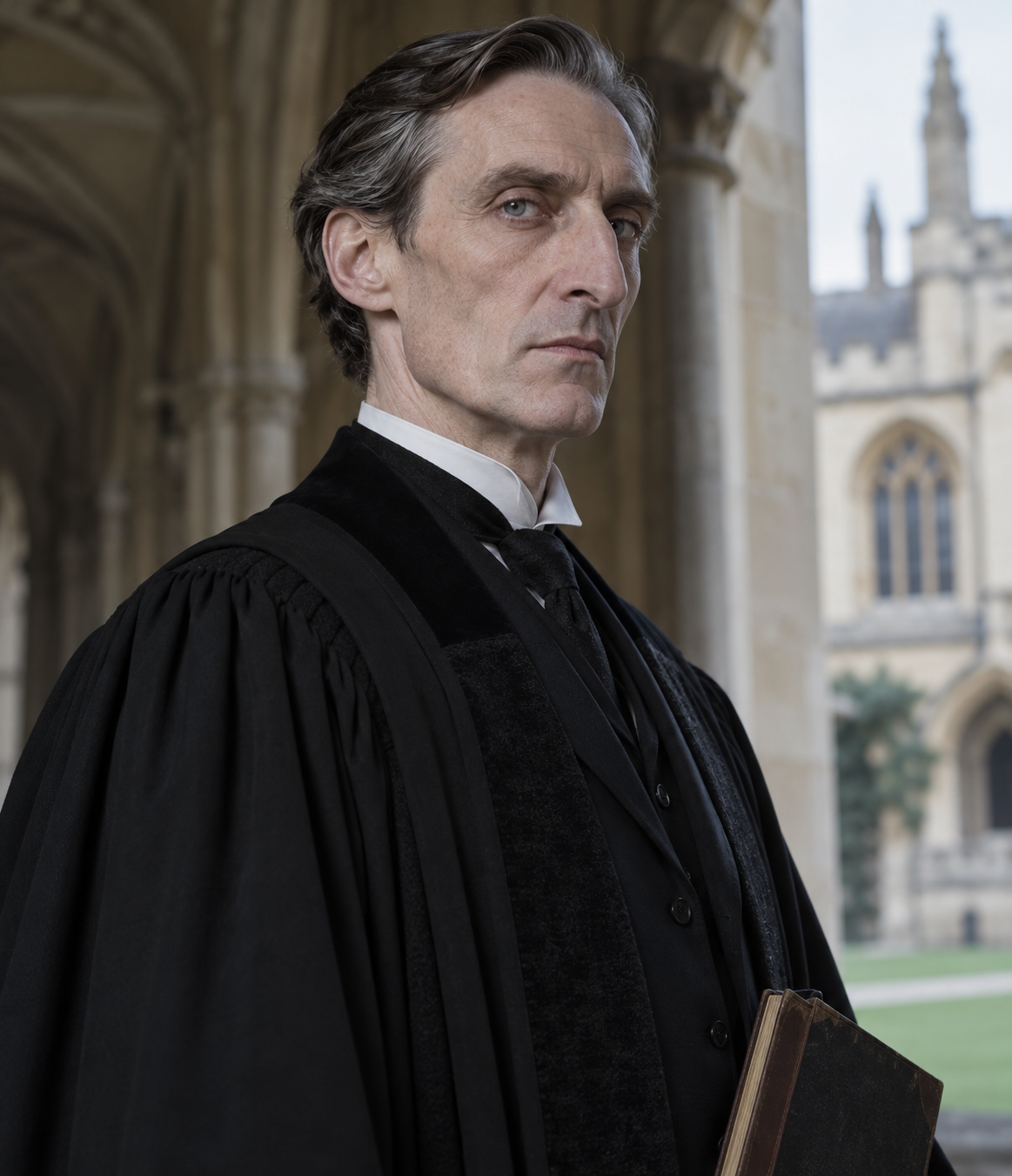
When Lovell threatens Robin and defends Britain’s plan to force war on China, Robin uses a Bào silver bar to blow apart his chest. Robin and his friends hide his corpse in a weighted trunk and dump it into the sea.
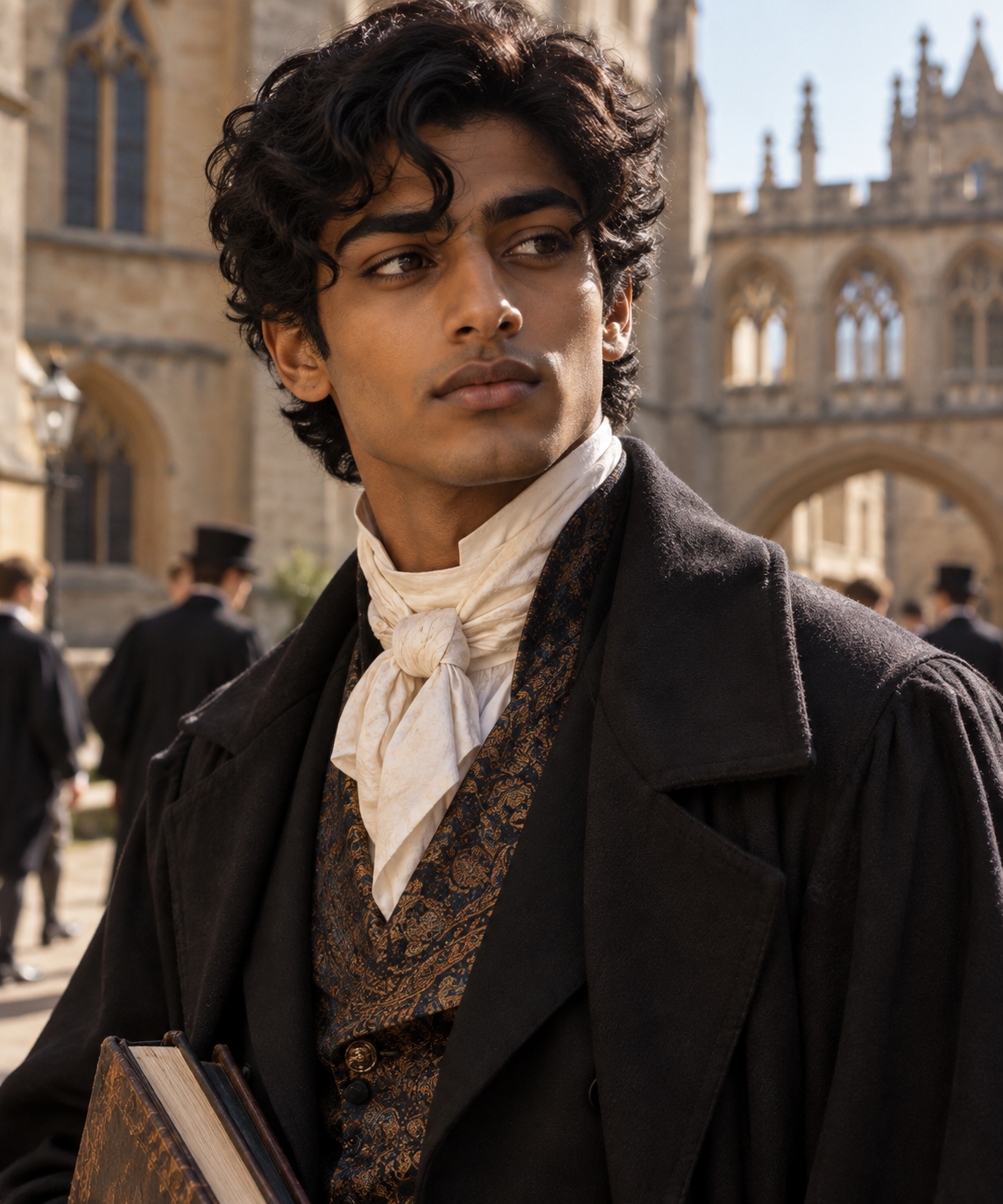
After joining Hermes and helping conceal Lovell’s death, Ramy is killed during the raid on the Old Library when he steps in front of Victoire and Letty shoots him through the heart. His death radicalizes Robin and helps trigger the takeover of Babel.

She joins the Babel takeover and shoots Professor Playfair when he threatens Robin. Realizing Robin intends to die destroying Babel, she escapes through the underground tunnels with stolen silver and ultimately sails for Haiti, surviving to preserve their story.

She betrays Hermes by revealing the Old Library base to authorities and shoots Ramy while aiming at Victoire. She later negotiates with the Babel strikers and begs Robin to surrender, but survives when the tower is destroyed.

He previously killed Eveline Brooke with a Bào bar after she caught him stealing silver. While rescuing Robin from Oxford Castle, Griffin and Sterling Jones shoot each other simultaneously, and Griffin dies from his wounds.
🔷 Supporting Characters

He fakes his death in Barbados so he can work underground for Hermes, but is eventually shot and killed by police during the raid on the Old Library.
During the Translators’ Strike, he draws a revolver against Robin, so Victoire shoots him in the stomach. He is carried from Babel alive but badly wounded.
He tackles Professor De Vreese to protect Robin and supports the strike, but refuses to participate once Robin deliberately turns toward destructive sabotage. He empties his pockets of silver and walks out before Babel collapses.
After learning the truth about Lovell’s war plans, she joins the Translators’ Strike and ultimately chooses to remain with Robin. She dies when his silver paradox destroys Babel.
He abandons the tower with most of the white faculty during the first day of the strike and survives Babel’s eventual destruction.
He confiscates and destroys more than 20,000 chests of British opium, prompting British merchants to demand retaliation and helping set the First Opium War in motion.
After Lin Zexu seizes the opium, Baylis pushes British officials and Parliament toward military action against China.
He mobilizes workers to build barricades around Babel and receives Robin’s written account of their struggle. Before Babel falls, Abel helps lead survivors to safety through underground tunnels.
She catches Griffin stealing silver and alerts authorities; panicking, Griffin activates a Bào bar against her chest, shattering her ribs and killing her.
He tortures Robin with silver-powered agony handcuffs in Oxford Castle. During Griffin’s rescue attempt, the two shoot each other simultaneously, and Sterling dies.
Unaware that Robin has murdered Lovell, she remains in Jericho and warmly says goodbye when Robin visits her for the final time.
She is killed by armed constables during the police raid on Hermes’s Old Library headquarters.
He is shot and killed by police during the raid on the Old Library.
She fights alongside the other Hermes members at the Old Library and is killed during the police raid.
After racially abusing Robin and harassing Letty and Victoire, he backs down when Robin threatens him and later disappears from the central conflict.
He flirts with Victoire in French and joins the drunken harassment at the commemoration ball, then fades from the story.
He participates in the harassment of Victoire and Letty at the ball but plays no major role in the later rebellion.
He remains outside Robin and Ramy’s revolutionary activities and continues with his law studies.
Robin lends him money to cover his university battels, and Bill remains outside the later revolutionary conflict.
He remains uninvolved in the Babel conflict and continues his privileged university life while anticipating his inheritance.
He remains outside the rebellion and continues living comfortably on his family’s wealth.
She dies alongside Robin’s mother and aunts during the 1828 cholera epidemic in Canton.
🕳️ Potential Plot Holes
Silver-working supposedly depends on native-level linguistic knowledge, and bars periodically need to be refreshed as their effects fade. Yet Britain operates enormous amounts of silver infrastructure while Babel trains only a tiny number of translators in each language. Chinese match-pairs in particular appear widely useful despite the extremely limited number of people qualified to create and maintain them. Babel may employ additional graduate scholars and specialists beyond the undergraduates emphasized in the story, but the scale of Britain's silver network still seems difficult to reconcile with the scarcity of qualified native speakers.
A Fānyì ("translate") match-pair creates a paradox that destroys the silver bar and can spread to silver physically touching it. That makes it potentially devastating sabotage technology, raising the question of why Hermes or Britain's foreign enemies have not used it against concentrated silver reserves before Robin does. One possible explanation is that the technique is obscure knowledge tightly controlled by Babel and that resistance groups would have difficulty getting both the necessary expertise and access to major silver stockpiles.
Robin constructs connected pyramids of silver throughout Babel so the Fānyì paradox can spread physically through the tower's silver reserves. But Babel also uses resonance rods capable of transmitting effects between geographically separated pieces of silver. This may look like a contradiction, but resonance does not necessarily mean physical contact: the novel establishes the Fānyì reaction as contagious through touching silver, not simply magically linked silver. Unless resonance can transmit the paradox itself, Robin would still need the physical chain he constructs.
The enormous Babel tower and portions of Oxford's geography and alternate history do not correspond perfectly to the real nineteenth-century city. This is not a genuine plot hole. R.F. Kuang explicitly acknowledges these alterations and establishes from the beginning that the novel takes place in an alternate historical world shaped by silver-working.
📚 Book Club Q&A's
⭐ Final Rating & Thoughts
What surprised me most about Babel is how dramatically my opinion changed after I finished it. While I was reading, I found it exhausting. The pacing is painfully slow, the characters circle the same arguments repeatedly, and for a large portion of the book, I genuinely wondered why I was forcing myself to continue. My initial reaction was much closer to two stars.
But Babel stayed with me. The more distance I had from it, the more I appreciated just how intelligent and original it is. The idea of translation itself creating magic is brilliant, and as a native Chinese speaker who learned English as a teenager and later worked as a translator, the nuances of language and everything that gets lost between languages resonated with me personally.
I still can't overlook how difficult the reading experience was, which keeps this from being a five-star book for me. But Kuang created something ambitious, meticulously researched, and genuinely unique. I didn't particularly enjoy reading Babel, yet somehow I ended up admiring it. Sometimes a book needs a little time to reveal just how good it actually was.
✨ Adaptation description
🎬 Screen Adaptation — In Development
R. F. Kuang’s bestselling 2022 historical fantasy novel Babel, or the Necessity of Violence was optioned for a screen adaptation in February 2024 by independent studio wiip, in partnership with Temple Hill Entertainment.
- Production Companies: wiip (Mare of Easttown, The Summer I Turned Pretty) and Temple Hill Entertainment (Twilight, The Fault in Our Stars).
- Announcement Date: February 28, 2024.
- Format: Film or television series; not yet confirmed.
- Director: Not announced.
- Screenwriter: Not announced.
- Cast: Not announced.
- Release Date: Not announced.
- Current Status (October 2026): Early development, with no confirmed production or filming schedule.
What Will the Adaptation Cover?
Set in an alternate version of 1830s Oxford, Babel follows Robin Swift, a Chinese orphan brought to England by Professor Richard Lovell to study languages at Oxford University’s prestigious Royal Institute of Translation.
There, Robin discovers that silver-working—a magical process powered by the meanings lost between translated words—fuels Britain’s industrial expansion and colonial dominance.
As Robin becomes increasingly aware of the exploitation underlying the institution, he must choose between the privileged academic life he has built and the revolutionary resistance seeking to dismantle the British Empire’s power.
The novel explores colonialism, racism, language, cultural identity, academic privilege, and revolutionary violence.
Book vs. Screen Adaptation
Because the adaptation remains in development, no changes to the novel’s characters, storyline, structure, or ending have been announced.
It is also unknown how the adaptation will translate the novel’s extensive scholarly footnotes, complex linguistic magic system, and historical commentary to the screen.
As of October 2026, no official release date or casting announcements have been confirmed.
✨ Books Like Babel (2022)
See an error on this page?