
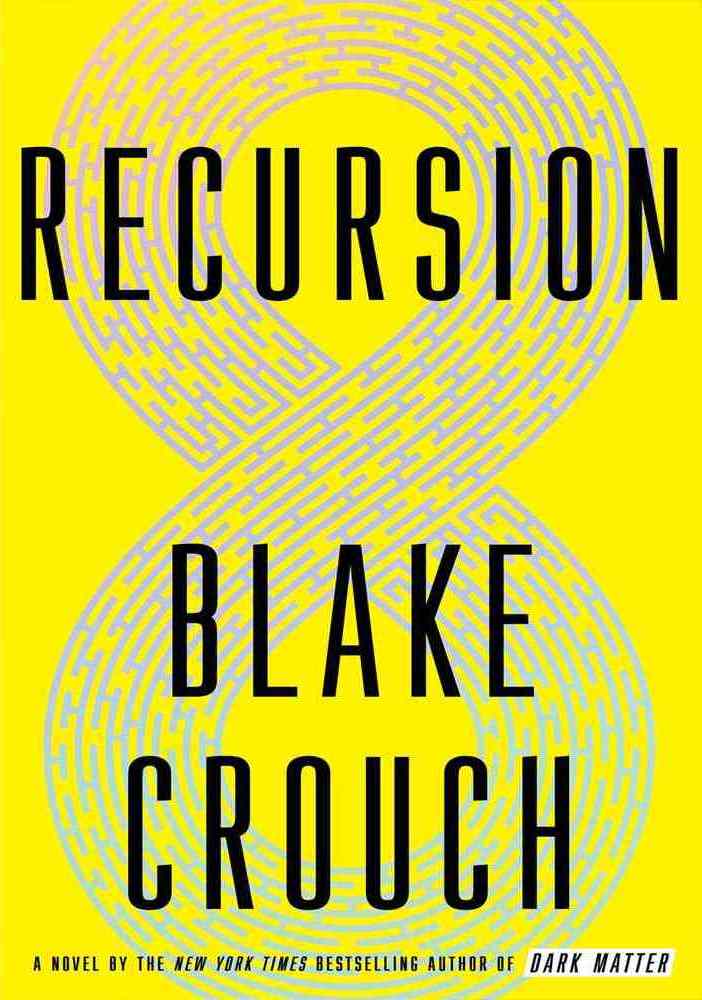
Recursion (2019)
Select Sections to Print
×Book Details
Recursion (2019)
Jump to Section
⚠️ Trigger Warnings
- Suicide
- Suicidal ideation
- Suicide attempts
- Mass suicide
- Self-harm
- Death of a child
- Murder of a child
- Nuclear war
- Mass casualties
- Graphic violence
- Gun violence
- Terrorism
- School shootings
- Bombings
- Substance abuse
- Drug addiction
- Drug overdose
- Domestic abuse
- Dementia
- Alzheimer’s disease
- Terminal illness
- Cancer
- Medical trauma
- Unethical human experimentation
- Clinical death
- Paralysis
⏱️ 2-Minute Spoiler Summary
Barry Sutton investigates people suffering from memories of lives that never happened and discovers that neuroscientist Helena Smith accidentally invented technology capable of sending human consciousness backward through memory. Billionaire Marcus Slade weaponizes the discovery, allowing people—including Barry—to rewrite their pasts.
Barry goes back to 2007 and prevents his daughter Meghan from dying, but when the rewritten timeline catches up with the moment of his temporal jump, everyone regains memories of the erased reality. Meghan remembers her own death and eventually dies again.
Barry and Helena try to destroy Slade’s technology, but the government obtains it and begins using it to prevent tragedies. The technology eventually leaks worldwide, causing nations and terrorist groups to constantly rewrite history. The resulting temporal chaos repeatedly ends in nuclear war.
Barry and Helena spend multiple lifetimes together trying unsuccessfully to stop the cycle. Eventually, Barry realizes they must return to the original timeline before Slade ever gains control of Helena’s discovery.
Barry goes back to November 2018, accepts that Meghan must remain dead, and stops Slade before he can steal Helena’s work. Reality is finally restored to its original course. Helena has no memory of Barry or their lives together, but Barry finds her at a San Francisco bar and prepares to introduce himself, choosing to build their relationship naturally rather than rewrite the past again.
📖 Full Spoiler Summary
Barry Sutton and the Memories of a Life That Never Happened
Recursion begins in New York City in 2018, where Detective Barry Sutton is still living with the consequences of the worst day of his life. Eleven years earlier, his fifteen-year-old daughter, Meghan, was killed in a hit-and-run. The loss destroyed his marriage to Julia, contributed to his alcoholism, and left Barry emotionally stuck in a past he would give anything to change.
That longing becomes especially important when Barry is called to the Poe Building to stop Ann Voss Peters from jumping. Ann suffers from a mysterious condition called False Memory Syndrome, or FMS. She remembers an entire second life in which she was married to Joe Behrman and had a son named Sam. The memories feel completely real, yet in the world around her, that life never happened and Sam never existed.
Unable to live with the grief of remembering a child who has effectively been erased from reality, Ann jumps.
Barry can’t forget her. His investigation leads him to Joe, who initially denies knowing Ann but later admits that he once responded to a mysterious advertisement promising people a chance to redo their lives. Joe was taken to a secret Manhattan facility called Hotel Memory, where someone gave him exactly that.
Before Barry can uncover much more, reality itself seems to shift. He experiences a nosebleed followed by an overwhelming flood of memories from a life he never lived. Events involving Ann have changed, and Barry suddenly remembers both versions.
His search eventually brings him to Hotel Memory, where he is drugged and captured.
The man behind the operation is billionaire Marcus Slade.
Slade forces Barry to relive the night Meghan died while sophisticated equipment records the memory. Barry is then paralyzed, placed inside a sensory-deprivation tank, and temporarily killed. Instead of simply dying, however, Barry’s consciousness is projected backward through his memories.
He wakes up on October 25, 2007.
And Meghan is still alive.
Helena Smith Creates the Impossible
Years before Barry discovers Hotel Memory, neuroscientist Dr. Helena Smith is trying to solve a very different problem.
Her mother, Dorothy, has Alzheimer’s disease, and Helena desperately wants to preserve her memories before they disappear. In 2007, Helena receives an extraordinary offer from Marcus Slade, who promises unlimited funding for her research.
Slade moves Helena and a handpicked team to Fawkes Station, an isolated former oil rig in the Pacific. There, Helena develops a machine capable of mapping and reactivating extremely specific memories.
Slade gradually pushes the research beyond anything Helena intended. He realizes that if a person’s heart is stopped while an intensely vivid memory is reactivated, the dying brain can somehow project consciousness back to the moment when that memory was formed.
Their first successful human subject, Reed King, doesn’t merely remember his past.
He wakes up inside it.
The implications are staggering. A person can essentially return to an earlier point in their own life and continue living from there, carrying memories of the future that has now been erased.
Helena quickly realizes what Slade sees in her invention. She wanted to preserve memories. He sees the ability to rewrite reality.
When Reed later kills himself, Helena understands how dangerous the technology has become. She also knows she can’t simply run away because Slade can use the chair to go back and prevent her escape.
So Helena uses the machine herself.
She returns to 2007, shortly before her partnership with Slade truly begins, then disappears under the name Marie Iden. She spends years hiding in remote parts of Canada and Alaska, refusing to recreate the technology.
She believes she has stopped the nightmare before it can begin.
She hasn’t.
Barry Saves Meghan
After Slade sends Barry back to 2007, Barry realizes he has been given the one thing he has wanted for eleven years: another chance.
He races to the intersection where Meghan was killed and pulls her out of the road moments before the car strikes her.
His daughter lives.
One of Slade’s men, Vince, warns Barry not to reveal what happened or exploit his knowledge of the future. Barry agrees because none of that matters compared with having Meghan back.
For the next eleven years, he gets to watch his daughter grow up. He stays sober and experiences countless ordinary moments that were stolen from him the first time.
Yet saving Meghan doesn’t magically repair everything else. His marriage to Julia eventually ends anyway, although far less painfully than before. Barry nevertheless considers the new life an extraordinary gift.
Then the timeline reaches the date when Barry originally traveled backward.
Suddenly, Julia and Meghan acquire memories of the erased timeline.
Meghan remembers dying.
This is the truth behind False Memory Syndrome. Whenever someone travels backward and creates a new reality, the old timeline disappears—but only temporarily from human memory. Once the new timeline reaches the moment when the jump originally occurred, people regain memories from the erased version of history.
Those “false” memories aren’t false at all.
They’re memories of dead timelines.
For Meghan, remembering her own violent death is unbearable. She eventually overdoses on alcohol and pills, accidentally starting a fire in her apartment building and dying along with several other people.
Barry has saved his daughter only to lose her again.
Barry and Helena Try to Stop Slade
Reality is now visibly breaking apart. A bizarre U-shaped skyscraper called the Big Bend suddenly appears in Manhattan because an architect who used Hotel Memory went backward and rebuilt his life around creating it.
Barry prepares to attack Hotel Memory, but Helena finds him first.
She explains what will happen if the government obtains Slade’s technology. Governments will inevitably use it to correct disasters, prevent attacks, win wars, and manipulate history. Every alteration will create another dead timeline whose memories will eventually return.
Barry and Helena decide they have to destroy Slade’s operation before that happens.
Their assault becomes a series of brutal do-overs. Before entering Hotel Memory, Helena deliberately cuts herself, creating a vivid memory she can use as a temporal “save point.” When an attempt fails, she can die in the chair and return to that moment with knowledge of what went wrong.
During one attempt, Helena is shot. During another, Barry is mortally wounded. They repeatedly attack the facility, learning more each time.
Eventually they reach Slade and attempt to erase his data, but the operation collapses into chaos. Slade dies from his injuries, and Gwen Archer, Barry’s friend and a commander with the NYPD, arrives with a tactical team.
Barry is shot and killed while trying to help Helena escape.
The government captures Helena.
And the very catastrophe she feared begins.
The Government Starts Rewriting History
DARPA salvages Slade’s technology and places Helena in captivity. Government officials create a secret program jokingly called the Department of Undoing Particularly Awful Shit.
Their intentions initially seem defensible.
Using the chair, operatives go backward to prevent tragedies. They stop a school shooting that killed nineteen children. They eliminate a serial killer before he can claim more victims.
But there is no way to keep something this powerful secret forever.
The technology leaks.
Soon other governments, terrorist organizations, and competing groups possess memory chairs. History begins changing constantly. Buildings disappear and reappear. Terrorist attacks happen and unhappen. People accumulate memories of multiple lives, deaths, marriages, children, disasters, and realities.
Humanity is losing its grip on which version of history is real.
Desperate to escape the escalating temporal war, Helena uses the chair again and travels all the way back to 1986, waking up in her sixteen-year-old body.
This time, she leaves information for her future self and tries to solve the problem from decades earlier.
Barry and Helena Live Through the End of the World
In the timelines that follow, Helena finds Barry.
They fall in love and marry.
Together, they spend decades trying to solve the problem she created. They build their own chair, become wealthy enough to finance their research privately, and search for some way to prevent people from acquiring memories of dead timelines.
Nothing works.
Every attempt eventually reaches the same catastrophe.
When the world regains memories of previous timelines, governments panic. Nations realize their enemies could use the chair to erase them from history entirely. Russia and China launch nuclear weapons rather than risk being retroactively destroyed.
Nuclear war follows.
Barry and Helena repeatedly escape backward through memory, only to live toward the same apocalypse again.
In one timeline, they watch Denver disappear beneath a nuclear blast and suffer horrific burns while struggling back to their laboratory. In another, Helena becomes so overwhelmed by the guilt of repeatedly overwriting her younger self that she attempts suicide. They eventually retreat all the way to Antarctica, hoping isolation might allow them to survive long enough to find an answer.
Instead, Helena’s mind deteriorates after too many trips through memory.
She dies.
Barry is left alone in Antarctica, exhausted by lifetimes of failure and grief. He prepares to kill himself beside Helena’s grave.
Then a crucial realization surfaces from his accumulated memories.
They have been trying to fix the wrong moment.
Barry Returns to the Original Timeline
Barry realizes that every version of reality they’ve been fighting grew from one original event: Marcus Slade’s discovery of Helena’s technology.
Instead of trying to repair the increasingly damaged future, Barry needs to return to the timeline before any of it happened.
He records a memory from November 4, 2018, climbs into the tank, and travels back one final time.
Barry wakes in the original reality.
There is no False Memory Syndrome. No Hotel Memory. No temporal war.
And Meghan is dead.
This time, Barry doesn’t save her.
Doing so would simply begin another altered timeline and restart the cycle. After everything he has experienced, Barry finally accepts that some losses cannot be undone without destroying everything that comes afterward.
But there is one event he can prevent.
On November 5, Barry travels to San Francisco, where Marcus Slade is preparing to meet Helena and steal the breakthrough that will eventually reveal how memory can rewrite time. Barry confronts him and makes sure Slade cannot carry out his plan.
The chain is broken before it begins.
Helena remains alive, but she remembers none of the lives she and Barry shared. Their marriage, their decades together, their desperate experiments, and all the worlds they watched end exist only in Barry’s memory.
Later, Barry goes to a San Francisco bar called Monk’s Kettle.
Helena is there, working on her laptop.
She doesn’t recognize him.
Barry sits beside the woman he has already loved across countless lifetimes. Instead of telling her everything or trying to recreate the future he remembers, he simply prepares to introduce himself.
For the first time, Barry isn’t trying to go backward.
He’s ready to live forward.
🔚 Ending Explained
How Recursion Ends
The final act of Recursion comes after Barry Sutton and Helena Smith have spent years trapped in a nightmare of their own making. No matter how many times they travel backward and create a new timeline, the result is essentially the same: sooner or later, humanity learns about the memory chair, governments weaponize it, and the world destroys itself. Every attempt to repair the past simply creates another path toward April 16, 2019, and nuclear annihilation.
By the seventh loop, Barry and Helena have retreated to an isolated research station in Antarctica, desperately searching for a solution. But Helena has traveled through too many timelines. Her mind is collapsing under the weight of multiple lives and memories, and she eventually dies.
Barry buries her in the ice and climbs into the grave beside her, intending to die there too. He takes oxycodone with whiskey and waits for the cold and drugs to finish the job.
Then, just before losing consciousness, he remembers something Marcus Slade told him in another timeline.
They have been approaching the problem incorrectly.
The solution isn’t to keep traveling backward and creating new realities. Barry needs to return to the original timeline, before the first alteration ever occurred. The true point of origin is November 5, 2018—the night Slade murdered Helena and stole her research. If Barry can prevent that single event, the entire chain of altered timelines may never begin.
Barry races back to the station and enters the memory chair one final time. Using his memory of celebrating Meghan’s birthday on November 4, 2018, he manages to reach the original version of his life.
He wakes at brunch with his ex-wife, Julia.
And immediately, Barry understands what returning to the original timeline really means.
Meghan is dead.
She has been dead for eleven years.
There is no False Memory Syndrome. There are no competing memories or alternate lives. This is the world as it existed before anyone began rewriting it.
And this time, Barry leaves it alone.
He doesn’t try to save Meghan again. Instead, he tells Julia that he is no longer angry about what happened to their family. Their marriage may not have lasted, and their daughter may have died far too young, but none of that makes the love they shared meaningless. Barry tells Julia that he wouldn’t trade away a second of his life with her or Meghan.
For the first time, Barry accepts his past instead of trying to repair it.
The next day, November 5, Barry flies to San Francisco and goes to Marcus Slade’s Dogpatch loft. Slade is preparing for his meeting with Helena—the meeting that originally ended with him murdering her and stealing the technology that eventually shattered reality.
But Barry has already broken into the loft and tampered with Slade’s .357 revolver, replacing its live ammunition with empty shell casings.
When Barry confronts him, Slade reaches for the gun and discovers that it is useless. Barry holds him at gunpoint with his own Glock and stops the murder before it can happen.
The original catastrophe has been prevented.
Barry then walks to Monk’s Kettle, where he knows Helena will be.
He finds her sitting at the bar with her laptop, absorbed in her research. She’s wearing a battered gray sweater scratched up by her cat, her glasses are smudged, and her hair is pulled into a messy ponytail.
She is simply Helena.
Not his wife. Not his partner through countless timelines. Not the woman he watched die in Antarctica.
And she has absolutely no idea who he is.
Helena eventually notices Barry looking at her and meets his eyes. Barry smiles, takes a sip of his beer, and prepares to introduce himself.
After spending lifetimes trying to rewrite the past, Barry finally chooses to begin something new.
What the Ending Means
The ending of Recursion isn’t really about Barry discovering the correct way to manipulate time. It’s about him finally understanding that time was never the problem.
His inability to accept loss was.
Barry begins the novel haunted by Meghan’s death. Helena begins it haunted by her mother’s Alzheimer’s disease. Both are drawn toward the possibility of recovering something that time has taken from them. The memory chair seems to offer the ultimate answer: if the past hurts badly enough, perhaps you can simply go back and change it.
Recursion spends the rest of the novel demonstrating why that fantasy is so dangerous.
Every attempt to create a better past produces unintended consequences. Meghan can be saved, but she can also die again. Helena can prevent one catastrophe only to create another. Entire civilizations can remember lives they never actually lived. Eventually, humanity becomes trapped in an endless effort to optimize reality.
Barry’s final victory therefore comes from doing something that would have been almost impossible for him earlier in the novel:
He accepts the world as it is.
Barry Lets Meghan Stay Dead
This is the most important choice in the ending.
Barry now possesses knowledge that could theoretically allow him to interfere with Meghan’s fate again. But he doesn’t.
He has already learned what endless correction does. Saving Meghan doesn’t erase grief; it merely moves it somewhere else. Every attempt to construct the perfect version of his family turns love into something that must constantly be protected from reality.
So Barry chooses the original loss.
That doesn’t mean Meghan’s death suddenly becomes acceptable or fair. It means Barry finally understands that grief is inseparable from having loved her in the first place.
The novel’s central idea crystallizes here: the beauty and the pain are meaningless without each other.
A life stripped of suffering would also be stripped of much of what gives love its value.
The Hudson River Finally Flows
The imagery surrounding Barry’s return reinforces that realization.
During his transition back into the original timeline, the world takes on a strange, frozen quality. But once Barry accepts where he is, the Hudson River becomes vivid and flowing again.
The river represents what Barry has spent the entire novel resisting: time moving in one direction.
You cannot stand in the same water forever. You cannot freeze the perfect moment. And you cannot continually return upstream without disrupting everything that follows.
Barry finally allows the river—and his life—to move forward.
Why Slade’s Empty Gun Matters
Barry defeats Marcus Slade in an unexpectedly understated way.
He doesn’t kill Slade. He doesn’t use the memory chair to erase him from existence. He simply removes the live ammunition from the weapon Slade intended to use against Helena.
It’s a fitting reversal.
Slade represents the desire to dominate reality—to take an extraordinary discovery and use it to impose his will on time itself. Barry stops him not by rewriting history on an enormous scale, but through one small act of prevention.
The gun is still there.
The possibility of violence is still there.
But its destructive power has been removed.
That mirrors Barry’s relationship with memory itself. He doesn’t erase the past. He simply stops allowing it to control what happens next.
Why Helena Doesn’t Remember Barry
The final scene would be far less meaningful if Helena suddenly recognized him.
Barry remembers entire lifetimes with her. Helena remembers none of them.
That imbalance is painful, but it’s also the point.
Earlier versions of Barry would have wanted those lost years restored. The Barry sitting beside Helena at Monk’s Kettle no longer needs them returned to him.
He is willing to meet her again.
Their relationship will no longer be built on time loops, impending apocalypse, shared trauma, or the desperate need to save humanity. Barry has the opportunity to know Helena in the ordinary way: conversation by conversation, day by day.
For a novel filled with spectacular technology, that mundane possibility becomes almost radical.
Helena’s Appearance Is Deliberately Ordinary
There’s also something meaningful about how Barry finds her.
Helena isn’t surrounded by the gleaming machinery of a laboratory. She’s sitting in a warm neighborhood bar wearing a worn sweater, with messy hair and smudged glasses.
After hundreds of pages devoted to controlling and perfecting reality, Barry finds happiness in something completely unoptimized.
Helena is imperfect, ordinary, alive, and real.
That’s enough.
The Meaning of the Final Scene
The tone of the novel changes dramatically in its closing pages. The Antarctic chapters are brutally bleak: freezing darkness, psychological deterioration, nuclear destruction, isolation, and death.
Then the story suddenly becomes small.
A warm bar.
A beer.
A woman working on her laptop.
A man wondering how to introduce himself.
That quietness is the reward.
Barry has spent what feels like lifetimes trying to control enormous forces—memory, history, death, civilization itself. His happy ending isn’t gaining mastery over any of them.
It’s being allowed to have an uncertain future.
That connects directly to the Kierkegaard quotation that opens the novel:
“Life can only be understood backwards; but it must be lived forwards.”
For most of Recursion, its characters violate the second half of that idea. They literally live backward. Their memories become places they can inhabit, and nostalgia becomes something more dangerous than longing: it becomes a technology.
Barry finally understands the distinction.
The past can teach him. It can shape him. He can love the people who existed there and mourn what he lost.
But he cannot live there.
What Happens After the Ending?
Barry successfully prevents the specific chain of events that produced False Memory Syndrome, the competing timelines, and eventually nuclear war. Slade never murders Helena and therefore never seizes control of her research in the way he originally did.
But the ending leaves one fascinating possibility unresolved.
Helena is still Helena.
She is still a brilliant neuroscientist. She is still studying memory. The intellectual path that eventually produced the chair hasn’t simply vanished from her mind.
So Barry hasn’t necessarily erased the possibility of memory travel forever.
What he has changed is the context in which Helena’s future unfolds.
Instead of Slade entering her life through violence and exploitation, Barry is about to enter it through something as ordinary as an introduction at a bar. He carries knowledge of exactly what her invention can become—and what it can do to both individuals and the entire world.
That makes the ending hopeful without making it completely certain.
Perhaps Helena will eventually rediscover the technology. Perhaps Barry will tell her what happened. Perhaps they will decide some discoveries are too dangerous to pursue.
We aren’t told.
And that uncertainty is precisely where Recursion wants to leave us.
For the entire novel, uncertainty is treated as something humanity desperately wants to eliminate. People want another chance, another timeline, another opportunity to correct the things that hurt them.
In the final scene, Barry willingly chooses uncertainty.
He doesn’t know exactly what will happen with Helena.
He doesn’t know what their relationship will become.
He doesn’t know what the rest of his life will look like.
He simply turns toward her and prepares to say hello.
And after a novel about people destroying the world because they cannot stop looking backward, that tiny act of moving forward is the real ending.
👤 Characters & Fates
🔶 Main Characters

After dying repeatedly across multiple timelines, Barry returns to November 2018 and stops Marcus Slade before the technology can be unleashed. He accepts Meghan’s original death rather than rewriting it again, then approaches Helena in San Francisco so they can begin a natural life together.

Repeated time travel eventually destroys Helena’s mind, and she dies cognitively shattered in Antarctica. Barry’s final reset prevents Slade from murdering her in 2018, leaving her alive and unaware of everything they endured when Barry approaches her in a San Francisco bar.

He dies from a gunshot wound in one timeline, but Barry ultimately returns to November 5, 2018, replaces Slade’s bullets with blanks, confronts him, and prevents him from stealing Helena’s technology—stopping the entire cycle before it begins.

Barry initially saves her, but Meghan later remembers her original death through FMS and dies after overdosing on pills and vodka, causing an apartment fire. In the final timeline, Barry accepts that he cannot engineer away every tragedy and allows her original 2007 death to stand.

She and Barry divorce even in the timeline where Meghan survives. In the restored timeline, Barry meets Julia for brunch, releases his lingering anger, and finally reaches a measure of peace with her over Meghan’s death.

Dorothy ultimately dies from Alzheimer’s; in one timeline she briefly recognizes Helena and tells her she is proud of her. Barry’s final reset ensures the memory technology is never used to exploit her mind.
🔷 Supporting Characters
He realizes too late that Helena was right about the technology’s dangers as nations begin rewriting history against one another. Barry’s final reset prevents DARPA from ever obtaining the chair.
Her SWAT team kills Barry after he deliberately fires a warning shot to give Helena time to escape. In the final timeline, Gwen remains an ordinary NYPD officer with no knowledge of temporal travel.
He grows deeply regretful about his involvement but continues working with DARPA. Barry’s final reset erases the Fawkes Station project, leaving Raj outside the temporal catastrophe.
Helena shoots and kills him during the lab raid when he tries to stop their reset. Barry’s final timeline prevents the project from occurring, sparing his life.
After returning with memories of his clinical death and a painfully vivid lost childhood, Reed cannot cope with the psychological consequences and hangs himself on Fawkes Station.
Helena and Barry kill him when he tries to reach the deprivation tank and reset the timeline for Slade. In the final timeline, he survives and continues running Apex Venture.
She jumps from the Poe Building after being unable to reconcile her erased family with her current life. Barry’s final reset prevents the timeline alteration that caused her FMS, so she survives.
He successfully saves Franny and lives with her in Montauk, but the returning dead memories expose what he has done. In Barry’s restored timeline, his temporal intervention never occurs.
She dies by suicide in the original history but is saved in the rewritten timeline, only to suffer a psychiatric breakdown when memories of her own death return. Barry’s final reset restores the natural timeline.
Barry later encounters a younger Vince, who reveals that he used time travel to escape his corrupt police life and eventually became the happy owner of a fly-fishing shop. That rewritten life disappears with Barry’s final reset.
After the Big Bend suddenly appears in reality, Amor is murdered in his apartment, apparently by Slade’s people for making such a conspicuous change. The building and altered history vanish in Barry’s final reset.
Repeatedly dying to reset timelines causes severe cognitive and psychological deterioration. His entire temporal career is erased when Barry prevents the technology’s creation.
Although her missions succeed, repeated clinical deaths and timeline shifts severely damage her mind. Barry’s final reset prevents her from ever becoming a temporal operative.
He realizes the world has entered a temporal version of Mutual Assured Destruction in which nations can erase one another through history. The crisis disappears when Barry restores the original timeline.
He dies with Jessica when a catastrophic flood and debris wave tears through the Queens-Midtown Tunnel in one timeline. That death is erased by later resets.
She dies with Alonzo in the Queens-Midtown Tunnel flood and experiences other catastrophic timeline endings before they are erased. Barry’s final reset removes her from the temporal crisis entirely.
She continues working at Hotel Memory until Barry’s final reset erases the entire operation from history.
He participates in Reed King’s and later Barry’s lethal procedures under Slade’s direction. The project never exists in Barry’s final restored timeline.
When memories of nuclear annihilation suddenly return on April 16, 2019, Shelia panics inside the precinct and fatally shoots herself. Barry’s final reset prevents this catastrophe.
He and his Big Bend career are erased from history when Barry restores the original timeline.
She experiences FMS and disappears from the narrative as Helena’s reset overwrites the Fawkes Station timeline; the entire project is ultimately prevented by Barry.
He suffers no major personal tragedy in the story and continues an ordinary police career, with the temporal alterations ultimately erased.
🕳️ Potential Plot Holes
Earlier in the book, Reed King proves that travelers cannot return to memories from overwritten timelines. After Reed changes his past, he tries to return to the now-erased memory of getting a tattoo, but the chair fails because that event no longer exists in the current timeline. Slade explicitly explains that there is “nothing for him to return to.” Yet Barry ultimately escapes the final loop by doing exactly that: he uses his memory of Meghan’s birthday from the original, long-overwritten timeline to travel back to November 2018. Barry’s success directly contradicts the limitation demonstrated through Reed without establishing a clear reason why the same rule no longer applies.
Repeated time travel is shown to progressively damage a traveler’s mind. Slade loses access to entire sections of his memories, Helena eventually deteriorates to the point that she becomes childlike, and even DARPA travelers begin showing mental problems after repeated resets. Barry, however, accumulates decades of additional memories across numerous timelines while retaining memories of horrific deaths and global catastrophes. Despite undergoing at least as much temporal stress as the other travelers, he remains mentally coherent and retains the memories he needs through the ending. The book never explains why Barry appears essentially immune to the cognitive fracture that becomes debilitating for other frequent travelers.
The book establishes that people regain memories of an erased timeline only when the new timeline reaches the exact moment when the original time jump occurred. Later, when DARPA sends Rodriguez farther into the past than previous interventions, all of the previous anniversary points are suddenly “overridden,” causing everyone to receive multiple dead timelines’ memories simultaneously when the chair is used. Nothing previously established suggests that traveling past an earlier jump should erase its anniversary point or cause those memories to arrive immediately. The new behavior appears just when the plot needs the accumulated timelines to crash into everyone at once.
📚 Book Club Q&A's
⭐ Final Rating & Thoughts
I went into Recursion with ridiculously high expectations because I loved Dark Matter so much, and somehow Blake Crouch still managed to deliver. I read this in a single sitting because this story was so fast-paced and engaging.
The way Crouch plays with memory, reality, regret, and the idea of getting another chance at the life you’ve already lived is fascinating. It’s the kind of book that makes your brain hurt a little, but in a good way. It also gave me major The Butterfly Effect vibes, which made me love it even more.
My only small complaint is that the second half becomes a little repetitive as certain situations play out again and again. But it never bothered me enough to knock off a star.
Smart, emotional, completely addictive, and genuinely thought-provoking. Recursion is exactly the kind of sci-fi thriller I love. Easy 5 stars.
✨ Adaptation description
Recursion Screen Adaptation
Blake Crouch’s 2019 science-fiction thriller Recursion was acquired by Netflix in October 2018, several months before the novel was published. Netflix announced an unusually ambitious adaptation plan: rather than simply turning the novel into either a movie or a series, the company intended to develop it as both a feature film and a television universe. (About Netflix)
Production Details
- Platform: Netflix
- Production Companies: Shondaland and Matt Reeves’s 6th & Idaho
- Producers Attached: Shonda Rhimes, Betsy Beers, and Matt Reeves
- Format: Planned as a feature film plus an interconnected television universe
- Announcement: October 2018
- Current Status: Development status unclear / apparently stalled
- Casting: None announced
- Director: None announced
- Release Date: None announced
Netflix’s original announcement specifically described the project as a “feature film as well as a television universe.” Crouch subsequently explained that the concept was for the adaptation to begin with approximately a two-hour film and then expand into television series, potentially allowing the screen version to explore storylines only touched upon in the novel. (About Netflix)
Current Status
There have been no substantial public production updates since the original announcement: no cast, director, screenwriter, filming dates, or release window have been announced. A 2026 article discussing Recursion notes that despite Netflix, Rhimes, and Reeves acquiring the project, no adaptation has materialized. Crouch’s current official news page likewise contains updates about adaptations such as Dark Matter, Upgrade, and Famous, but no recent Recursion production announcement. (SlashFilm)
Interestingly, Shonda Rhimes renewed her overall Netflix deal for another five years in August 2026, so her relationship with Netflix remains very active; but that doesn’t tell us whether Recursion itself remains on the active slate. (TheWrap)
✨ Books Like Recursion (2019)
See an error on this page?