
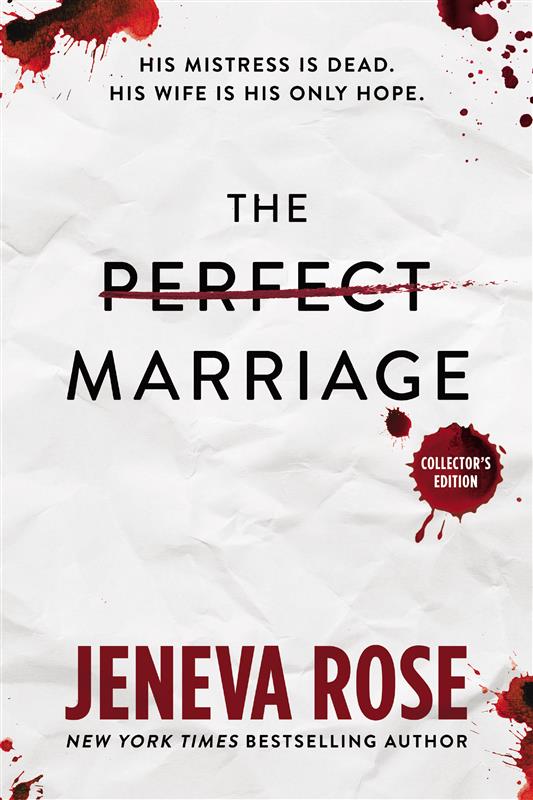
The Perfect Marriage (2020)
Series
Select Sections to Print
×Book Details
The Perfect Marriage (2020)
Series
Jump to Section
⚠️ Trigger Warnings
- Graphic violence
- Murder
- Stabbing
- Blood and gore
- Sexual assault / rape
- Rough sex
- Domestic abuse
- Physical abuse
- Verbal abuse
- Infidelity
- Drug addiction
- Heroin use
- Drug overdose
- Death of a pregnant woman
- Pregnancy loss / death of an unborn child
- Police brutality
- Capital punishment / execution
- Suicide references
- Self-harm references
- Death and grief
⏱️ 2-Minute Spoiler Summary
Successful defense attorney Sarah Morgan discovers that her husband, Adam, has been having a sixteen-month affair with Kelly Summers. When Kelly is found stabbed thirty-seven times in the Morgans’ lake house, Adam is arrested for her murder. Sarah surprisingly becomes his defense attorney and uncovers Kelly’s secret past: her real name was Jenna Way, she had once been accused of murdering her first husband, and Sarah’s colleague Bob Miller is actually that man’s brother, Nicholas Miller.
Despite several alternative suspects, Adam is convicted and sentenced to death. Eleven years later, Sarah visits him at his execution and reveals that she knows he is innocent—because she killed Kelly herself. Sarah had learned about Adam’s affair from Bob, with whom she was secretly having an affair of her own. Together, they plotted revenge. Sarah drugged Adam, murdered Kelly in front of him, and then deliberately allowed him to be convicted while pretending to defend him. Adam is executed, while Sarah ends up married to Bob and raising their daughter, Summer, having successfully eliminated both Kelly and her cheating husband.
📖 Full Spoiler Summary
A Marriage That Isn’t So Perfect
From the outside, Sarah Morgan and Adam Morgan look like a successful Washington, D.C. power couple. Sarah is a highly accomplished criminal defense attorney, while Adam is a novelist still struggling to achieve the kind of success his wife enjoys. After ten years of marriage, the imbalance between them has become impossible to ignore. Sarah spends most of her time working, and Adam increasingly feels like an afterthought in her life.
Rather than confronting the problems in his marriage, Adam finds fulfillment elsewhere. For sixteen months, he has been having an affair with Kelly Summers, a waitress he met at a café near the Morgans’ secluded lake house in Brentsville, Virginia. The lake house becomes their regular meeting place, allowing Adam to maintain a secret relationship while Sarah remains consumed by her career.
That arrangement ends violently when Kelly is found murdered in the lake house—in Adam and Sarah’s bed. She has been stabbed thirty-seven times.
Adam immediately has a serious problem. He was at the house, his DNA is on Kelly, and there is no question that the two were having sex. Sheriff Ryan Stevens and Deputy Marcus Hudson quickly make him their primary suspect and place him under arrest.
Sarah learns two devastating things almost simultaneously: her husband has been cheating on her for more than a year, and he is now accused of brutally murdering his mistress.
Instead of walking away from him, she decides to defend him.
Sarah Takes Her Husband’s Case
Sarah’s decision shocks nearly everyone around her. She insists that whatever Adam has done to their marriage, that does not mean he murdered Kelly. As an experienced defense attorney, she knows how easily circumstantial evidence can make someone appear guilty, and she begins preparing to save her husband’s life.
Adam’s situation becomes even more dangerous because Kelly was married. Her husband, Scott Summers, is a police officer, and he is furious about the affair. While Adam is in custody, Scott viciously attacks him, leaving him hospitalized with a broken cheekbone.
As Sarah investigates Kelly’s background, she discovers that the murdered woman was hiding much more than an affair. Kelly Summers isn’t even her real name.
She was born Jenna Way, and years earlier, she had been accused of murdering her first husband, Greg. The case took place in Wisconsin, but the charges against Jenna were eventually dismissed after crucial evidence mysteriously disappeared. Even more suspiciously, Scott had been one of the officers involved in that investigation.
Sarah now has another possible version of Kelly’s story: perhaps Scott wasn’t simply the betrayed husband everyone thinks he is. He had helped Jenna escape a murder charge years earlier and then married her.
Adam Starts Investigating for Himself
Adam becomes increasingly desperate to prove that someone else had a reason to kill Kelly. While his case is moving toward trial, he is contacted by Rebecca Sanford, who presents herself as a reporter interested in hearing his side of the story. Adam eventually hires Rebecca to investigate Greg’s family, particularly Greg’s brother, Nicholas Miller.
If Nicholas believes Jenna murdered Greg and escaped justice, Adam reasons, he has an obvious motive for revenge.
At the same time, Sarah’s decision to represent Adam creates problems at her law firm, Williamson & Morgan. Her colleague Bob Miller and senior partner Kent Williamson worry about the attention the case is bringing to the firm. Sarah is also dealing with Eleanor Morgan, Adam’s mother, who makes it clear that she believes Sarah’s obsession with work helped drive her son into another woman’s arms.
Adam, however, becomes suspicious of Sarah herself after examining a threatening note he previously received that read, “End it or else I will.” He realizes the handwriting looks remarkably similar to Sarah’s handwriting on Post-it notes she has left around the house.
The discovery terrifies him, but instead of immediately concluding that Sarah killed Kelly, Adam becomes convinced that Sarah’s assistant, Anne, may somehow be involved. He violates the conditions of his house arrest and heads to Sarah’s office to confront her.
What he finds there only makes the case stranger.
Bob Miller’s Real Identity
At Sarah’s office, another major secret comes out: Bob Miller is actually Nicholas Miller, Greg’s brother.
The man Adam has been trying to track down has been working beside Sarah all along.
Bob has every reason to hate Kelly. He believes she murdered his brother and escaped punishment, giving him a strong motive for wanting her dead. Between Bob’s connection to Kelly’s past, Scott’s suspicious involvement in her old murder case, and the unanswered questions surrounding the threatening note, Sarah has several possible ways to create reasonable doubt.
Her defense focuses heavily on Kelly’s hidden history and the possibility of corruption within law enforcement. If the investigation was compromised by officers with personal connections to Kelly, then the evidence against Adam cannot necessarily be trusted.
But none of it is enough.
Despite Sarah’s efforts, the prosecution convinces the jury that Adam murdered his mistress. He is found guilty and sentenced to death.
Sarah loses the case, and Adam spends the following years waiting to be executed for a murder he insists he did not commit.
Adam’s Execution
Eleven years pass.
On the day Adam is finally scheduled to die, Sarah comes to see him. By now, there is nothing left she can do for him. His appeals have failed, his sentence stands, and he is strapped down to receive a lethal injection.
Sarah approaches him during his final moments and whispers something that completely changes Adam’s understanding of everything that has happened.
“I know for a fact it wasn’t you.”
Only then does Adam realize the truth.
Sarah didn’t fail to save an innocent man.
She deliberately made sure a guilty verdict would stick.
Sarah Was the Killer
Long before Adam’s arrest, Sarah had discovered his affair. Bob Miller, who knew Kelly as Jenna Way and wanted revenge for his brother Greg’s death, told Sarah what Adam was doing.
But Bob and Sarah weren’t merely colleagues exchanging information. They had become lovers, and together they devised a plan that would solve both of their problems. Bob wanted revenge against Kelly, while Sarah wanted to punish Adam for betraying her without allowing a divorce to threaten everything she had worked for.
On the night Kelly died, Sarah drugged Adam with Rohypnol, leaving him conscious enough to witness what was happening but unable to stop it or properly remember it afterward. She placed a plastic tarp over him and murdered Kelly in front of him, stabbing her repeatedly.
Adam had been at the murder scene because Sarah needed him there.
His affair ensured that his DNA would be found on Kelly. His presence at the lake house made him the obvious suspect. Their secret relationship gave prosecutors a believable motive and explanation for why Kelly was in the Morgans’ bed.
Sarah then took control of Adam’s defense herself.
For years, Adam believed his wife had stood beside him despite his betrayal. In reality, the person responsible for proving his innocence was the same person who had framed him.
Sarah had orchestrated the entire situation so carefully that Adam would never understand what happened until it was too late to do anything about it.
Sarah Gets Her Perfect Ending
Adam dies knowing the truth but unable to expose Sarah.
By the end of the novel, Sarah has built an entirely new life with Bob Miller, the man who helped set everything in motion. The two are now married and have an eight-year-old daughter named Summer.
Sarah has also protected the career, money, and future she feared losing if she simply divorced Adam. Instead of allowing his affair to dismantle the life she had built, she arranged for Adam to take the blame for Kelly’s murder and spent years maintaining the appearance of the devoted wife who had fought desperately to save him.
Only at his execution does she finally allow him to understand what she did.
Adam’s affair with Kelly ultimately costs both of them their lives: Kelly is murdered by Sarah, while Adam is executed for the crime. Sarah walks away untouched, free to enjoy the life she planned with Bob and their daughter.
🔚 Ending Explained
How Does The Perfect Marriage End?
The Perfect Marriage ends with the ultimate betrayal: Adam Morgan is executed for Kelly Summers’s murder, only for the epilogue to reveal that Sarah Morgan orchestrated the entire thing. She murdered Kelly herself and deliberately manipulated the investigation and trial so that her cheating husband would take the fall.
Adam’s Execution
The story jumps forward eleven years, to the day of Adam’s execution. Sarah visits him at the maximum-security prison, presenting herself as the devoted wife who has continued to stand beside him all these years.
But there is something unnervingly deliberate about her behavior. As they sit together, Sarah squeezes Adam’s hand once every minute, silently counting down the remaining moments of his life.
Adam is eventually strapped to the gurney for lethal injection. Just before the execution begins, Sarah leans close and delivers the sentence that finally tells him the truth:
She knows for a fact that he didn’t kill Kelly.
Only then does Adam understand what has happened. Sarah never failed to save him. She never intended to save him at all.
As the lethal drugs enter his system, Adam looks through the glass and sees the sinister hint of a smile on Sarah’s face. His wife—the brilliant defense attorney he believed was fighting desperately for his freedom—has actually been controlling his fate from the beginning.
Sarah Killed Kelly
The epilogue finally reveals the full conspiracy.
Sarah discovered that Adam had been having an affair with Kelly through her colleague Bob Miller, whose real identity is Nicholas Miller. Nicholas was connected to Kelly through her first husband and had his own reason for wanting revenge.
For Sarah, however, Kelly’s murder solves another problem entirely.
She does not want a divorce.
After everything Sarah has accomplished, she refuses to watch Adam walk away with half of what she has earned. Instead of ending her marriage, she decides to eliminate both the mistress and the husband who betrayed her.
Sarah drugs Adam by putting Rohypnol in his scotch. Once he is incapacitated, she places him beneath a clear plastic tarp, creating what she chillingly thinks of as a “viewing window.” Then, with Adam helpless nearby, Sarah stabs Kelly thirty-seven times.
From that point forward, Sarah uses the very skills that made her an exceptional defense attorney to ensure Adam is convicted.
Her supposed investigation is largely theater. She uses Jesse Hook as a convenient alternative suspect, giving the appearance that she is vigorously defending Adam while quietly steering events toward the outcome she wants. She also discovers evidence suggesting Sheriff Stevens was involved with Kelly, but keeps that information from becoming useful to Adam’s defense.
Sarah does not merely get away with murder.
She weaponizes the justice system to execute her husband for it.
What the Ending Means
The central irony of The Perfect Marriage is that Sarah really does prove herself to be an extraordinary defense attorney—just not for Adam.
She is defending herself.
Everything that initially looks like loyalty can be reinterpreted after the reveal. Sarah taking Adam’s case is not an astonishing act of forgiveness. It gives her control over his defense, access to the evidence, and the ability to influence which possibilities are pursued and which are quietly abandoned.
Even Adam’s execution becomes Sarah’s final performance.
Her repeated hand squeezes initially resemble affection between spouses facing an unbearable goodbye. In reality, they function almost like the ticking of a clock. Sarah has spent the novel controlling the timing of events, and now she literally counts down Adam’s remaining minutes. A loving gesture becomes an expression of absolute power.
Her clothing reinforces the same contradiction. Sarah arrives dressed in white, imagining herself as an “angel of death.” White traditionally suggests innocence, purity, and virtue—the exact image Sarah has successfully projected. Beneath that immaculate exterior, however, is the person responsible for the bloodshed.
That contrast captures Sarah perfectly: respectability is her camouflage.
Sarah’s Idea of Survival
The revelation about Sarah’s mother also makes the ending considerably darker.
Sarah grew up burdened by her mother’s heroin addiction and eventually facilitated the overdose that killed her. That experience appears to have shaped Sarah’s ruthless understanding of survival: vulnerability makes you dependent upon other people, while control keeps you safe.
Adam’s affair therefore represents more than infidelity. It threatens the identity Sarah has constructed for herself—the successful lawyer, wealthy woman, and person who will never again be powerless.
Her response is grotesquely disproportionate, but perfectly consistent with her worldview.
She does not forgive betrayal.
She removes the threat.
And because Sarah narrates her choices in practical terms, the ending becomes particularly unsettling. She does not see herself as the villain. In her mind, she simply recognized a problem and solved it.
The “Perfect” Marriage
The title becomes completely ironic by the final pages.
Sarah and Adam’s marriage was never perfect. It was built upon resentment, neglect, ambition, secrecy, and infidelity. But Sarah ultimately achieves her own warped version of perfection by removing Adam altogether.
Eleven years later, she is married to Bob/Nicholas, and they are raising their eight-year-old daughter, Summer, at the lake house where Kelly was murdered.
Sarah now considers the house a paradise because Adam’s presence—his “patina of filth”—has effectively been scrubbed away.
That image is deeply disturbing because nothing has actually been cleansed. The supposedly perfect home is built directly on the site of Sarah’s crime. Her marriage, family, wealth, and peaceful domestic life exist because Kelly was murdered and Adam was executed for it.
Summer therefore represents the most ominous implication of the ending. She is an innocent child growing up inside the “perfect” life Sarah manufactured through violence and deception.
There is no remorse, reckoning, or moral awakening waiting for Sarah in the final pages. She has gotten exactly what she wanted.
And that is what makes the ending so chilling: justice does not prevail. Sarah does.
👤 Characters & Fates
🔶 Main Characters

Sarah murdered Kelly after drugging Adam, then let him take the blame. Eleven years later, she reveals the truth moments before his execution and ends up married to Bob/Nicholas, raising their daughter Summer at the lake house.

Adam is innocent but convicted and sentenced to death. After eleven years in prison, Sarah tells him she knows he didn't kill Kelly just before he is executed by lethal injection.

Kelly previously murdered her first husband, Greg, fled Wisconsin, and assumed a new identity. She is four weeks pregnant with Adam’s child when Sarah stabs her thirty-seven times.

Bob becomes Sarah’s lover and accomplice, helps provide her alibi, and later marries her. Together they raise their daughter, Summer, after Adam’s conviction.
🔷 Supporting Characters
Sarah forgives Anne after learning the truth because her devotion makes her useful and easy to manipulate, and Anne remains her assistant.
Matthew remains Sarah’s closest confidant and is set to walk her down the aisle when she marries Bob/Nicholas.
Stevens conceals his involvement and conducts a sloppy investigation, including overlooking the Rohypnol in Adam’s system, inadvertently helping Sarah successfully frame Adam.
Scott flees before the trial ends, fearing exposure of his own crimes and his role in helping Kelly cover up evidence connected to Greg Miller’s murder.
Eleanor watches Adam’s execution and apologizes to Sarah afterward, never discovering that Sarah actually murdered Kelly and deliberately sent her son to his death.
Rebecca deliberately steers Adam toward clues that make him behave suspiciously and then disappears once her role in Sarah and Bob’s scheme is complete.
Hudson faces no major consequences and remains with local law enforcement, attending Adam’s trial in uniform.
Kent allows Sarah to keep working at the firm but temporarily cuts her profit-sharing while the case is ongoing.
Josh successfully convinces the jury that Adam murdered Kelly and secures the death sentence that ultimately leads to Adam’s execution.
Jesse is ultimately cleared when his DNA and handwriting fail to match the evidence.
Summer grows up at the lake house unaware that her mother murdered Kelly there and that both of her parents conspired to frame Adam for the crime.
Sarah reveals that on her sixteenth birthday she deliberately facilitated her mother’s fatal heroin overdose, making Kelly far from her first intentional killing.
🕳️ Potential Plot Holes
Sarah claims she slipped away from drinks with Anne around 10:00 PM, drove to the lake house, murdered Kelly, and returned without Anne realizing she had been gone. But the lake house is more than an hour from D.C. each way. Even without accounting for the time needed to drug Adam, prepare the room, murder Kelly, clean herself up, dispose of the knife and tarp, and leave the scene, Sarah would have been missing for well over two hours. Anne being drunk might explain her fuzzy memory of the evening, but it doesn't explain how Sarah's lengthy disappearance went unnoticed while Anne was supposedly providing her alibi.
📚 Book Club Q&A's
⭐ Final Rating & Thoughts
I had such a good time with The Perfect Marriage. It’s messy, dramatic, ridiculously addictive, and exactly the kind of domestic thriller that makes it very easy to say, “Okay, just one more chapter.”
The story revolves around a successful defense attorney whose husband is accused of murdering his mistress, and from there, the secrets, betrayals, and questionable decisions just keep piling up. There’s definitely a slightly over-the-top, soap-opera quality to the whole thing, but honestly, that was part of the fun. I wasn’t looking for subtle, and this delivered.
My biggest issue is that I actually figured out where the story was heading. That almost never happens because I’m usually far too lazy to sit around trying to solve the mystery before the book does it for me. 😂 So when I predict a thriller’s big reveal, it probably could have been hidden a little better.
Still, knowing where it was going didn’t ruin the ride. I was completely entertained and happily kept turning the pages.
Twisty, trashy, dramatic fun, even if the twist wasn’t quite twisty enough.
✨ Adaptation description
The Perfect Marriage — Film Adaptation
Jeneva Rose’s bestselling psychological thriller The Perfect Marriage is being developed as a feature film by Picture Perfect Federation and Zurich Avenue. The adaptation was first announced in October 2022. (Federation Studios)
Current status: In development; there is no announced release year, cast, or filming date as of August 2026.
Director: Sigal Avin (Losing Alice)
Screenplay: Academy Award-nominated screenwriter William Broyles (Apollo 13, Cast Away)
Producers: Patrick Wachsberger and Ashley Stern for Picture Perfect Federation
Executive producers: Karl Spoerri and Viviana Vezzani for Zurich Avenue, William Broyles, and Adam Berkowitz
Co-executive producer: Olivia Wachsberger (Federation Studios)
✨ Books Like The Perfect Marriage (2020)
See an error on this page?