
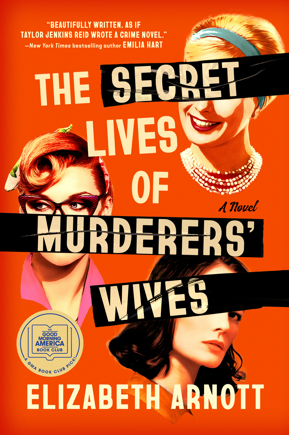
The Secret Lives of Murderers’ Wives (2026)
Select Sections to Print
×Book Details
The Secret Lives of Murderers’ Wives (2026)
Jump to Section
⚠️ Trigger Warnings
- Domestic abuse and intimate partner violence
- Physical assault and emotional abuse
- Sexual violence and aggression
- Choking and strangulation
- Serial murder
- Graphic murder and mutilation
- Stabbing and shooting
- Corpse desecration and decomposition
- Kidnapping and abduction
- Forced captivity and restraint
- Sexual harassment and coercion
- Sexual predators and abuse of power
- Voyeurism and stalking
- Exhibitionism
- Masturbation
- Erotic asphyxiation
- Violent pornography
- Alcoholism
- Prescription drug abuse
- Child endangerment and distress
- Aggressive behavior in a child
- Sleepwalking
- Fear of inherited psychopathy/violent tendencies
- Death and grief
⏱️ 2-Minute Spoiler Summary
Five years after discovering that their husbands were murderers, Beverley Lightfoot, Margot Green, and Elsie Parker are drawn into a new serial-killer investigation when young California women begin turning up dead in elaborately staged crime scenes. Their search initially leads toward abusive mechanic Hank Farrer and then his movie-obsessed teenage son, Peter, especially after Peter’s Polaroid camera appears at a murder scene.
But the evidence against Peter has been deliberately planted. The real killer is Detective Roger Greaves, Beverley’s longtime lover. Angry about being passed over professionally, Roger has been committing spectacular murders modeled after famous movies so he can frame Peter and then become famous for solving the case himself. Roger has also imprisoned his suspicious wife, Enid, in his basement—the captive woman whose perspective appears throughout the novel.
Beverley, Margot, and Elsie discover Enid and attempt to rescue her, but Roger returns and attacks them. Enid gets hold of his gun and shoots him before he can kill Beverley. Roger survives and receives life in prison. Six months later, Elsie has become a crime reporter, Margot has begun therapy and a new relationship, and Beverley finally burns the true-crime scrapbook she has obsessively kept since her marriage to the Heatwave Killer, symbolically closing the door on the fear that has controlled her life.
📖 Full Spoiler Summary
The Secret Lives of Murderers’ Wives is told mainly in third-person limited, moving between Beverley Lightfoot, Margot Green, and Elsie Parker, three women whose lives are forever linked by the horrifying discovery that each was married to a murderer.
Their stories are interrupted by short, italicized sections labeled “Days Missing.” These chapters switch to first person and follow an unidentified woman being held captive in a dark basement. Her identity—and the person responsible for keeping her there—doesn’t become clear until the mystery is nearly solved.
Three Murderers’ Wives
California is baking under a brutal summer heat wave in 1966 when Beverley Lightfoot, Margot Green, and Elsie Parker find themselves pulled back into the kind of nightmare they thought they had escaped five years earlier.
All three were once married to killers. Beverley’s ex-husband, Henry Lightfoot, became infamous as the “Heatwave Killer” after murdering seven women in the Bay Area. Margot’s wealthy politician husband, Stephen Green, murdered eight people before killing himself in jail. Elsie’s husband, Albert Moss, murdered several women, including his student Lucy Glass, whose body he concealed in the crawl space beneath their home.
The women became friends after their husbands’ crimes turned them into public spectacles. They were blamed, mocked, and treated as though they should somehow have known what the men closest to them were capable of doing. Eventually, they made a pact: no contact with their murderous husbands and no allowing those men to control the rest of their lives.
Beverley is the one having the hardest time keeping that promise.
On July 3, she attends an LAPD gala at the urging of Chief Tom Cornwell, the ambitious police official who helped bring Henry down. Beverley publicly discusses cooperating with the investigation into her husband, while privately hiding something that could cause another scandal: she has been having a years-long affair with Detective Roger Greaves, the handsome detective who helped arrest Henry.
Roger is married to Enid Greaves, although Beverley has been led to believe their marriage is essentially over.
The gala is interrupted when Roger and Cornwell are called to a murder scene. Twenty-one-year-old track athlete Cheryl Jean Herrera has been strangled. Her killer has put a synthetic blond wig over her dark hair and driven an arrow through her eye.
Then another young woman dies.
Twenty-year-old cheerleader Emily Roswell is pulled from a lake at the Meadow Vine Golf Course. She has been stabbed repeatedly, and the words “LOVE” and “HATE” have been crudely tattooed across her knuckles.
Someone is killing young women again, and Beverley, Margot, and Elsie know better than most how dangerous it can be when everyone is looking in the wrong direction.
The Women Start Investigating
The police quickly push the theory that Cheryl’s death was connected to a gang called the Kings. Elsie and Margot don’t buy it. Beverley wants nothing to do with another murder investigation, but her friends convince her that their experiences with Henry, Stephen, and Albert have given them an understanding of killers that most people simply don’t have.
Each woman begins following her own leads.
Elsie works at the Los Angeles Signal as an assistant to the sexist editor Paul Hunter, but she wants to become a real reporter. She finds an ally in Patti Fowler, a confident journalist who takes Elsie seriously and encourages her instincts. Elsie visits Cheryl’s grieving father, Mr. Herrera, and learns that Cheryl’s silver bracelet, engraved with the initials “CJH,” disappeared when she was murdered. Elsie also notices a suspicious man watching the mourners from a utility van and sketches the blurry logo she sees on its side.
Margot investigates another missing young woman, Diane Howard Murray, a twenty-one-year-old model from the poor Golden Point neighborhood. A local dealer named Ray Roberts points her toward Diane’s grandmother, Pearl, who reveals that Diane was strangled and then dressed in an expensive coat and suspenders before being posed like a mannequin.
Margot learns that Diane had been corresponding with predatory Hollywood director Mason Clarke and sneaks into one of his parties to confront him. Clarke seems like exactly the kind of man who could be responsible, but his alibi destroys the theory: he was in Capri during all three murders.
Beverley takes a more dangerous route. She has become terrified that her seven-year-old son, Benjamin, might have inherited something violent from Henry, especially because the boy has begun sleepwalking and struggling emotionally. Desperate for reassurance, she secretly visits Henry at San Quentin, breaking the pact she made with Margot and Elsie.
Henry enjoys having Beverley come back to him. He taunts her, but he also offers his assessment of the new murderer. This killer hates women, Henry says, but he is also performing for an audience. The elaborate staging of the bodies is deliberate. He is pushing boundaries and trying to create something “poetic” with his crimes.
Soon afterward, Beverley discovers a slaughtered pig on her lawn, its throat cut. Whether it is connected to the murders or meant simply to terrify her, the message is clear: Beverley is no longer observing the danger from a safe distance.
The Police Are Hiding Something
Elsie and Patti eventually connect the logo on the suspicious van to the cleaning company that employed Diane. The company belongs to Sean Wilson, who cleans local athletic facilities, making him another possible suspect.
Their digging also exposes something much bigger inside the police department.
Roger quietly encourages Elsie to investigate Chief Cornwell’s expensive anti-gang surveillance program. She and Patti discover that the equipment is being supplied by Broderick Arnold, Cornwell’s brother-in-law—and Margot’s wealthy boss and lover at Arnold’s Department Store.
Cornwell has been pouring public money into a program that financially benefits his own family. Even worse, he has an incentive to keep blaming the Kings for violent crimes because doing so justifies the continued spending. His corruption has helped steer attention away from the possibility that a serial killer is operating in California.
The women also visit a church café in Calabasas run by Betty, who provides a safe haven for vulnerable young women. Betty keeps a “Beware Book” containing descriptions of dangerous men her girls have encountered, and she allows Elsie to borrow pages from it in case they prove useful.
The more immediate breakthrough comes from Beverley. Appearing on the live television program The California Day, she abandons the safe statement she was supposed to deliver and instead warns women watching at home to lock their doors and pay attention to the men in their lives.
Her warning reaches Sharon Farrer, who writes to Beverley because she is frightened of her husband, Hank. Beverley meets Sharon at a diner, where Sharon describes Hank’s increasingly volatile and abusive behavior, including forcing her to scrub her face raw while he watches. Then she produces something far more alarming: the silver “CJH” bracelet that belonged to murdered track athlete Cheryl Jean Herrera. Sharon found it near the brake pedal of Hank’s truck.
The Wrong Farrer
Beverley immediately takes the bracelet to Elsie and Margot, and the three women visit the Farrer home to learn more. Before they leave, Elsie asks Sharon for Hank’s license plate number.
Back at her apartment, Elsie remembers the pages she borrowed from Betty’s “Beware Book” and begins cross-referencing its entries. Hank’s license plate appears in the book under a false name, connecting him to a previous violent encounter involving erotic asphyxiation.
Now the women have two disturbing pieces of evidence pointing toward the same man: Cheryl’s missing bracelet was found inside Hank’s truck, and his license plate appears in a private record of men known for dangerous behavior toward women. Combined with Sharon’s account of his abuse, it seems almost impossible to dismiss as coincidence.
Convinced that Hank Farrer may be the killer, Beverley, Margot, and Elsie begin staking out his garage.
Then Kate McKenzie, a talented young horse rider and musician, is murdered in her shower while Hank is at the garage under their surveillance.
Hank cannot be the killer.
Their mistake nearly gets them killed when Hank discovers them watching him and pulls a gun. They escape, but the investigation has also damaged their friendship. Margot and Elsie discover that Beverley has been secretly visiting Henry and are furious that she broke their pact.
At the same time, another victim appears. Sarah Gunn, a wealthy young majorette, is found hanging from a hook on her parents’ porch.
The murders are becoming increasingly theatrical, but no one has figured out why.
The Movie Connection
The breakthrough comes from an unexpected source.
Roger accidentally leaves a Polaroid photograph at Beverley’s house. It shows the scene of Kate McKenzie’s murder, and in the photo, Beverley notices a distinctive Polaroid camera with a checked strap lying in the grass.
She has seen that camera before. It belongs to Sharon and Hank’s teenage son, Peter Farrer, an aspiring filmmaker.
Suddenly, Peter looks like the perfect suspect. He loves movies, has access to the camera found at a crime scene, and could potentially explain why the murders have such an elaborate visual quality.
Beverley takes the details to her elderly neighbor, Christopher Appleton, a former Warner Brothers props employee and devoted movie fan. Christopher immediately recognizes what everyone else has missed.
The murders are recreating scenes and images from films.
Kate’s shower murder echoes Psycho. Sarah hanging from a hook resembles On the Waterfront. The words “LOVE” and “HATE” on Emily’s knuckles come from The Night of the Hunter. Cheryl’s arrow through the eye points to Eye of the Devil. Diane’s carefully arranged clothing resembles the imagery of Blood and Black Lace.
Beverley, Margot, and Elsie reconcile long enough to act on what seems like the answer. Peter is a young cinephile, and everything appears designed around his obsession with movies.
They race to the Farrer house to warn Sharon.
Instead, Sharon tells them something that turns the entire case around.
Peter didn’t lose his Polaroid camera.
The police confiscated it weeks ago.
And the detective who took Peter’s camera and the family’s fingerprints was Roger Greaves.
Roger Greaves Is the Killer
Sharon’s revelation about Peter’s camera makes everything fall into place. Peter Farrer never lost the Polaroid camera found at Kate McKenzie’s murder scene. Detective Roger Greaves had confiscated it weeks earlier, along with the Farrers’ fingerprints. If the camera later turned up beside a victim, Peter couldn’t have put it there. Roger had.
Beverley finally sees what Roger has been doing. Frustrated by being repeatedly passed over for promotion, he decided to manufacture the kind of spectacular serial-killer case that could make his career. He would commit the murders himself, build the evidence around an innocent suspect, and then become the celebrated detective who solved the “crime of the decade.”
Peter was an ideal person to frame. Roger regularly brought LAPD patrol cars to Hank Farrer’s garage for repairs, giving him access to the family and their vehicles. During those visits, he noticed that Peter was a moody teenager obsessed with movies and determined to become a filmmaker. Roger then designed the murders around famous films so that, once Peter was identified as the suspect, his interest in cinema would appear to explain the bizarre staging of the bodies.
Roger had been planting evidence against the Farrers all along. He stole Peter’s Polaroid camera and eventually left it at Kate McKenzie’s murder scene. He also took the silver “CJH” bracelet belonging to Cheryl Jean Herrera and tossed it near the brake pedal of Hank’s truck, apparently assuming that Hank and Peter shared the family vehicles. That was why Sharon had found such damning evidence in her husband’s truck. Hank really was violent and abusive, but the physical evidence connecting his family to the serial murders had been deliberately planted.
Beverley, Margot, and Elsie break into Roger’s house looking for proof and discover a hidden room filled with his plans and crime-scene sketches. Then they hear a scratching sound coming from behind a locked door near the kitchen.
They force their way through and descend into the basement, where they finally discover what happened to Roger’s missing wife, Enid Greaves. She is the unidentified captive whose ordeal has been unfolding throughout the novel in the “Days Missing” chapters.
Enid is emaciated, gagged, and bound to a pipe with cable ties. She had begun to suspect Roger weeks earlier after realizing that one of her Burberry trench coats was missing. Roger had taken the coat to use when staging Diane Howard Murray’s body. When Enid confronted him about it, he beat her and imprisoned her in the basement rather than risk having her expose him.
Elsie uses a pair of garden shears to begin cutting Enid free, but before the women can get her out of the house, Roger comes home.
He attacks Elsie at the top of the basement stairs and knocks her unconscious. Beverley is trapped below with Roger, who no longer has any reason to hide what he is. He corners her and raises the heavy garden shears, preparing to kill her.
But Roger has underestimated Enid.
Despite being starved, beaten, and imprisoned for weeks, she has managed to get hold of his gun. Enid points it at her husband and shoots him in the chest, stopping him before he can kill Beverley.
The detective who engineered an entire serial-killer investigation around his ability to manipulate evidence and outthink everyone around him is ultimately brought down inside his own home by the wife he thought he had successfully silenced.
Six Months Later
Roger survives the shooting and accepts a plea deal that will keep him imprisoned for life while sparing Enid from having to endure a public trial. Later, Beverley receives a card from Enid containing only one word: strength.
The three friends finally begin moving beyond the men who once defined their lives.
Elsie becomes a crime reporter at the Los Angeles Signal, with Patti continuing to support her career. Her writing about the murdered women is being turned into a book. Margot begins therapy and starts seeing someone new.
Beverley also begins releasing the fear she has carried since discovering what Henry was.
Six months after Roger’s capture, she gathers with Margot, Elsie, and Christopher in her yard for mimosas. Her children are nearby, laughing and playing.
Beverley brings out the scrapbook in which she has obsessively collected newspaper clippings about crimes for years. It has been her way of watching for danger and trying to understand how she failed to recognize what Henry was capable of doing.
She no longer wants it.
Beverley throws the scrapbook into the fire and watches it burn, finally allowing the record of all that fear and guilt to disappear into smoke.
🔚 Ending Explained
The final confrontation takes place in the basement of Detective Roger Greaves’ house, where Beverley Lightfoot, Elsie Parker, and Margot Green finally discover what happened to Roger’s missing wife, Enid. She is alive, but barely—emaciated and bound to a pipe with cable ties.
Elsie manages to cut Enid free with a pair of garden shears, but Roger comes home before they can get her out. He attacks Elsie at the top of the basement stairs, knocking her unconscious, then drags Beverley back downstairs. Beverley is already badly injured after slicing herself on broken window glass during the break-in, and Roger uses the moment to gloat. Holding the shears near her neck, he boasts about how clever he has been and how thoroughly he has fooled everyone.
What Roger fails to notice is Enid.
She steps out of the darkness holding his gun and shoots him in the chest. Then she turns one of his favorite assumptions against him: Roger has always believed that being a detective makes him smarter than the women around him, but Enid points out that no one has spent more time watching and understanding the way he thinks than his own wife.
Roger survives.
Six months later, he accepts a plea deal and confesses to the five murders as well as Enid’s kidnapping and imprisonment. He is sentenced to life in prison. Even then, Roger cannot resist trying to make himself the hero of the story, claiming that he pleaded guilty to protect Enid from the humiliation of a public trial. It is one last attempt to control how people see him, even after everyone finally knows exactly what he is.
The women, meanwhile, have begun building lives that are no longer defined by the murderous men they married.
Elsie has published a book about Roger’s five victims, deliberately putting the women rather than their killer at the center of the story. Her work also earns her a promotion to the crime desk at the Signal, where she continues working under Patti.
Margot finally seeks therapy for the trauma she has spent years carrying—and, in a somewhat cheekier development, ends up dating her therapist.
And Beverley begins to loosen her grip on the constant vigilance that has ruled her life since discovering the truth about Henry.
The novel closes in Beverley’s backyard on a cool spring evening. Her children are playing nearby, her friends are with her, and her neighbor Christopher Appleton arrives carrying a slightly burned, lopsided cake.
Beverley brings out the true-crime scrapbook she has kept for years. It contains the murders, disappearances, newspaper clippings, and reminders of violence she has compulsively collected ever since Henry’s crimes were exposed.
She throws it into the fire.
As the pages burn and disappear into smoke, Beverley finally allows herself to stop watching for the next terrible thing.
What the Ending Means
The ending is really about who gets to tell the story after a murderer is caught.
For years, Beverley, Elsie, Enid, and Margot have existed in relation to violent men. They are murderers’ wives, and that label has followed them long after those marriages ended. Roger operates from the same assumption: the women around him are supporting characters in his story. Even after he is caught, he tries to frame his guilty plea as an act of generosity toward Enid.
The ending quietly takes that power away from him.
Beverley burning the scrapbook
The scrapbook is probably the clearest symbol in the final chapter. Beverley has convinced herself that if she pays close enough attention to violence, she might recognize it before it reaches her again. Her obsession with crime is partly fear and partly penance. She still carries guilt over having lived with Henry without realizing what he was doing.
Burning the scrapbook means accepting that she cannot protect herself by anticipating every possible horror.
That realization is especially important because Beverley finally understands that terrible things do not happen because someone failed to notice the correct warning sign. She cannot make the world orderly simply by becoming more vigilant.
She also doesn’t have to spend the rest of her life punishing herself for Henry’s crimes.
Enid gets the final word
Enid shooting Roger is particularly satisfying because Roger has spent years underestimating her.
He sees his wife as passive and intellectually inferior. Yet Enid has been studying him simply by surviving beside him. When she uses his own gun against him, she proves that the qualities he dismissed in her—patience, observation, familiarity with his habits—are exactly what allow her to defeat him.
Her line about knowing how to think like a cop because she is a cop’s wife turns Roger’s worldview upside down. He thought proximity to him made Enid insignificant. In reality, it made her uniquely capable of understanding him.
Elsie refuses to make another killer famous
Elsie’s book carries the same idea into the public sphere.
Rather than writing the sensational story of Roger Greaves, brilliant detective turned serial killer, she writes about the five women he murdered: who they were, what they wanted, and what their lives might have become.
Roger becomes secondary.
That choice challenges the way true crime can turn killers into fascinating celebrities while their victims become names in a body count. Elsie gives the women back the individuality Roger took from them.
Beverley finally steps out of the role she has been playing
There is also meaning in Beverley taking off the expensive court shoes Margot bought her and throwing them away.
She has spent years feeling as though she must present herself correctly—as the remorseful ex-wife, the responsible mother, the woman appropriately horrified by what her husband did. The shoes belong to that performance.
Barefoot in her own yard, she no longer has to perform for anyone.
The setting reinforces that change. Earlier, Beverley’s life revolves around locks, barriers, windows, and elaborate routines designed to keep danger outside. The final gathering happens outdoors. Her children are playing. Her friends are laughing. She is no longer trying to seal herself away from the world.
Even Christopher’s burned, lopsided cake fits the moment. It isn’t polished or impressive. It’s simply something one lonely person made for other people because he wanted to be with them. After years of appearances and carefully maintained façades, Beverley is surrounded by something much more valuable: imperfect but genuine relationships.
The Change in Season
The weather makes Beverley’s transformation even more obvious.
Much of the novel unfolds beneath an oppressive heatwave. The suffocating temperature mirrors the women’s lives: everything feels trapped, overheated, dangerous, and ready to explode.
By the final chapter, the heat has broken.
It is spring. The air is cool. The light is clear.
The danger hasn’t vanished from the world, but Beverley has stopped living as though danger is the only thing worth noticing.
The Bigger Meaning of the Ending
At its heart, The Secret Lives of Murderers’ Wives rejects the idea that these women should spend their lives answering for the men they married.
Beverley couldn’t have known what Henry would become. Enid isn’t responsible for Roger’s murders. Elsie doesn’t have to remain defined by Albert. Their failure to prevent male violence does not make them complicit in it.
What ultimately saves them isn’t perfect vigilance, either. It is their willingness to believe one another and act for one another.
The novel begins with women who have been isolated by shame and fear. It ends with those same women sitting together in Beverley’s backyard.
And that may be the most important image in the ending. Beverley’s idea of safety has completely changed. Safety is no longer another lock on the door or another clipping added to a scrapbook.
It is having people she trusts on the other side of that door.
When Beverley watches the scrapbook disappear into the fire, she isn’t pretending that evil no longer exists. She is accepting that she doesn’t have to spend the rest of her life waiting for it.
For the first time in years, she can simply live.
👤 Characters & Fates
🔶 Main Characters

She is badly cut breaking into Roger’s basement but survives; six months later, she finally lets go of her guilt, throws away her court heels, and burns her true-crime scrapbook while her children play nearby.

She finally agrees to therapy for her trauma and addictions—then gleefully reveals that she has seduced her therapist.
Roger knocks her unconscious during the basement rescue, but she recovers, becomes a crime reporter at the Signal, and lands a book deal about the murdered women.
Enid shoots him in the chest when he threatens Beverley; he survives with a permanent rasp and accepts life in prison while narcissistically portraying his plea deal as a sacrifice for Enid.

After weeks tied to a pipe and nearly starved to death, she is freed and shoots Roger with his own gun as he threatens Beverley, later testifying against him.
🔷 Supporting Characters

He remains imprisoned at San Quentin, revels in his notoriety, and announces that he plans to marry his penpal Lorraine in prison.
He commits suicide in jail while awaiting trial.
He is serving life at San Quentin after unsuccessfully trying to portray his victims’ deaths as accidents.
He is cleared of Beverley’s suspicions, rescues her tortoise Meatball, and becomes part of the women’s friendship circle, happily joining them with a lopsided homemade cake.
His corruption is exposed, and his career is left in ruins after his trusted deputy Roger is revealed as the murderer.
He ultimately shows no sign of becoming his father and is last seen laughing and playing safely outside as Beverley finally releases her fears.
She survives the story unharmed and is last seen happily playing with Benjamin.
She remains in Beverley’s life and continues babysitting the children while dispensing her usual cutting criticism.
After the case is solved, he finally acknowledges her talent and promotes her to the crime desk.
She remains at the Signal and mentors Elsie after Elsie earns her place on the crime desk.
He is cleared when the scratches turn out to have come from his wife’s new cat, which apparently hates him.
She was strangled, dressed in a blond wig, and shot through the eye with an arrow; Elsie later helps restore her humanity by writing about her life rather than just her murder.
He finally receives justice for Cheryl when Roger is exposed and sentenced to life.
She plans to marry Henry at San Quentin.
She is stabbed and dumped in a lake, but Elsie later memorializes her life through her reporting and book.
Roger chokes her and poses her like a mannequin in designer clothing; after his conviction, her grandmother Pearl finally sees Diane’s killer brought to justice.
He remains in Golden Point running his shoe and illicit-drug business.
She finally receives justice for her granddaughter when Roger is sentenced to life.
He has an airtight Capri alibi and is cleared of the murders; Margot’s confrontation with him is interrupted when a pet crocodile escapes and attacks a party guest.
Patti and Elsie expose his involvement in the scheme to funnel police funds toward his business.
Roger murders her, dresses her in a trench coat, and hangs her from a cargo hook on her parents’ porch in a gruesome reference to On the Waterfront.
She continues running the café and protecting vulnerable women.
Hank and Peter are cleared of murder, but Hank is not imprisoned for abusing her, leaving Sharon and her children trapped with him.
He is completely cleared of the serial murders and remains free, meaning Sharon is still stuck living with her abuser.
Peter is completely exonerated once Roger is revealed as the real murderer.
Roger murders her while she showers in her own bathroom.
Alice catches him masturbating while spying on Beverley, strikes him across the face, and throws him out.
He is professionally humiliated when Roger is exposed as the serial killer.
He dies while Beverley is still young.
She never changes and continues treating Beverley with disdain.
Albert strangles her and hides her decomposing body in the crawl space beneath his and Elsie’s home, where Elsie eventually discovers it.
She remains at home with Sharon and Hank after Hank is cleared of the murders, still living under the shadow of his violence.
After Beverley defies Henry to help Sandie shop for funeral clothes, Henry deliberately drives onto the sidewalk and hits Sandie, breaking her leg and causing her to miss her father’s funeral.
🕳️ Potential Plot Holes
Roger stages Cheryl Herrera’s murder to mimic imagery from Eye of the Devil, including the blond wig and arrow through the eye. The problem is that the film had not yet been released. Christopher Appleton plausibly knows about it because of his former Hollywood studio connections, but Roger has no established connection to the film industry or other explanation for knowing enough about an unreleased movie to reproduce its imagery. The book never explains how he obtained this knowledge.
📚 Book Club Q&A's
⭐ Final Rating & Thoughts
I had so much fun with this one. The premise immediately hooked me, but it was Beverley, Elsie, and Margot who really made the book work. I loved their friendship, their completely different personalities, and especially the idea that their experiences being married to murderers gave them a unique perspective on the new crimes happening around them.
The 1960s California setting was also fantastic. The oppressive heatwave added to the tension, and the chapters from an unidentified captive woman gave the story an extra sense of urgency.
My only real complaint was that the eventual reveal relied on a thriller trope I've seen quite a few times before, so I wasn't completely blown away by it. Thankfully, I was having way too much fun with everything else to care much.
Overall, this was clever, suspenseful, surprisingly funny, and ridiculously easy to fly through. I loved spending time with these women, and would happily read another book about them. Give me a sequel!
✨ Adaptation description
As of August 2026, The Secret Lives of Murderers’ Wives does not have an announced film or television adaptation.
Elizabeth Arnott is represented by the Madeleine Milburn Literary, TV & Film Agency.
✨ Books Like The Secret Lives of Murderers’ Wives (2026)
See an error on this page?