
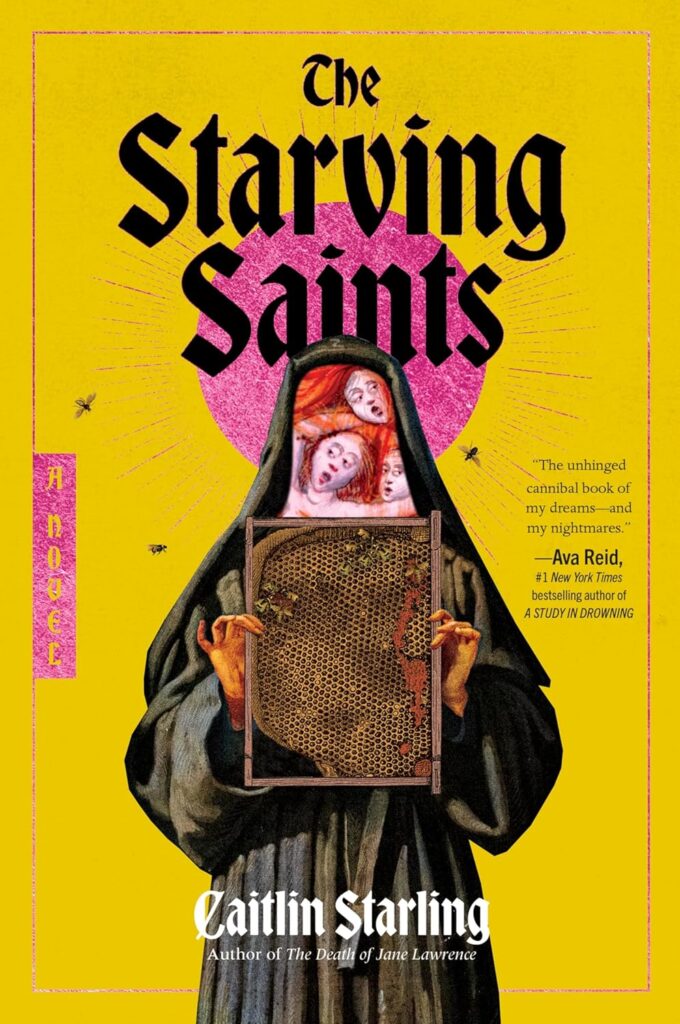
The Starving Saints (2025)
Select Sections to Print
×Book Details
The Starving Saints (2025)
Jump to Section
⚠️ Trigger Warnings
- Severe Starvation and Deprivation
- Cannibalism
- Butchered Human Remains
- Graphic Body Horror
- Amputation and Dismemberment
- Mutilation
- Extreme Graphic Violence and Gore
- Beheading
- Throat Slashing
- Mob Violence
- Desecration of Corpses
- Graphic Dissection and Flaying
- Physical Assault and Choking
- Forced Feeding and Ingestion
- Self-Harm and Suicide
- Animal Cruelty and Death
- Insect and Parasite Infestations
- Swarming Bees
- Vomiting
- Drowning and Choking
- Severe Physical Illness and Infected Wounds
⏱️ 2-Minute Spoiler Summary
Aymar Castle, a stronghold in the kingdom of Carcabonne, has been under siege by the rival army of Etrebia for six months and is nearly out of food. King Cardimir turns to Phosyne, an excommunicated nun and alchemist who previously saved the castle’s water supply, and demands that she find a way to feed the nine hundred people trapped inside. Instead, Phosyne’s experiments inadvertently summon four supernatural beings resembling the Constant Lady, the goddess worshipped throughout Carcabonne, and Her three attendant saints. They arrive with seemingly endless fresh food, but their miracle is horrifying: the crops grow from human body parts, the meat is human flesh, and the creatures use honey and religious devotion to enchant the starving inhabitants.
Among the few people resisting them are Ser Voyne, King Cardimir’s guilt-ridden war hero who initially falls under the Constant Lady’s control, and Treila, a castle rat-catcher secretly seeking revenge against Cardimir and Voyne for the execution of her nobleman father years earlier. Phosyne frees Voyne from the Lady’s enchantment using purified water, while Treila discovers an ancient creature living in a grotto beneath the castle that can transport her through the supernatural barrier surrounding Aymar—but only in exchange for pieces of her body. Treila eventually sacrifices her left little finger to escape and discovers that while Aymar has remained trapped in an endless midsummer, months have passed outside and the surrounding valley has reached autumn. Rather than abandon Phosyne and Voyne, she sacrifices an ear to return.
Phosyne discovers that the false saints feed on human devotion and are vulnerable to iron. The shape-shifting Loving Saint, one of the Constant Lady’s attendants, repeatedly impersonates Voyne, causing Treila to mistake the real Voyne for him and stab her to death. Voyne is later resurrected in the underground grotto, where she finally tells Treila the truth about her father: he wasn’t innocently executed over a minor dispute but had betrayed their kingdom, Carcabonne, to its enemy, Etrebia. Voyne then bargains with the ancient iron creature beneath Aymar for supernatural armor that will allow her to fight the invaders.
As the castle descends into cannibalism and supernatural chaos, King Cardimir dies and Phosyne makes a dangerous bargain with the Constant Lady, who is actually a predatory otherworldly entity rather than the benevolent goddess She appears to be. Phosyne offers Her an iron knife in exchange for magical dominion over Aymar and everyone inside it. Because iron is the creatures’ weakness, accepting the knife secretly binds the Constant Lady to the castle and gives Phosyne power over Her.
With Treila and the resurrected, iron-armored Voyne fighting alongside her, Phosyne uses her new dominion to drag the Constant Lady through the stone floor and trap Her in a boiling cistern, destroying Her. The Lady’s death destabilizes the supernatural reality surrounding Aymar, so Phosyne transfers her dominion over the castle to Voyne. The endless summer finally disappears, Aymar returns to the same autumn timeline as the outside world, and Phosyne commands that the surviving inhabitants awaken fed and with no memory of the cannibalism, mutilation, or supernatural horrors they endured.
With the castle finally free, Phosyne, Voyne, and Treila walk out through Aymar’s open gates together and leave it behind.
📖 Full Spoiler Summary
Aymar Castle Is Starving
For six months, Aymar Castle has been under siege by the army of Etrebia. Nearly nine hundred soldiers and refugees are crammed behind its walls, and although the castle has managed to hold off the enemy, starvation is becoming the greater threat. Food will run out within weeks, the crowded population is growing desperate, and the baking summer seems to stretch on without end.
Their unlikely hope is Phosyne, formerly Sister Sefridis, an excommunicated nun whose obsessive experiments with alchemy and magic once saved Aymar by curing its contaminated water. King Cardimir now expects her to perform another miracle and create food. So far, everything Phosyne has tried to grow has withered into blight. Her experiments have also produced things she doesn’t understand, including two sleek, scaled creatures called Ornuo and Pneio, which mysteriously appeared in her tower months earlier.
After hunger erupts into a riot, Cardimir assigns Ser Voyne to become Phosyne’s constant minder. Voyne is a celebrated knight and war hero, but she is deeply haunted by the violence she committed in Cardimir’s service. Her relationship with the king has also deteriorated until she feels less like his trusted warrior than his decorative lapdog.
During another major Etrebian attack, Prioress Jacynde and her technically skilled nuns help defend Aymar with incendiary weapons launched from catapults. In the chaos, Phosyne nearly burns herself trying to retrieve Pneio before Voyne tackles her away from the danger. Pinned in the dirt, Phosyne suddenly announces that she may have an idea for the food miracle Cardimir wants.
She will need it quickly, because Aymar is already approaching the point where its inhabitants will do anything to survive.
The Castle Begins Eating Its Dead
Among the starving refugees is Treila, a clever young woman who makes herself useful by catching rats. Her lowly position conceals her real identity: she is the daughter of Lord de Batrolin, a nobleman Cardimir had executed for treason five years earlier. Voyne participated in his downfall, and afterward Treila’s family was driven into the wilderness, where they starved. Treila has never forgiven either Voyne or Cardimir.
While hunting rats, she discovers a loose flagstone in her stitching room. After several days of work, she widens the opening enough to squeeze into a narrow passage leading deep beneath Aymar. It opens into a vast grotto containing a strange milk-blue stream. From a fissure in the rock, something speaks to her in a faint, almost boyish voice and asks her not to leave.
Treila flees.
Aboveground, the food crisis becomes horrific. Ser Leodegardis, Aymar’s castellan and Voyne’s childhood friend, secretly kills the remaining dogs for meat. When a starving man named Jecobe dies, Voyne discovers Leodegardis cutting the hands and feet from his corpse so the flesh can be sent to the kitchen without the refugees knowing what they are eating.
Voyne is appalled, but Cardimir makes the situation brutally clear. Unless Phosyne produces a miracle, cannibalism may be the only thing keeping Aymar alive.
Overwhelmed, Voyne admits to Treila that they are approaching a choice between feeding the garrison human flesh and “feeding them heresy.” Voyne also begins to recognize Treila’s face, forcing Treila to retreat before her true identity can be exposed.
Then trumpets suddenly sound through the castle.
The Saints Arrive with a Miracle
Four strangers have somehow appeared inside Aymar.
At their center is a tall woman who perfectly resembles the Constant Lady, the deity worshipped by Jacynde’s priory. Her eyes contain concentric rings of red, blue, and green, and accompanying her are figures matching the Warding Saint, Absolving Saint, and Loving Saint.
Most of Aymar immediately falls into religious ecstasy. Even Voyne weeps at the sight of them.
Jacynde is far less convinced. She has spent her life worshipping the Constant Lady without ever seeing evidence of direct divine intervention, and she bitterly distrusts the convenient appearance of these supposed holy beings.
Phosyne soon discovers something even more troubling. The guards never opened Aymar’s gates to admit the visitors.
They simply appeared inside.
Worse, they have brought exactly what everyone desperately wants: food. The great hall fills with impossible quantities of fresh fruit, vegetables, meat, honey, and wine. Phosyne realizes that her own reckless experiments and attempts to manipulate reality may somehow have summoned these creatures.
Jacynde openly challenges the supposed Lady. The saints overpower her and force honeyed wine into her mouth. Voyne briefly breaks through the strange intoxication surrounding them and tries to attack the Lady with Cardimir’s knife, but the Warding Saint easily stops her.
The Lady responds not by punishing Voyne but by seducing her. She promises to make Voyne Her champion, and under the intoxicating scent and taste of honey, Voyne pledges herself completely to Her.
Treila Learns the Price of Escape
Treila has no intention of trusting the newcomers. She asks Phosyne for help escaping through the passage beneath the castle, and Phosyne creates a strange candle whose flame will burn continuously unless extinguished by water.
Treila returns to the grotto and deliberately douses the flame so she can speak with the creature inside the fissure.
It offers her passage out of Aymar in exchange for “just a touch.”
Treila cautiously slides a finger into the crack. She immediately feels teeth and a tongue closing around the joint and jerks her hand back in terror. The creature tears away a strip of flesh, leaving a bloody welt, but she saves the finger.
Then it makes its actual demand clear.
It wants the whole finger.
Treila refuses. She relights Phosyne’s candle, banishing the presence back into the darkness, and retreats to the castle.
For now, freedom costs more than she is willing to pay.
The Miracle Becomes a Nightmare
The saints’ salvation quickly reveals its true nature.
Phosyne discovers Jacynde kneeling blank-eyed with her tongue brutally cut from her mouth. A living bee crawls out from between her lips.
Soon afterward, Voyne attacks Phosyne. Her eyes are vacant and painted with the Lady’s colors, and there is fresh blood on her hands. Phosyne realizes Voyne herself mutilated Jacynde while under the Lady’s influence.
The food is equally horrifying. Treila watches the Loving Saint plant human fingernails in the garden, where they immediately grow into flourishing crops. At the great feast, roasted meat appears decorated with tiny wrist bones.
The saints are feeding Aymar human beings.
Voyne, completely enthralled, eats eagerly and tries to force Phosyne to do the same. Phosyne bites her and escapes, racing to the cistern containing the water she previously purified.
Voyne follows, ready to kill her.
Instead of fighting, Phosyne convinces Voyne to drink.
The purified water instantly breaks the Lady’s enchantment. Voyne remembers everything—the mutilation of Jacynde, the human flesh she consumed, and the atrocities she committed while believing herself blessed. She collapses in horror.
Phosyne, Voyne, and Treila now know they must escape. But when they try to use Treila’s underground passage, they discover that the Lady’s magic has altered Voyne in another way: Voyne’s attention slides away from Treila as though she isn’t there, and when Voyne attempts to crawl through the tunnel, solid stone mysteriously blocks her path.
Aymar itself seems determined to keep her inside.
Treila Finally Sacrifices Her Finger
With the castle deteriorating and escape becoming increasingly urgent, Treila returns to the grotto alone.
This time she knows exactly what the creature wants.
She extinguishes her candle and willingly pushes her left little finger into the fissure. The creature takes its payment slowly, biting through the finger in three agonizing stages until it finally severs it from her hand.
Only then does the bargain take effect.
Treila tumbles through a grotesque, fleshy passage and emerges outside Aymar.
The world beyond the castle is completely different.
Inside Aymar, everyone has remained trapped in sweltering midsummer. Outside, the valley has already reached autumn. Treila encounters royal soldiers who tell her they have been stationed there for two months, unable to approach the castle because of a strange supernatural barrier.
The saints haven’t simply taken over Aymar. They have trapped it inside a distorted pocket of time.
Treila has finally escaped and could remain safely outside.
Instead, she chooses to go back for Phosyne and Voyne.
She returns to the grotto creature and makes another bargain.
This time, she gives it her ear.
Phosyne Discovers the Saints’ Weakness
Back inside Aymar, Phosyne decides that understanding the Constant Lady may be more useful than simply running from Her. When the Lady offers to teach her, Phosyne accepts long enough to experience the entity’s strange perception of reality.
She learns that the saints feed on devotion.
She also discovers their weakness: iron.
That explains why Theophrane, Aymar’s blacksmith, has been unusually resistant to their influence. Years of working iron have left traces embedded in his skin.
By now, the castle has become grotesquely transformed. Voyne discovers sleeping refugees with pieces of flesh carved from their bodies. She finds Leodegardis missing an arm and a leg after sacrificing parts of himself to feed his people. Cardimir has deteriorated into casually drinking blood directly from a servant.
Shadowy creatures begin filling the castle, and Leodegardis tells Voyne to trust Phosyne and protect the people.
Treila returns through the grotto with her missing ear and encounters the Loving Saint, who is furious that she has been dealing with the ancient creature beneath Aymar. She threatens him with her knife and manages to get away.
Phosyne, meanwhile, is changing. Her magical abilities are growing stronger as reality inside Aymar becomes increasingly unstable. When Treila reaches her tower and urges her to escape, Phosyne refuses. She believes Aymar has become her responsibility, and she will not abandon Voyne.
Voyne eventually reaches the smithy, where Theophrane confirms that the invaders hate iron and gives her an iron hammer. Voyne uses it to smash the Warding Saint’s head, proving the creatures can be injured.
But the victory lasts only moments.
A mob of enchanted inhabitants storms the smithy and tears Theophrane apart.
Treila Kills Voyne
The Loving Saint has repeatedly tormented Treila by changing his appearance, including taking the form of Voyne. That deception eventually has catastrophic consequences.
Treila encounters the real Voyne in the kitchen garden wearing armor. Convinced she is actually facing the Loving Saint in another disguise, Treila draws her knife.
They fight.
Voyne pins her down and tries to reassure her, but Treila refuses to believe anything she says. She drives her dagger deep into Voyne’s throat.
Only when Voyne collapses and continues bleeding does Treila understand what she has done.
She has killed the real Voyne.
The saints seize upon Voyne’s death. Her body is taken to the chapel and covered in honeycomb. The Constant Lady tells Phosyne that She can resurrect Voyne—but only if Phosyne removes the iron knife from her throat, since neither the saints nor their servants can touch it.
Phosyne recognizes the manipulation and refuses to cooperate immediately.
Treila emerges from hiding and confesses that she killed Voyne. Rather than condemn her, Phosyne tells her to move Voyne’s body into the underground grotto.
There, Treila removes the iron knife.
Voyne convulses back to life.
Voyne Reveals the Truth About Treila’s Father
Voyne’s resurrection finally forces a confrontation that has been building between the two women from the beginning.
Treila has spent years believing Cardimir and Voyne destroyed her father over a petty dispute involving salt. Voyne tells her the truth: Lord de Batrolin betrayed Carcabonne to Etrebia. His execution was punishment for genuine treason.
That revelation doesn’t erase what happened to Treila’s family, but it changes what she believed about Voyne.
More importantly, they now have a common enemy.
Treila takes the iron knife back to Phosyne while Voyne remains in the grotto and speaks directly with the ancient creature. It reveals that it is itself connected to iron and has existed beneath Aymar since the castle’s first stones were cut.
It offers Voyne another bargain: it will strengthen her armor into true iron capable of fighting the invaders if she feeds it their blood.
Voyne agrees.
Phosyne Takes Dominion Over Aymar
When Treila returns aboveground, she discovers that King Cardimir is dead.
Even worse, Phosyne is cutting flesh from his corpse with a bone knife to feed the starving survivors. Phosyne insists she is negotiating with the Constant Lady and trying to save whoever remains.
Treila gives her the iron knife.
The Loving Saint confronts Treila again, but this time she discovers a strange power within herself. Focusing on an inner “prism” she has begun to perceive, Treila attacks him savagely, sinking her teeth into his throat and tearing him apart until the other hungry creatures devour what remains.
Phosyne makes an even more dangerous move.
She offers the Constant Lady the iron knife in exchange for dominion over Aymar and every life within it.
The Lady accepts.
But Phosyne has trapped Her.
Because the knife is iron, accepting it binds the Lady to Aymar. Phosyne becomes the one holding Her leash.
The power is almost too much for a human mind and body to contain. Reality begins collapsing around the castle. Weather and time shift wildly, the stones themselves move, and Phosyne feels her identity beginning to dissolve. She clings to the name Phosyne, repeating it to herself so she can remember who she is.
Voyne Returns in Iron
Treila makes her way back beneath Aymar and discovers that Voyne is alive.
The grotto creature has fulfilled its promise. Voyne now wears heavy, genuine iron armor capable of resisting the saints.
Together, Treila and Voyne return to the keep, which has become almost unrecognizable. Human remains have been incorporated into ordinary objects, shadow creatures fill the corridors, and the boundary between people, insects, saints, and the castle itself is breaking down.
They fight their way toward Phosyne.
Voyne retrieves her sword and joins Treila in climbing toward Phosyne’s tower, where the final struggle with the Constant Lady is unfolding.
The Constant Lady Falls
Voyne attacks the Lady, but an ordinary sword cannot simply kill Her. The Lady retaliates by stabbing Treila with the iron knife.
Phosyne saves Treila, using her growing supernatural power to heal the wound.
She finally understands that possessing dominion means she doesn’t have to defeat the Lady like an ordinary enemy.
She can command the world around Her.
Phosyne pulls the Constant Lady directly into the stone floor and drags Her down into the cistern beneath the tower. Ornuo and Pneio ignite, heating the water until it boils around the trapped entity.
The Constant Lady is cooked alive.
But killing Her destabilizes everything She has changed. Aymar begins collapsing as the distorted reality surrounding it tears itself apart. Phosyne chains herself to the stone in an attempt to hold the world together and begs Voyne to kill her before the destruction spreads.
Voyne refuses.
She pulls Phosyne free instead.
The three women make their way back to the throne room, where Phosyne realizes there is another way to restore order. She kneels before Voyne and relinquishes her dominion over Aymar to her, asking only for Voyne’s continued protection in return.
Voyne accepts.
Instantly, the distorted world rights itself.
The endless midsummer disappears. Aymar returns to the same cool autumn experienced by the world outside, and time finally begins moving normally again.
The surviving Absolving Saint, now revealing a more insectlike form, negotiates for the remaining invaders’ release. As part of the bargain, they will once again be vulnerable to iron.
Before leaving, Phosyne makes one final command concerning the people of Aymar.
The survivors will wake fed and without memories of the horrors that occurred inside the castle.
After everything they have sacrificed and survived, Phosyne, Voyne, and Treila walk through Aymar’s open gates together.
Outside, summer is finally over.
They leave the starving castle behind and step into autumn.
🔚 Ending Explained
How The Starving Saints Ends
By the end of The Starving Saints, the siege of Aymar Castle has pushed everyone inside to the edge of starvation. The invading Etrebian army still surrounds the fortress, food is almost gone, and the castle’s social and religious order is beginning to collapse. Phosyne, an alchemist living under the authority of the Priory, calculates that the inhabitants have roughly fifteen days left before their supplies fail completely.
Phosyne has already accomplished something that seems miraculous: she purifies the castle’s contaminated cistern water through alchemy. But the distinction between human ingenuity and divine intervention soon becomes increasingly difficult to maintain.
Four mysterious strangers known as the Saints somehow appear inside the sealed castle despite the Etrebian forces outside and the castle’s supposedly secure defenses. To the starving inhabitants, their arrival appears to be the salvation they have been praying for. But almost immediately, disturbing signs suggest that these beings are not benevolent saints at all.
Phosyne discovers Prioress Jacynde, the religious authority who has long controlled her, horribly mutilated in the observatory with her tongue cut out. Meanwhile, the Saints begin exerting a supernatural influence over the people around them. Their presence is associated with honey, unnatural abundance, physical transformation, and a strange placidity that gradually replaces individual will.
Even Ser Voyne, the formidable knight who has spent the siege defining herself through loyalty, discipline, and martial duty, falls under their influence. Phosyne notices that the distinctive rings of color in Voyne’s eyes disappear, leaving them uniformly brown and strangely peaceful. Voyne’s transformation makes clear that whatever the Saints offer, it comes at the cost of the self.
The supposed miracle becomes even more sinister when Treila, a scarred and resourceful survivor whose past at Carcabonne has taught her to distrust promises of safety, discovers the unnatural reality behind the Saints’ abundance. Strange “fingernail seeds” planted in the castle garden grow impossibly quickly. The implication is horrifying: the Saints have not simply arrived to feed the starving population. Their gifts are part of something predatory.
Treila also discovers another possible route out of Aymar through the underground cisterns. Within the cracks below the castle lurks a strange unseen creature with teeth and a tongue. Her first encounter with it costs her physically and teaches her that escape will require its own kind of transaction. The underground world is frightening, but unlike the Saints’ beautiful miracle, its danger is at least recognizable.
Rather than remain above and surrender themselves to the Saints, Treila and Phosyne choose the uncertain path below. Their survival depends on each other: Phosyne brings her alchemical knowledge and the impossible candle she has created, while Treila knows the route through the subterranean passages. Their alliance becomes an alternative to every hierarchy that has failed them—the king, the military order, and the Priory.
Above them, however, most of Aymar embraces the miracle.
The starving inhabitants believe they have finally been saved. Food and abundance have apparently returned, and the terrible desperation of the siege gives way to something resembling peace. But the reader understands what the people celebrating in the castle do not: their salvation is itself a form of consumption.
The Saints have not necessarily rescued Aymar from hunger.
They may simply have replaced one predator with another.
What the Ending Means
The ending turns the entire idea of hunger inside out. For most of the novel, hunger appears straightforward: the Etrebian siege is starving Aymar into submission. But the Saints reveal that hunger belongs not only to human beings. The supernatural world is hungry too.
That makes the Saints’ feast deeply ironic. Throughout the siege, the inhabitants have desperately wanted food, and when miraculous abundance finally appears, they are too desperate to question where it came from. The novel therefore makes being fed very different from being saved.
The Saints understand exactly what starving people want. They arrive with sweetness, abundance, beauty, and apparent divine authority. Their imagery—especially honey—turns traditional ideas of religious blessing into something parasitic. Honey should represent nourishment and divine generosity. Here, its sweetness disguises predation.
That is why the contrast between iron and honey matters so much.
Iron represents the old human order: armor, weapons, gates, labor, discipline, and physical boundaries. That order fails spectacularly. The castle cannot defeat the Etrebians through military strength, and Phosyne even melts iron down for her alchemical work as desperation grows.
But what replaces iron is worse.
Honey offers effortless salvation. Instead of demanding labor or resistance, the Saints ask people to surrender themselves. The transition from iron to honey is therefore not simply a movement from violence toward peace. It is a movement from visible danger to invisible danger.
Why Phosyne and Treila Choose to Leave
Phosyne and Treila’s decision to descend into the cistern rather than remain for the miraculous feast is the ending’s most important act of resistance.
Neither woman is offered certainty. The underground passages are dangerous, and the creature living within the cracks is openly predatory. But that honesty matters. The creature has teeth. It bites. It demands a price.
The Saints conceal their teeth behind miracles.
Choosing the tunnel therefore means choosing a frightening reality over a comforting lie.
It also completes the development of Phosyne and Treila’s relationship. Throughout the novel, survival has often been individualistic: people hoard food, conceal information, enforce hierarchy, or protect their own positions. Treila herself keeps a private cache of supplies. Yet when escape becomes possible, she returns for Phosyne.
Their partnership creates a different model of survival. Phosyne provides the light; Treila provides the way. Neither can easily escape alone.
That small act of reciprocity becomes more meaningful than the grand systems surrounding them. The king cannot protect his people. The Priory cannot provide salvation. The knights cannot defeat starvation. The Saints offer salvation only by consuming the identities of those they supposedly save.
Two frightened people helping each other through the dark ultimately becomes the novel’s most genuine form of grace.
Voyne’s Fate
Voyne provides the bleak counterpoint.
For much of the story, her identity rests on strength, discipline, loyalty, and her role as the King’s Sword. Yet those qualities cannot protect her from the Saints. Her increasingly placid behavior and the physical change in her eyes suggest that her devotion to the Constant Lady, one of the mysterious Saints, is not genuine spiritual fulfillment but supernatural surrender.
There is a cruel irony in this. Voyne spends much of the novel serving systems larger than herself, first through fealty to the king and eventually through devotion to the Saints. Her ending suggests that loyalty becomes dangerous when it requires the abandonment of individual judgment.
She survives, but the novel leaves open the far more disturbing question of how much of Voyne remains.
The Meaning of the Cistern
The ending also reverses the symbolic geography of Aymar Castle.
Power traditionally resides above: towers, battlements, the observatory, the Priory, and the spaces associated with kings, religion, warfare, and intellectual authority. Yet all of those structures fail.
Survival is found below.
The cistern begins as a place of contamination and becomes the site of Phosyne’s first genuine accomplishment when she purifies the water. Eventually, it becomes the route through which she and Treila attempt to escape.
Their descent therefore is not simply a retreat underground. It represents an abandonment of the supposedly elevated systems that have failed them. The castle’s highest places contain false holiness; its lowest places contain frightening truth.
Even the creature hiding in the cracks reinforces that idea. The supernatural has always existed beneath the orderly surface of Aymar. The siege and starvation have merely made those boundaries thin enough for people to notice it.
The Larger Meaning of the Ending
Ultimately, The Starving Saints is less interested in whether Aymar survives than in what people are willing to surrender in order to survive.
Starvation strips away civilization remarkably quickly. Kingship becomes meaningless when a king cannot feed his subjects. Religious authority becomes hollow when prayer cannot produce salvation. Military honor means little against an enemy willing to wait outside the walls. Even individual identity becomes negotiable when the alternative is death.
The Saints exploit exactly that vulnerability.
They do not conquer Aymar by force. They give its inhabitants what they desperately want.
That is what makes them more frightening than the Etrebian army.
The enemy outside the walls is recognizable. Everyone understands what an army wants and what defeat would mean. The Saints arrive as rescuers, making resistance feel irrational—even ungrateful. By the time their true nature becomes apparent, most of the castle no longer wants to resist.
The novel therefore ends on a deliberately unsettling inversion: Aymar appears to receive its happy ending at precisely the moment the reader realizes something is terribly wrong.
The starving are fed. Order returns. The siege may no longer be the greatest threat.
But the abundance comes from beings whose relationship with humanity appears fundamentally predatory, while the people most capable of recognizing that danger are either fleeing beneath the castle or, in Voyne’s case, already being absorbed into it.
Phosyne and Treila’s escape offers a sliver of hope, but not certainty. They choose hunger, darkness, danger, and the unknown rather than accept salvation that requires surrendering themselves.
That choice crystallizes the novel’s central idea: survival is not merely keeping the body alive. It is preserving enough of yourself that the person who survives is still you.
And that is the final cruelty of the Saints. They offer Aymar exactly what everyone has been praying for.
The horror lies in discovering what answered.
👤 Characters & Fates
🔶 Main Characters
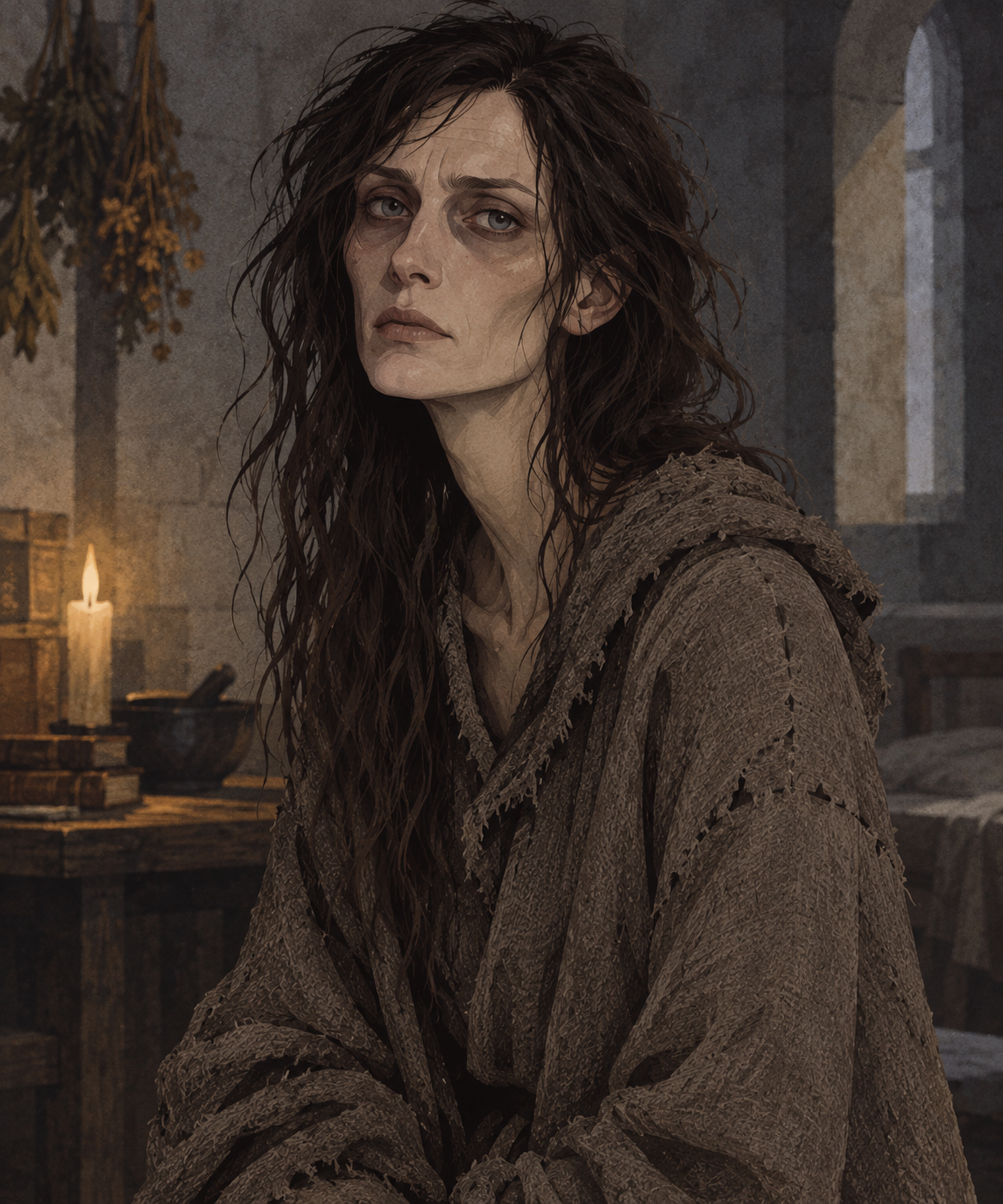
Enters the True Lady’s mind-state, traps and destroys the False Lady in the boiling cistern, and chains herself to the stone to stabilize reality. She relinquishes her dominion to Voyne, restores Aymar to autumn, and leaves the castle with Voyne and Treila.
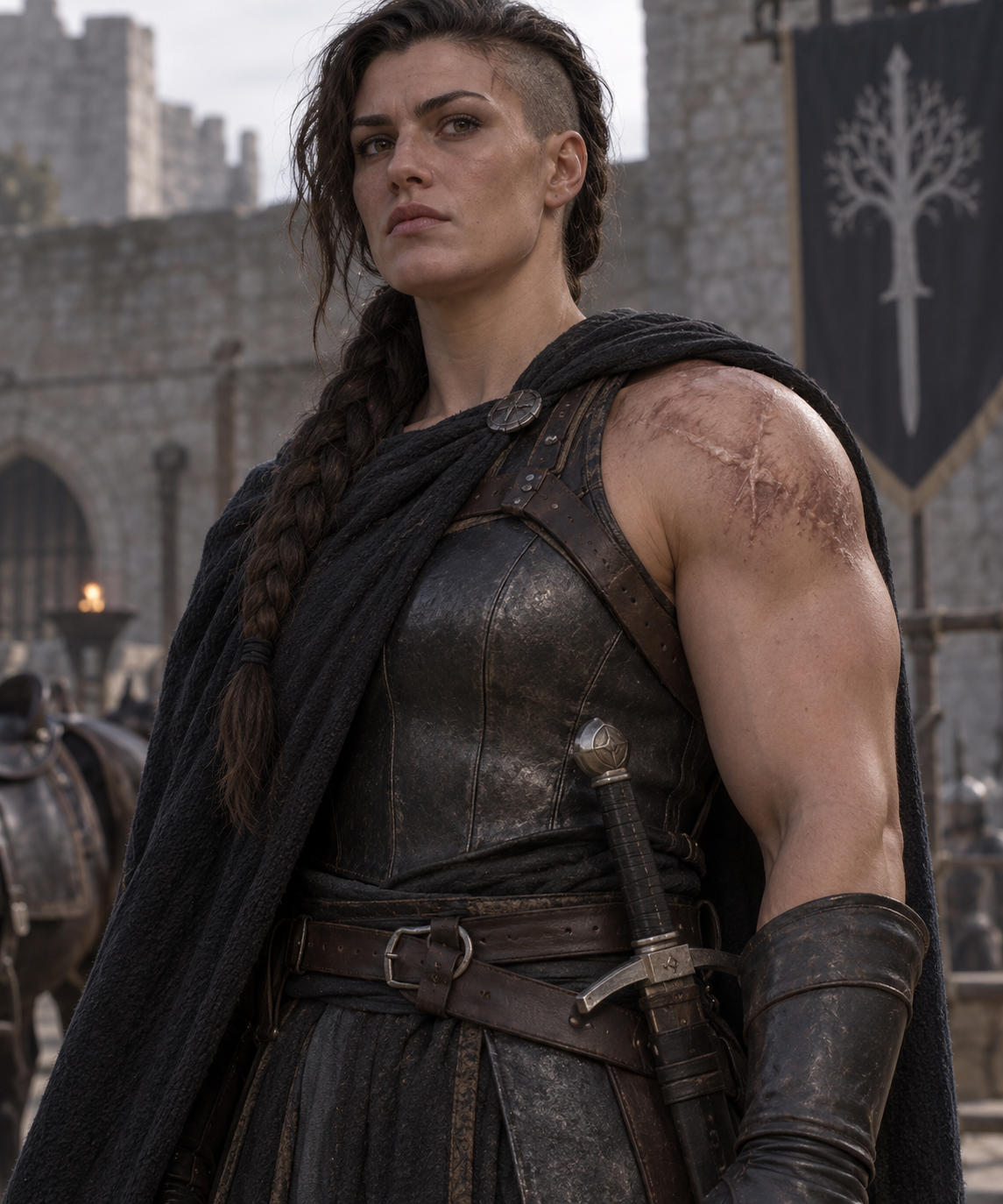
Treila accidentally kills her after mistaking her for the shape-shifting Loving Saint, but Voyne resurrects after the knife is removed from her neck. She bargains with the Grotto Creature for iron armor, accepts Phosyne’s surrendered dominion, and leads Phosyne and Treila out of Aymar.
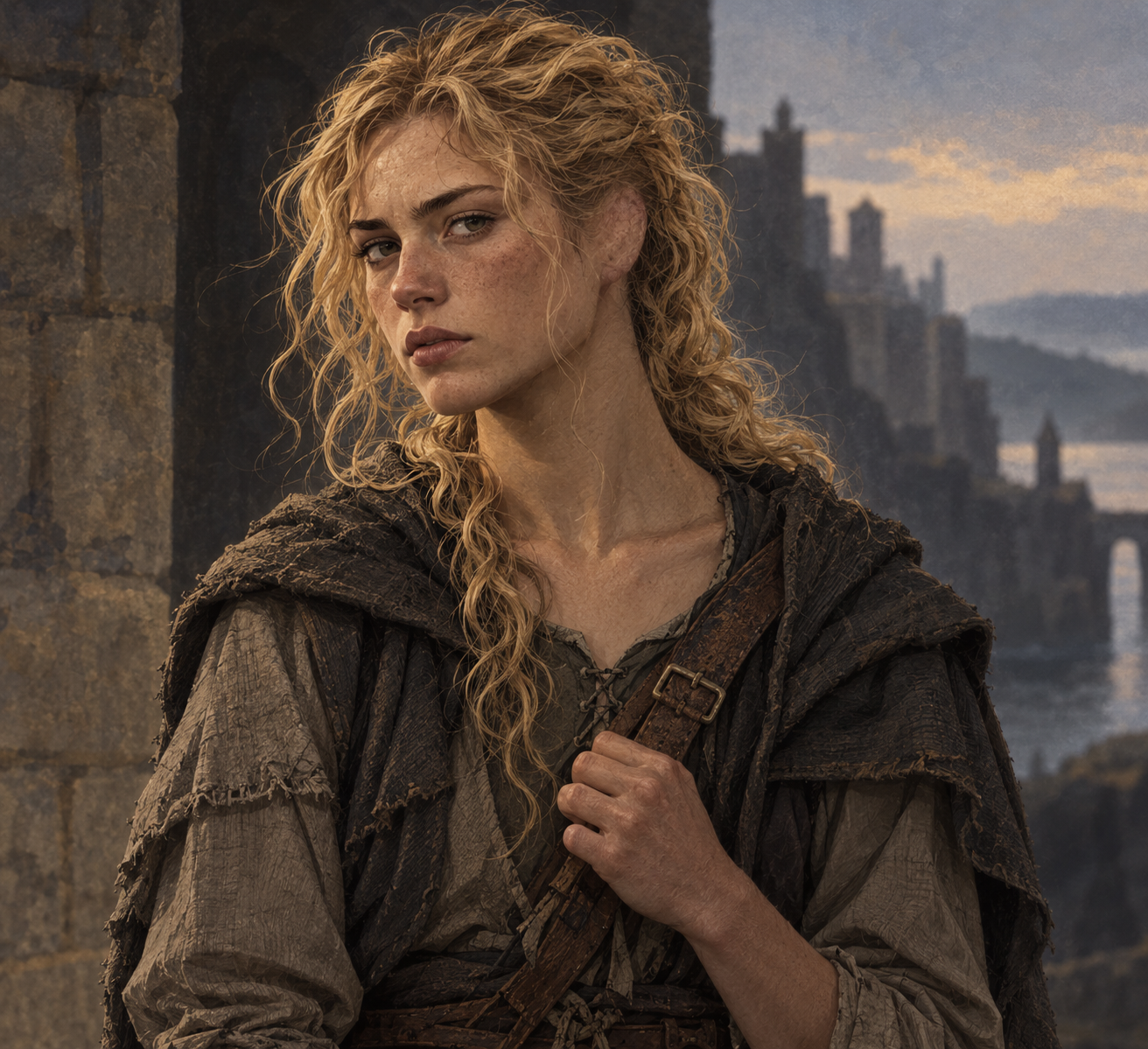
Accidentally kills Voyne, later savagely kills the Loving Saint by biting and tearing him apart, and survives Aymar’s restoration. She retrieves her knife and walks out of the castle with the resurrected Voyne and Phosyne.
🔷 Supporting Characters
He is killed, hung upside down, flayed, and butchered with a bone knife by Phosyne under the entities’ influence, his flesh becoming food for Aymar’s starving inhabitants.
He survives after consuming King Cardimir’s heart during the supernatural feast. Phosyne’s reset puts him to sleep so that he will awaken fed and unaware of the horrors he endured.
Voyne cuts out her tongue for questioning the False Lady and later runs her through with a sword. Jacynde dies behind the throne, where her corpse becomes engulfed in living honeycomb and wax.
Phosyne traps her within the stone through an iron bargain and drags her into the subterranean cistern, where Phosyne and the serpents Pneio and Ornuo boil her to death.
He confronts Treila while wearing Voyne’s face, provoking her into attacking him. Treila bites through his throat and tears him apart, after which other shadow-creatures devour his remains.
Survives the False Lady’s destruction and reverts into a gold-shelled insectoid form. He returns Treila’s iron knife in exchange for freedom for himself and the surviving lesser entities.
Voyne rejects his enchanted fruit and uses Theophrane’s iron hammer to smash his skull and pulp his body.
Phosyne ignites them inside the cistern, using their tremendous heat to boil the False Lady to death. They survive and remain beside Phosyne afterward.
It later encases Voyne’s spine and body in powerful iron armor in exchange for her promise to slaughter the remaining invaders and feed their blood into the stone. It remains beneath Aymar.
The entities reduce him to crawling naked like a wounded animal along the walls. He apparently survives and is restored with the others by Phosyne’s reset.
He is killed and decapitated under the False Lady’s influence, with the skin of his face grotesquely displayed over an upturned bowl.
He becomes a sleepwalking pallbearer carrying Voyne’s corpse but survives. Phosyne’s reset leaves him fed, healthy, and unaware of the cannibalism and supernatural horrors.
He is eventually bewitched and joins the cannibalistic feast, then helps carry Voyne’s corpse while entranced. Phosyne restores him to health and erases his awareness of what occurred.
A mob of starving, enchanted castle inhabitants overruns his workshop and violently tears him to pieces.
He dies of starvation, after which Leodegardis cuts off his hands and feet and sends the rest of his body to the kitchens to stretch the castle’s rations.
King Cardimir orders his execution five years before the siege, and he is publicly beheaded with Voyne’s sword.
🕳️ Potential Plot Holes
Phosyne acts shocked when she realizes that Ser Voyne has been magically prevented from seeing or noticing Treila, even though she already witnessed the effect firsthand several chapters earlier. In Chapter 20, Phosyne is present when Voyne enters the lower workspace and her gaze repeatedly slides past Treila, allowing Treila to speak and escape while Voyne focuses entirely on Phosyne. Yet in Chapter 24, when Voyne once again fails to notice Treila standing in the room, Phosyne reacts as though she is witnessing the phenomenon for the first time and only then realizes that Voyne has been enchanted to ignore her. Unless Phosyne somehow forgot the earlier encounter—which the book does not suggest—her later realization contradicts what she already knows.
📚 Book Club Q&A's
⭐ Final Rating & Thoughts
There’s a lot about The Starving Saints that I should have loved. I’m always up for a weird book, and the cannibalism, gruesome body horror, and sheer WTF-ness were easily my favorite parts. Caitlin Starling absolutely nails the oppressive atmosphere—you can practically feel the hunger and desperation closing in as everything inside Aymar Castle gets progressively more horrifying.
Unfortunately, I spent way too much of the book confused about what was actually happening. The unusual character names didn’t help, and the deliberately dreamlike storytelling often made me feel as disoriented as the characters. I can appreciate that this was probably intentional, but there’s a difference between intriguingly bizarre and constantly trying to figure out what I just read. The story also started to feel repetitive as characters fell under the same influences again and again, and I wanted more explanation of the magic and the creatures behind it all.
I definitely didn’t hate this—I actually loved some of its strangest moments. But ultimately, the confusion outweighed the fascination. It was creative, disturbing, atmospheric, and completely unhinged... just not quite satisfying enough for me.
✨ Adaptation description
As of September 2026, there is no official announcement of any screen adaptation of The Starving Saints.
✨ Books Like The Starving Saints (2025)
See an error on this page?