
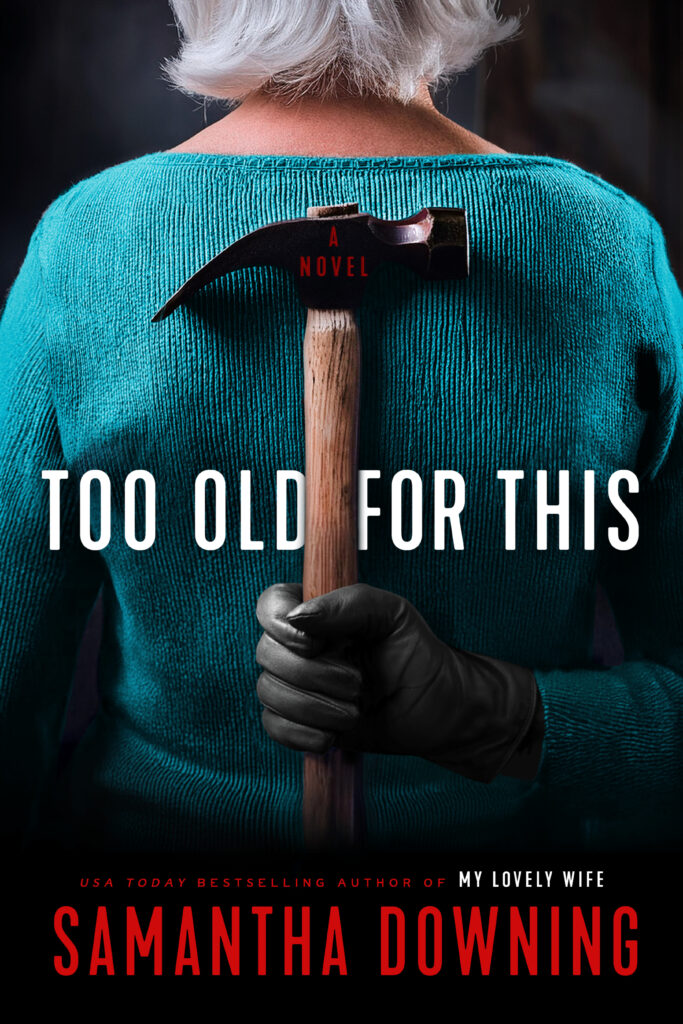
Too Old For This (2025)
Select Sections to Print
×Book Details
Too Old For This (2025)
Jump to Section
⚠️ Trigger Warnings
- Graphic violence and murder
- Body disposal and dismemberment
- Torture
- Kidnapping and physical restraint
- Fire and explosions
- Severed body parts
- Forcible drugging
- Child abandonment and neglect
- Bullying
- Pregnancy
- Medical issues (including morning sickness and preeclampsia)
- Death of parents
- Profanity
- Misogynistic slurs
⏱️ 2-Minute Spoiler Summary
Retired serial killer Lottie Jones is forced back into action when a true-crime producer threatens to expose her real identity as Lorena Mae Lansdale, the prime suspect in a 1985 murder spree. To protect her secret, Lottie kills the producer, then murders a blackmailing detective, Plum’s mother, Burke’s son, and finally retired detective Kenneth Burke, who orchestrated the entire investigation in hopes of finally catching her. She expertly stages each crime, framing Norma Dixon for the murders before burning Burke’s house to destroy the evidence. With the police satisfied, Lottie sells her home, moves into a luxury retirement community, attends her son’s wedding, and ironically begins producing documentaries about elderly people who were actually wrongfully accused—ending the novel as a free woman whose true crimes remain undiscovered.
📖 Full Spoiler Summary
Plum Comes Knocking
Seventy-five-year-old Lottie Jones enjoys a quiet, anonymous life in Baycliff, Oregon, but her peaceful retirement is built on a deadly secret. Decades earlier, she was Lorena Mae Lansdale, the prime suspect in a string of serial murders that terrorized Spokane in 1985. After disappearing and creating a new identity, she has spent forty years carefully hiding from anyone who might connect her to those crimes.
Her carefully constructed life begins to unravel when Plum Dixon, an ambitious young documentary producer, arrives at her doorstep. Plum believes Lottie was wrongly accused all those years ago and wants to create a true-crime docuseries that will clear her name. While Plum sees the project as an opportunity to uncover the truth, Lottie immediately realizes the publicity would expose her real identity and destroy the life she has spent decades protecting.
Rather than risk being discovered, Lottie kills Plum with an umbrella. She calmly dismembers the body using a rechargeable chainsaw and burns the remains in her home’s fireplace, believing she has once again eliminated a threat before anyone realizes what happened.
A Detective Gets Too Close
Plum’s disappearance draws the attention of Detective Rey Tula and Detective Kelsie Harlow, who begin investigating her last known movements. Tula sees Lottie as an elderly widow with nothing to hide, but Kelsie quickly notices inconsistencies that point toward a much darker past.
As Kelsie digs deeper, she uncovers evidence that Lottie is actually Lorena Mae Lansdale. Instead of immediately arresting her, Kelsie decides to exploit the discovery for personal gain. She demands $50,000 in exchange for keeping Lottie’s identity secret, believing she has found the perfect victim for blackmail.
At the same time, Lottie faces complications within her own family. Her son, Archie Jones, announces his engagement to his much younger pregnant fiancée, Morgan. During the preparations for the wedding, Lottie discovers something even more alarming than the marriage itself. Archie has secretly installed a phone-tracking app on her cellphone months earlier as a way to make sure she was safe. Instead, the app has created a digital record that could place her near the scene of Kelsie’s eventual death.
Knowing Kelsie will never stop extorting her, Lottie murders the detective with a claw hammer. She carefully stages the bathroom to resemble a bizarre accidental fall in the bathtub, hoping investigators will never suspect foul play.
Norma and Burke Close In
Plum’s mother, Norma Dixon, refuses to believe her daughter simply vanished. She travels to Baycliff determined to find answers, unaware that someone else has been quietly steering her investigation.
That someone is Retired Detective Kenneth Burke, the man who spent forty years obsessed with proving that Lorena Lansdale was the Spokane serial killer. Burke never accepted that she disappeared without justice, and after finally locating her through modern technology, he uses Norma as an unwitting pawn to pressure Lottie into revealing herself.
Norma eventually drugs Lottie in hopes of uncovering evidence about Plum’s disappearance, but the plan backfires. Lottie recovers, escapes, and kills Norma using the brass handle of her cane. Once again, she destroys most of the body in her fireplace.
Instead of disposing of everything, however, Lottie keeps one severed finger. Using the preserved finger to unlock Norma’s phone, she begins impersonating the missing woman through text messages, allowing her to manipulate Kenneth Burke while convincing everyone else that Norma is still alive.
The Frozen Finger
Lottie’s elaborate deception nearly collapses when Morgan visits the house before the wedding. While searching through the freezer, she discovers the severed finger hidden among the frozen food.
Thinking quickly, Lottie invents an absurd explanation. She claims the finger is simply a prop for a church play based on the biblical story of Adoni Bezek, whose thumbs and big toes were cut off. Although the story sounds ridiculous, Morgan reluctantly accepts it.
The lie becomes even more complicated when Lottie’s church friends, Bonnie and Sheila, learn about the strange discovery. Rather than admit the truth, Lottie doubles down on the deception, insisting her granddaughter is involved in theatrical productions and that everyone has misunderstood the situation. Through a combination of confidence and manipulation, she convinces them to accept the increasingly unbelievable explanation.
Meanwhile, Morgan unknowingly creates another problem by posting an old photograph of Lottie on social media. The image proves invaluable to Kenneth Burke, who had originally located Lottie by running old photographs through facial recognition software. Morgan’s innocent post reinforces that he has found the right woman.
Hunting the Hunter
As Burke continues closing in, Lottie decides to eliminate everyone helping him.
She tracks down Burke’s son, Junior Burke, who has been acting as his father’s fixer and investigator. After luring him to the Dew Drop Inn, Lottie captures him and demands to know exactly how Kenneth finally discovered her after so many years in hiding.
To force answers, she brutally slices Junior’s Achilles tendon, preventing him from escaping. Once he reveals that facial recognition technology and Morgan’s online photograph led Burke to her, Lottie kills him with a hammer.
Armed with this information, Lottie drives to Spokane to confront the man who has haunted her life for four decades.
Kenneth Burke is now elderly, frail, and confined to a wheelchair. During their final confrontation, he admits that everything—including sending Plum to Lottie’s house—was part of an elaborate plan to force her into exposing herself. More than justice, Burke desperately wants to be remembered as the detective who finally solved Spokane’s most infamous serial murder case before he dies.
Lottie refuses to give him that satisfaction.
She kills Burke, then stages the scene by setting his home on fire. The blaze reaches his oxygen equipment, causing a violent explosion that destroys much of the evidence.
Before leaving, Lottie scatters Norma Dixon’s teeth throughout the wreckage. The planted remains convince investigators that Norma murdered Burke before killing herself in the explosion, neatly tying together the disappearances of both Norma and Plum. Detective Tula and the rest of the police accept the story, allowing the case to close without ever connecting the crimes back to Lottie.
A New Retirement
With every loose end eliminated, Lottie quietly moves on with her life.
She sells her Baycliff home to a wealthy tech investor named Kelvin through real estate agent Delia Crane, then arranges to move into the luxurious Oak Manor Senior Living community. Rather than hiding in isolation, she embraces the next stage of her life surrounded by other retirees.
She also attends Archie and Morgan’s wedding, where she unexpectedly develops a friendly relationship with Detective Rey Tula, who remains completely unaware that he is celebrating alongside a prolific serial killer.
Lottie’s future takes another surprising turn when she reconnects with Cole Fletcher, Plum Dixon’s former boyfriend. Together, they decide to produce a documentary series highlighting elderly people who were genuinely wrongfully accused of crimes. The project allows Lottie to stay involved in the world of true crime while presenting herself as someone helping innocent people reclaim their reputations.
As she settles into Oak Manor and begins this new venture, Lottie reflects that it is the perfect kind of retirement. She remains close to the world of murder without becoming its target, convinced she has finally found a “murder-adjacent” life where she can do some genuine good while leaving her own bloody past safely buried.
🔚 Ending Explained
The novel ends with Lottie Jones successfully erasing the final threats to her secret identity, reinventing herself once again, and settling into a new life where she remains both safe and dangerously in control.
How the Book Ends
The climax takes place in Spokane, where Lottie comes face-to-face with her longtime pursuer, retired Detective Kenneth Burke. Burke reveals that he deliberately sent Plum Dixon to Lottie’s house as bait, hoping to provoke the woman he believes is a serial killer into making a mistake. More than justice, however, Burke is motivated by his desperate desire to be remembered as the detective who finally solved the infamous Lansdale murders before he dies.
Holding Lottie at gunpoint, Burke believes he has finally won. Instead, Lottie overpowers him, takes his gun, strikes him with it, and stages his death. She sets his house on fire, allowing his oxygen tank to explode and destroy the evidence. To complete the deception, she scatters Norma Dixon’s teeth at the scene, making it appear that Norma went on a killing spree before dying in the explosion herself. With Burke dead and the false evidence in place, the investigation effectively ends.
Back in Baycliff, Lottie finally reconciles with her son, Archie. Although she had been furious that he secretly tracked her phone, she realizes he acted out of concern rather than betrayal. Their relationship heals as Archie marries Morgan, giving Lottie the family future she never expected to have.
Lottie also sells her longtime home to a wealthy tech investor named Kelvin and purchases a ground-floor apartment at the upscale Oak Manor Senior Living community. Rather than viewing the move as surrendering to old age, she sees it as another carefully calculated disguise—surrounded by elderly residents, she becomes even less noticeable.
At Archie and Morgan’s wedding, Lottie befriends Detective Rey Tula, who remains completely convinced that Norma Dixon was responsible for the recent murders after suffering a psychological breakdown. Lottie leaves the celebration knowing she has escaped suspicion once again.
The novel closes with Cole Fletcher, Plum Dixon’s grieving boyfriend, asking Lottie to participate in the true-crime documentary Plum had hoped to make about her. Lottie refuses the interview but surprises him with a business proposal instead. She suggests they create documentaries about other elderly people who were supposedly wrongfully accused of crimes. She frames the idea as honoring Plum’s memory while allowing herself to stay involved in the world of murder investigations—from a safe distance and entirely on her own terms.
Ending Explained
The ending is less about Lottie escaping justice than about her mastering the power of storytelling. Throughout the novel, she survives by controlling not only evidence but also the narratives people choose to believe. By framing Norma Dixon, manipulating Burke’s death, and eventually helping produce true-crime documentaries, Lottie transforms from someone hunted by stories into the person who creates them. In the end, controlling the narrative becomes even more powerful than committing the crimes themselves.
The contrast between Lottie and Kenneth Burke reinforces one of the novel’s central ideas. Burke fears becoming forgotten, so he sacrifices his ethics in pursuit of one final career-defining victory. Lottie, however, understands that anonymity is her greatest weapon. She has spent decades surviving because society consistently overlooks elderly women, allowing her to hide in plain sight. Burke wants recognition, while Lottie wants invisibility—and invisibility ultimately proves far more powerful.
Several recurring objects gain symbolic meaning in the final chapters. Lottie’s umbrella and brass-handled cane have long represented the harmless image she projects to the world despite their use as deadly weapons. When Cole visits her at the end, Lottie instinctively reaches for the umbrella before choosing not to use it. The moment suggests that she no longer needs physical violence to protect herself. Instead, she has evolved into someone who manipulates people, evidence, and public opinion rather than relying solely on murder.
The novel also explores reinvention as a lifelong survival strategy. Every time Lottie faces exposure, she sheds another identity and creates a new one. Selling her house, moving into Oak Manor, repairing her relationship with Archie, and launching a documentary venture all represent another carefully planned transformation. She never changes morally, but she continually adapts socially, making herself almost impossible to pin down.
The tone is darkly ironic rather than triumphant. Lottie earns a peaceful retirement, family acceptance, financial security, and even a promising business opportunity—not because she redeems herself, but because she remains smarter than everyone trying to expose her. Justice never arrives, leaving readers with the unsettling realization that evil can sometimes survive simply by becoming ordinary.
The final pages also suggest that Lottie’s story is far from over. Her partnership with Cole places her inside the booming true-crime industry, where she can influence how suspects, victims, and investigations are portrayed. Rather than hiding from the stories told about her, she now helps shape the stories told about others. It is a fitting conclusion for a character whose greatest talent has always been convincing the world to believe exactly what she wants them to believe.
👤 Characters & Fates
🔶 Main Characters

Murders Plum, Kelsie, Norma, Kenneth, and Junior, then successfully frames Norma for the killings. She gets away with everything, moves into Oak Manor, and starts producing true-crime shows with Cole.

Lottie murders him in Spokane, burns his house, and uses his exploding oxygen tank as part of an elaborate scene framing Norma for his death.

After Norma drugs and kidnaps her, Lottie kills her with a brass cane handle, removes her teeth, and later plants them in Spokane to frame Norma for multiple murders and suicide.

Lottie murders her with an umbrella almost immediately, dismembers her with a chainsaw, and burns her remains in her fireplace.

Lottie kills her with a claw hammer and stages her death as an accidental bathtub fall, which authorities accept.

Marries Morgan and remains oblivious to his mother’s crimes. Lottie forgives his surveillance but plans to replace her phone so he can never track her again.

Marries Archie while pregnant with his child and accepts Lottie’s ridiculous explanation that the severed finger was a church-play prop.

Survives and ironically becomes Lottie’s business partner, developing a true-crime series about elderly people who were supposedly wrongfully accused.
🔷 Supporting Characters

Survives and befriends Lottie, completely believing her fabricated story that Norma Dixon was responsible for the murders.
Lottie captures and tortures him, slicing his Achilles tendon before killing him with a hammer, then adds his murder to the crimes she pins on Norma.
Survives completely unaware of Lottie’s crimes and continues judging her fashion choices.
Remains her loyal friend and believes Lottie’s claim that the severed finger discovered in her freezer was merely a prop.
Survives, but becomes the prime suspect when church raffle money disappears, a situation Lottie intends to enjoy exploiting.
After Gary insults her during a shower, Lottie pushes him; he strikes his head on the faucet and dies. She stages it as an accident, and later tells Archie his father was a kind, loving man who died accidentally before he was born.
Lottie strangles him. Burke later claims a hair belonging to her was found on his body, but Lottie knows he is bluffing because her hair was a different color when she killed Paul.
Lottie murders her; decades later, Burke incorrectly claims Marilyn was burned to death, revealing that he has confused details of her murder with Walter’s.
Lottie follows Walter to a theater showing St. Elmo’s Fire and later burns him to death.
Remains in California co-parenting her children while maintaining a strained relationship with Archie’s new family.
Still alive at the end, but after calling Lottie a “hag” and saying he wishes she were dead, she decides to make him a retirement “project,” strongly implying Jax will become one of her next victims.
Remains pastor, officiates Archie and Morgan’s wedding, and inadvertently makes Glenda the prime suspect when church raffle money goes missing—something Lottie plans to exploit for her own amusement.
Successfully sells Lottie’s house to a cash buyer for enough to fund her move to Oak Manor, unknowingly helping her permanently leave behind the house where she murdered and cremated Plum and Norma.
Successfully purchases Lottie’s house with the highest cash offer and a quick closing, unknowingly buying the former home—and crime scene—of a serial killer.
Survives and apparently never recognizes Lottie beneath the disguise, allowing Lottie’s plan to frame Norma to proceed without another loose end.
Agrees to Lottie’s terms and secures her as a resident, allowing her to move into her preferred ground-floor unit with a private garden.
Both remain safely unaware of their grandmother’s crimes and attend Archie’s wedding before Lottie moves to Oak Manor.
🕳️ Potential Plot Holes
Lottie disposes of two bodies—Plum Dixon and Norma Dixon—by dismembering them and burning the remains in her home fireplace.
●The Problem: Standard residential fireplaces typically reach 600–1000°F, while professional cremation requires sustained temperatures of 1400–1800°F to fully reduce a body to ash and bone fragments.
●Lottie’s Defense: She acknowledges the limitation, burns the remains slowly in small portions, and uses bellows to increase airflow. She also burns rosemary to mask the smell.
●The Gap: Even with these adjustments, the sheer amount of fuel required—and the unmistakable odor of burning flesh—would likely draw attention in a residential neighborhood. The lack of neighbor suspicion feels a bit too convenient.
Lottie stages a false trail by driving Plum’s car to the Salem airport, destroying her electronics, and leaving via taxi.
●The Problem: The airport is described as small, and Detective Kelsie Harlow is thorough enough to canvass employees and track Lottie elsewhere.
●The Gap: It’s highly unlikely that parking lots and drop-off zones wouldn’t have surveillance cameras capturing Lottie arriving in Plum’s car and leaving in a registered taxi. This feels like a major investigative oversight.
After killing Junior Burke, Lottie takes his phone and vehicle on a multi-stop trip before heading to Spokane.
●The Problem: Junior had a location-sharing app with his father, Kenneth Burke.
●The Gap: Given Burke’s obsession, it’s hard to believe he wouldn’t actively monitor his son’s movements—especially when they suddenly became erratic (motel → medical stop → long-distance travel). His delayed realization relies heavily on plot convenience.
Archie admits he has been tracking Lottie’s phone and is attentive enough to question her movements.
●The Problem: Lottie brings her phone to the home of Detective Kelsie Harlow the night of her death.
●The Gap: When news breaks that a detective died at that exact location, it’s surprising Archie doesn’t connect the dots. He questions other locations (like the Harmony Hotel), but not this one—despite it being far more suspicious.
Lottie uses hydrogen peroxide to clean blood from her home.
●The Problem: While peroxide breaks down visible blood, modern forensic tools like Luminol and BlueStar can detect trace evidence even after cleaning.
●Context (Not Quite a Plot Hole): This works only because police never obtain a search warrant. If they had, her cleanup likely wouldn’t hold up—making this more of a “lucky escape” than a true inconsistency.
Morgan discovers a frozen severed finger in Lottie’s kitchen.
●The Problem: Lottie claims it’s a prop for a church play, then backtracks when that lie falls apart.
●The Gap: Morgan is established as observant and intelligent, yet she ultimately accepts a weak explanation involving church-hopping. It requires a fair amount of suspension of disbelief that she wouldn’t escalate something so obviously disturbing.
📚 Book Club Q&A's
⭐ Final Rating & Thoughts
Too Old for This was an absolute blast. Samantha Downing somehow made me root for a 75-year-old serial killer, and I’m not even going to question what that says about me. 😂
Lottie is easily the best part of this book. She’s clever, practical, completely ruthless, and genuinely funny without ever feeling like a caricature. I loved the contrast between her ordinary grandmotherly life and the increasingly ridiculous lengths she’ll go to protect the quiet retirement she’s worked so hard for.
The pacing was another huge win. There’s always a new problem barreling toward Lottie, and watching her figure out how to handle each one kept me completely entertained. The dark humor worked perfectly for me too—it’s outrageous without becoming so over-the-top that the thriller itself stops working.
Most importantly, this book was just FUN. Twisty, fast, dark, clever, and wonderfully unhinged, it gave me exactly what I wanted. And if Lottie ever decides retirement is overrated and comes back for another adventure? I’m there on release day. 🔪👵
✨ Adaptation description
As of August 2026, there is no official screen adaptation of Too Old For This.
✨ Books Like Too Old For This (2025)
See an error on this page?